
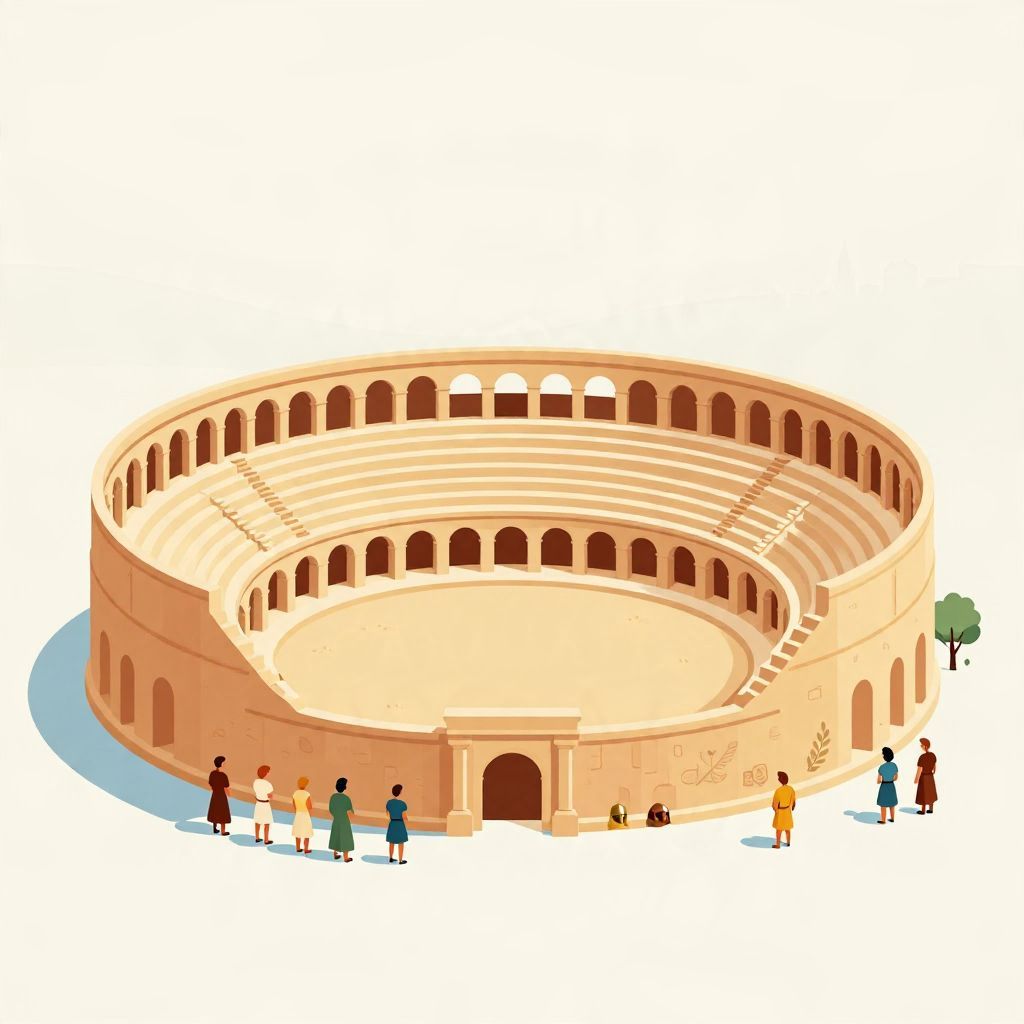
What is an amphitheater? In history, it is a large open-air venue designed for public spectacles, with seating arranged so audiences could watch events from many angles. The word is most closely associated with the Roman world, especially gladiatorial contests, animal hunts, and public executions.
Yet amphitheaters were more than entertainment spaces. They reflected Roman engineering, social hierarchy, and imperial power, and their influence can still be seen in stadiums and performance venues today.
What Is an Amphitheater?
An amphitheater is a freestanding, usually oval or circular building with tiered seating surrounding a central performance area. The best-known examples come from ancient Rome, where amphitheaters hosted gladiator fights, animal hunts, and other public spectacles. The term comes from Greek roots meaning “on both sides,” referring to seating all around the arena.
Where Did Amphitheaters Come From?
Amphitheaters developed in the ancient Mediterranean, but they were especially shaped by Roman culture. Before the Roman amphitheater became standard, public performances often took place in Greek theaters, which were typically semicircular and used mainly for drama, music, and civic gatherings. Roman builders adapted earlier forms to create a venue for mass spectacle.
From Greek Theater to Roman Arena
The Greek theater was usually built into a hillside and faced one direction. Roman amphitheaters, by contrast, were designed as enclosed structures with seating all around the central space. This allowed a larger audience to see the action from every side and made the building itself part of the spectacle.
Scholars generally trace the rise of amphitheaters in Italy to the late Republic, around the 1st century BCE. Early examples were often temporary wooden structures used for games and festivals. Over time, stone amphitheaters replaced them, especially as Roman cities expanded and elites competed to impress the public.
Why Were Amphitheaters Built?
Amphitheaters were built to stage public entertainment, but they also served political and social purposes. Roman leaders used games to gain popularity, display generosity, and reinforce their authority. These buildings helped turn public spectacle into a tool of government and urban identity.
Entertainment, Politics, and Status
- Entertainment: Gladiator contests, beast hunts, and staged performances drew huge crowds.
- Political messaging: Rulers and magistrates used games to win favor with the public.
- Social order: Seating often reflected rank, with elites placed closest to the arena.
- Imperial power: Monumental amphitheaters demonstrated Rome’s wealth, engineering skill, and control.
In this way, amphitheaters were not neutral buildings. They organized people physically and symbolically, showing who belonged where in Roman society.
What Happened Inside an Ancient Amphitheater?
The central arena was the stage for highly varied events. The most famous were gladiatorial combats, in which trained fighters battled one another or sometimes faced animals. Other spectacles included animal hunts, executions, mock battles, and ceremonial displays. Not every amphitheater hosted every type of event, and local customs varied across the empire.
Gladiators and Public Spectacle
Gladiators were often slaves, prisoners of war, or condemned men, though some fought voluntarily. Their contests were not simply random violence; they followed rules, training traditions, and public expectations. Victories could bring fame, while defeats could be fatal. The crowd’s reaction mattered, but the exact power of audience “thumbs up” or “thumbs down” gestures is often oversimplified in popular culture.
Animal spectacles were also common. Exotic creatures from across the empire—lions, bears, leopards, and other animals—were brought to Roman arenas as signs of imperial reach. These displays dramatized Roman domination over nature and conquered lands.
How Were Amphitheaters Built?
Roman amphitheaters were feats of engineering. Builders used stone, concrete, arches, vaults, and complex support systems to create large seating bowls that could hold thousands of people. The design allowed crowds to enter and exit efficiently through multiple passageways, which was essential for managing large public gatherings.
Engineering Features
- Oval plan: Helped spectators see the arena from many angles.
- Tiered seating: Maximized capacity and reflected social rank.
- Arches and vaults: Supported heavy structures and long corridors.
- Vomitoria: Passageways that let crowds move in and out quickly.
- Underground spaces: Some amphitheaters had chambers for animals, equipment, and performers.
The most famous amphitheater, the Colosseum in Rome, shows how advanced this architecture became. Built under the Flavian emperors beginning in the late 1st century CE, it could accommodate vast crowds and included sophisticated systems for staging spectacles.
What Is the Difference Between an Amphitheater and a Theater?
A theater is usually semicircular and designed for drama, music, or speeches facing a stage. An amphitheater is typically fully or nearly fully enclosed around a central arena. In ancient Rome, the difference mattered: theaters were for performance in one direction, while amphitheaters were for action visible from all sides.
Common Confusion in Modern Usage
Today, the word “amphitheater” is sometimes used loosely for any open-air performance space, including modern concert venues. Historically, however, the term refers more specifically to the Roman-style arena building. This distinction helps explain why the word appears in both ancient history and modern architecture.
Famous Amphitheaters in History
Several ancient amphitheaters survive, either in full or as ruins. They reveal how widespread the form became across the Roman Empire, from Italy to North Africa, France, and beyond. Some were built for major urban centers, while others served provincial cities and military colonies.
Notable Examples
- The Colosseum in Rome, the most famous Roman amphitheater.
- Amphitheater of Verona, one of the best-preserved and still used for performances.
- Amphitheater of Nîmes in southern France, a major surviving Roman arena.
- Amphitheater of El Jem in Tunisia, an impressive North African example.
These structures show that amphitheaters were not limited to Rome itself. They spread with Roman urban life and became part of local civic identity throughout the empire.
Did Other Ancient Cultures Have Amphitheaters?
The Roman amphitheater is the classic model, but other cultures had large public performance spaces of their own. Greek theaters, Hellenistic stadiums, and later Byzantine or medieval arenas served different functions, even if they sometimes resembled amphitheaters in appearance. The Roman amphitheater remains distinct because of its enclosed arena and association with spectacle.
It is important not to assume that every ancient circular or oval building was an amphitheater. Some were theaters, stadiums, odeons, or ceremonial spaces. Archaeologists identify amphitheaters by their shape, seating arrangement, and evidence of arena use.
What Is the Historical Significance of Amphitheaters?
Amphitheaters matter because they reveal how Roman society worked. They show the importance of public entertainment, the role of elite patronage, and the use of architecture to project power. They also help historians understand how urban populations gathered, watched, and participated in civic life.
Legacy in Later History
After the decline of the Western Roman Empire, many amphitheaters fell into disuse, were quarried for stone, or were transformed for new purposes. Some became fortifications, housing, or religious sites. Others survived as ruins that inspired later architecture and modern ideas of stadium design.
Modern arenas and sports stadiums do not copy Roman amphitheaters exactly, but they share a basic principle: large crowds arranged around a central event space. That enduring design shows how powerful the Roman model was.
So, What Is an Amphitheater in One Sentence?
An amphitheater is a large ancient or Roman-style arena building with seating all around a central space, built for public spectacles and designed to display both entertainment and power.
Understanding amphitheaters helps explain Roman culture, from engineering and urban planning to politics and public life. If you want to explore related ancient structures, you may also be interested in what the Acropolis was and when the Colosseum in Rome was built.