
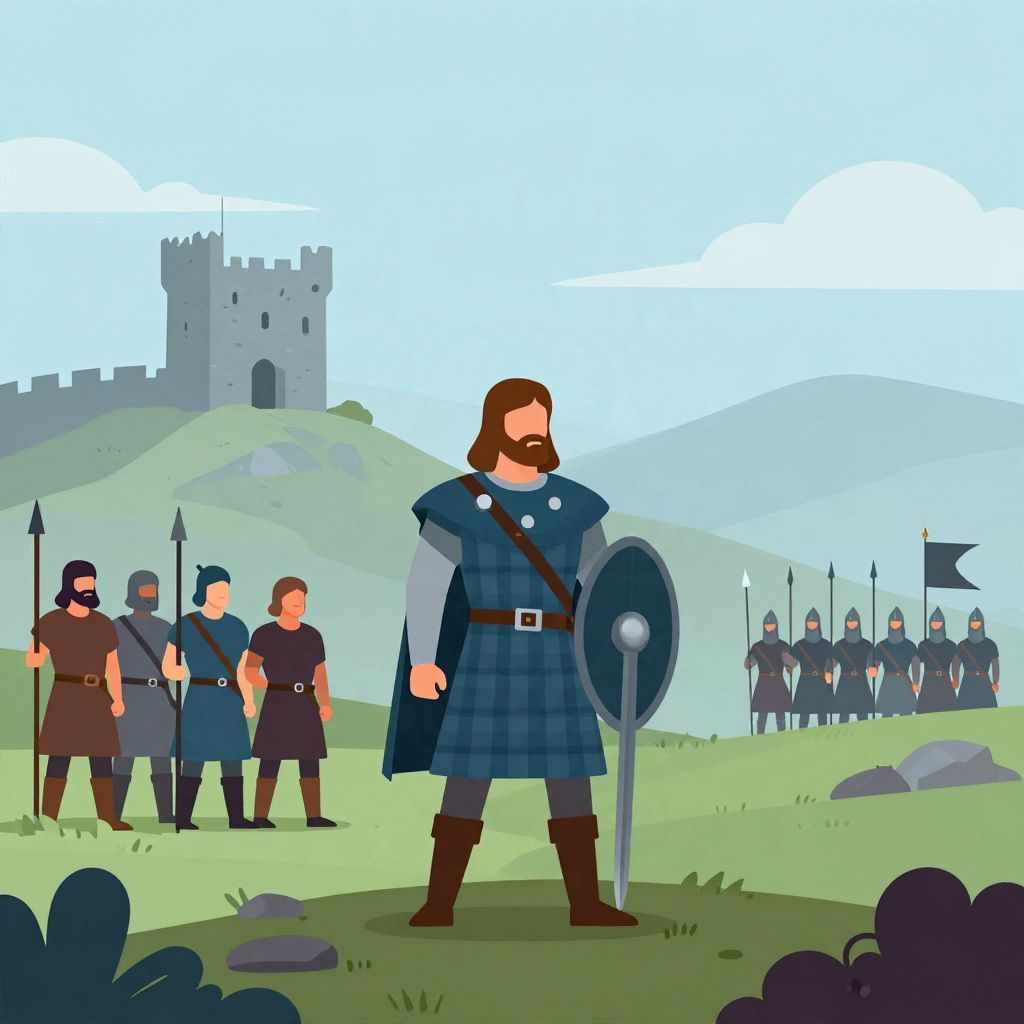
Is Braveheart a true story? The short answer is: partly. Braveheart (1995) is inspired by the life of William Wallace and the Scottish Wars of Independence, but it takes major liberties with chronology, politics, costumes, relationships, and even some of the central events. It is best understood as a dramatic retelling of real history, not a reliable account of what actually happened.
The film captures a real struggle between Scotland and England in the late 13th and early 14th centuries, but it reshapes that history to create a more emotional and heroic story. If you want the historical truth behind Braveheart, the answer lies in separating Wallace’s real life from the movie’s inventions.
Is Braveheart a true story?
Yes, in broad outline, but not in detail. Braveheart is based on real people and real conflicts, especially William Wallace’s role in the Scottish resistance to English rule. However, many of the film’s most memorable scenes are inaccurate or invented, and the movie compresses events that happened years apart into a simplified heroic narrative.
What Braveheart gets right about William Wallace
William Wallace was a real Scottish leader who became a symbol of resistance during the Wars of Scottish Independence. He emerged in the 1290s, when Scotland was under pressure after the death of King Alexander III and the succession crisis that followed. England’s King Edward I took advantage of the instability, and Scottish nobles eventually rebelled.
The historical Wallace
Wallace is believed to have been active in armed resistance by 1297. He and Andrew Moray led a major Scottish victory at the Battle of Stirling Bridge in September 1297, one of the most important early successes against English forces. Wallace later served as Guardian of Scotland, a political and military role that reflected his importance in the resistance movement.
The real conflict
The film is right that Scotland was fighting for political independence and that Edward I played a central role in the conflict. It also correctly presents Wallace as a figure who inspired loyalty among many Scots and became a lasting national hero. His eventual capture and execution in 1305 are also historical facts.
What Braveheart gets wrong
The movie’s emotional power depends on dramatic simplification, but many of its best-known elements are historically false. Some changes are minor, while others completely alter the timeline or the people involved. In several cases, the film borrows events from different decades and attaches them to Wallace’s story.
1. The timeline is heavily compressed
One of the biggest problems is chronology. The film presents Wallace’s rebellion as if it leads directly and quickly to the Battle of Bannockburn and Robert the Bruce’s triumph. In reality, Wallace was executed in 1305, while Bannockburn took place in 1314, nearly a decade later, under very different leadership.
2. Robert the Bruce is misrepresented
The film turns Robert the Bruce into a conflicted but eventually noble ally of Wallace. Historically, Bruce’s position was more complicated. He was a powerful noble with shifting loyalties in a brutal political struggle. He did become the key Scottish king in the later phase of the independence wars, but he was not Wallace’s close companion in the way the film suggests.
3. The romance with Princess Isabella is fictional
Perhaps the most famous invention is the relationship between Wallace and Princess Isabella of France. In the film, she is shown as Wallace’s lover and the mother of his child. This is impossible. Isabella was born around 1295, making her a child during Wallace’s active years in Scotland, and she did not arrive in England until later. The romance is entirely fictional.
4. The “prima nocte” plot is not historical
The movie’s claim that English nobles had the right of prima nocte—the supposed right to sleep with a bride on her wedding night—is not supported by evidence as a real English legal practice in medieval Scotland. Historians generally regard it as a myth or a literary trope, not a documented policy.
5. The costumes and battlefield look are anachronistic
Braveheart is famous for its visual style, but it is not historically precise. The Scottish warriors are often shown wearing tartan kilts, face paint, and loose medieval-fantasy clothing that does not match the 13th-century evidence. Kilts in the form popularized by the film belong to a much later period. The battle scenes also reflect modern cinematic expectations more than medieval warfare.
The real historical William Wallace
Wallace remains a somewhat elusive figure because the surviving evidence is limited and often shaped by later legend. He was not a king, and he did not single-handedly “free Scotland.” He was one important leader in a wider movement involving nobles, clergy, and local fighters.
Origins and rise
Wallace likely came from a minor noble or gentry family, though the details of his early life are uncertain. Later tradition places his origins in Ayrshire or Renfrewshire. Because the sources are sparse, historians must be cautious about claims of his childhood, education, or early motivations.
Military leadership
Wallace’s greatest historical achievement was helping organize resistance at a time when Scotland was politically fragmented. The victory at Stirling Bridge showed that English forces could be defeated. That success made Wallace a major figure, but it did not end the war. English military power remained strong, and Scottish politics stayed divided.
Capture and execution
Wallace was captured in 1305 and taken to London. He was tried for treason and executed in a brutal manner. This was meant to punish him and deter rebellion, but it instead helped turn him into a martyr in later Scottish memory.
How the film reshaped history
Mel Gibson’s Braveheart is not a documentary; it is a historical epic. Like many films of its kind, it uses real history as a framework while changing details for drama, clarity, and emotional impact. The result is a powerful story that has shaped popular understanding of medieval Scotland, even when it departs from the record.
Why filmmakers changed the story
Films often simplify history because real events are messy. Multiple leaders, shifting alliances, and long political processes are harder to dramatize than a single heroic arc. In Braveheart, Wallace becomes the central symbol of freedom, while the broader conflict is streamlined into a personal revenge story.
The effect on public memory
The movie had a huge cultural impact. For many viewers, it became the main introduction to William Wallace and Scottish independence. That popularity matters historically because films can shape memory as much as textbooks do. At the same time, popularity can blur the line between evidence and legend.
What historians say about Braveheart
Most historians would say that Braveheart is historically inspired but unreliable in its specifics. It is useful as a cultural artifact of the 1990s and as a modern myth about freedom, but not as a factual guide to medieval Scotland. The film reflects a romantic view of national struggle more than the complexity of thirteenth-century politics.
Evidence versus legend
There is a difference between what is documented and what is popularly believed. Wallace’s existence, his role in resistance, Stirling Bridge, his capture, and his execution are all historically grounded. By contrast, the romance with Isabella, the kilted battlefield imagery, and several of the political motivations shown in the film are products of later imagination or cinematic invention.
A more accurate way to watch the film
The best way to approach Braveheart is to enjoy it as drama while recognizing that it is not a trustworthy historical account. It can spark interest in medieval Scotland, but it should be followed by real history, not taken as the final word.
The lasting significance of William Wallace
Even though the film is inaccurate, it does point to something real: Wallace became an enduring symbol of Scottish resistance. His story survived because it spoke to larger themes of identity, sovereignty, and opposition to domination. Later generations transformed him into a national hero, and that heroic image has often been more influential than the sparse details of his actual life.
In that sense, Braveheart tells us as much about modern ideas of heroism as it does about medieval Scotland. The film is not a true story in the strict historical sense, but it is built on a real and important chapter of Scottish history. If you want the facts, the movie should be a starting point, not the destination. For more on how films reshape the past, see related articles like Is Fury a True Story? and Is The Help a True Story?