
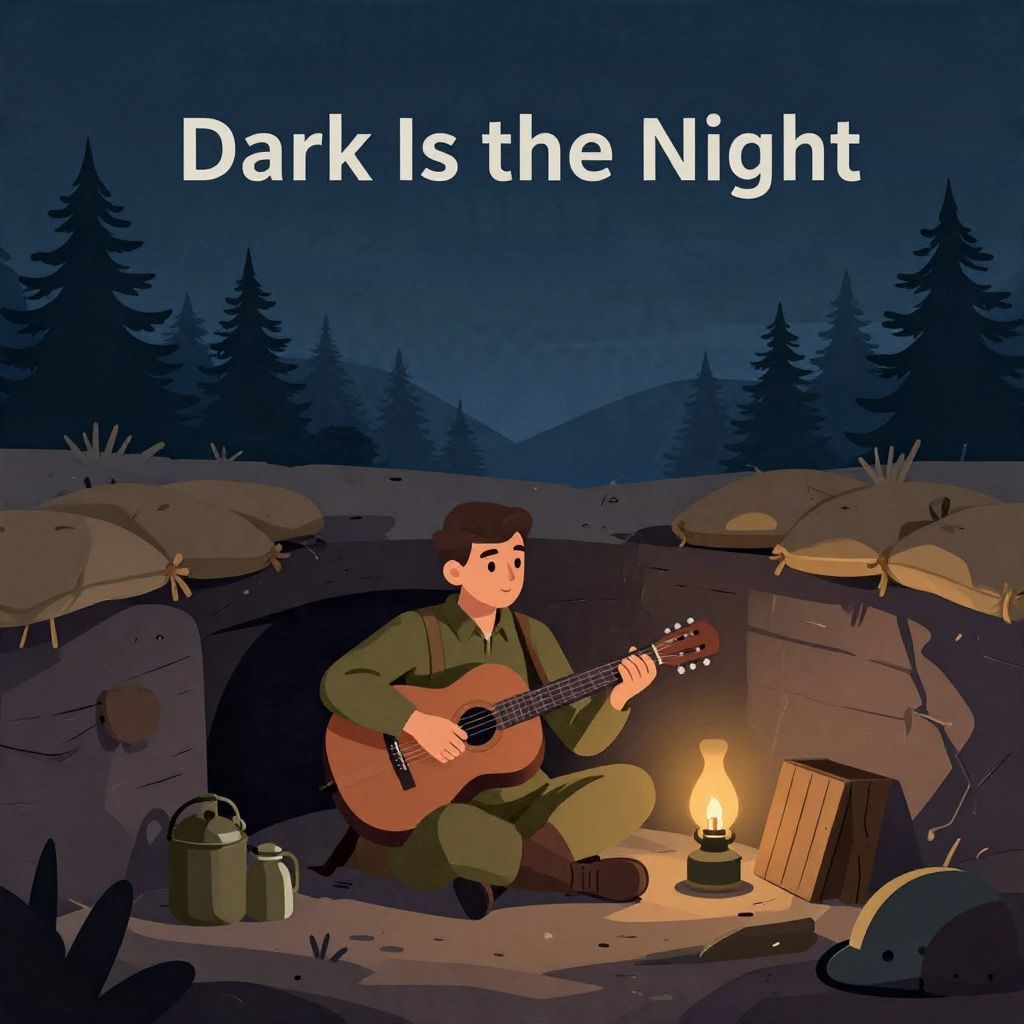
“Dark Is the Night” is best known as a Soviet wartime song, not as a modern pop lyric. When people search for Dark Is The Night Lyrics English, they are usually looking for the English meaning of the song’s words, along with the story behind its creation and why it became so emotionally powerful during World War II.
The song’s history begins in the Soviet Union in the early 1940s, where music was used to sustain morale, express separation, and give ordinary soldiers and families a language for wartime grief and hope.
What are the English lyrics of “Dark Is the Night,” and where did the song come from?
“Dark Is the Night” is the English title commonly used for the Russian wartime song Tyomnaya noch (“Dark Night”), written in 1943 for the film Two Soldiers. The lyricist was Vladimir Agatov, and the music was composed by Nikita Bogoslovsky. It became one of the most beloved Soviet songs of World War II.
The song’s wartime origins
“Dark Is the Night” emerged during the most difficult years of the Eastern Front. By 1943, the Soviet Union had endured enormous losses, mass displacement, and the strain of total war. Songs written for films and radio often carried a dual purpose: they entertained, but they also helped shape emotional resilience. This song’s quiet, intimate tone stood out from more martial patriotic music.
Why it resonated so strongly
Unlike many wartime anthems that emphasize victory or sacrifice in public terms, “Dark Is the Night” focuses on private feeling. Its central image is a soldier lying awake at night, thinking of a loved one far away. That perspective made it especially moving for listeners living through separation, uncertainty, and fear.
The song was associated with the 1943 film Two Soldiers (Dva boytsa), which helped spread it widely. In the Soviet cultural system, film songs could travel quickly through theaters, radio broadcasts, and live performances, becoming part of everyday wartime memory.
Timeline of “Dark Is the Night”
The song’s history is best understood through a short chronology of its creation and spread:
- 1943 — Vladimir Agatov writes the lyrics and Nikita Bogoslovsky composes the music for Two Soldiers.
- 1943–1945 — The song becomes widely known in the Soviet Union during the war.
- Postwar decades — It remains a standard in Soviet and Russian popular memory, performed by many singers and adapted in different styles.
- Late 20th century onward — English translations and recordings help introduce the song to international audiences interested in Soviet wartime culture.
English meaning of the lyrics
Because the song was written in Russian, “Dark Is the Night Lyrics English” usually refers to translation rather than an official English-language original. The lyrics describe a soldier alone at night, thinking of his wife and child, and imagining their connection across distance. The emotional core is not battle itself, but longing, faithfulness, and endurance.
A careful note on translation
Translations of songs are never exact. A line that sounds simple in one language may carry different shades of meaning in another. In the case of “Dark Is the Night,” English versions often preserve the song’s mood more than its literal phrasing. That is typical for translated lyric traditions, where rhythm, rhyme, and singability matter as much as word-for-word accuracy.
For that reason, readers should treat any English rendering as an interpretation. The historical value lies less in a single fixed translation than in how the song communicates the wartime experience of separation and hope.
Why the song mattered in Soviet wartime culture
Soviet wartime music served several overlapping functions. It could encourage enlistment, celebrate resistance, mourn the dead, or affirm domestic loyalty. “Dark Is the Night” belongs to the quieter emotional register: it humanizes the soldier by placing him in a family relationship rather than only a military one.
Domestic feeling as wartime strength
This emphasis was historically significant. In a total war, states often tried to link private emotion to public duty. A song about a father, husband, or son missing home could reinforce the idea that the war was being fought for the survival of ordinary life. In that sense, the song was both personal and political.
Film, radio, and memory
The song’s popularity also shows how Soviet cinema helped create shared cultural memory. Film songs were not merely background music; they often became the most memorable part of a movie. Once repeated on radio and in homes, they could outlive the film itself and enter the broader repertoire of the era.
Historical significance beyond the Soviet Union
“Dark Is the Night” later became known outside Russia because wartime songs often travel well across borders when they express universal emotions. Even listeners unfamiliar with Soviet history can recognize the loneliness, tenderness, and endurance in the lyrics. That universality has helped the song survive long after the specific political moment that produced it.
Part of a larger wartime musical tradition
The song belongs to a wider 20th-century tradition in which war produced not only propaganda and marches, but also intimate ballads. Similar songs appeared in many countries during World War II, reflecting the human cost of conflict. What distinguishes “Dark Is the Night” is its restraint: it does not glorify combat so much as it preserves the emotional life of those left waiting.
How to understand the song today
Modern listeners often encounter “Dark Is the Night” in two ways: as a historical artifact of Soviet wartime culture, and as a moving lyric about love across distance. Both readings are valid. Historically, the song reveals how the Soviet Union used art to sustain morale. Culturally, it shows how a simple melody and a few carefully chosen images can carry deep emotional weight across generations.
What not to assume
It is worth avoiding a few common mistakes. First, the song is not an ancient folk ballad; it has a clear 1943 origin. Second, English versions are translations, not the original text. Third, its fame comes not from a single definitive performance alone, but from decades of repeated use in Soviet and post-Soviet memory.
Why “Dark Is the Night” still matters
The enduring appeal of “Dark Is the Night” lies in its historical honesty. It does not pretend war is easy or glorious. Instead, it captures the emotional geography of wartime life: darkness, distance, memory, and the fragile hope that loved ones remain connected. That is why the song remains important in discussions of Soviet culture, World War II memory, and translated lyrics.
For readers interested in the broader cultural setting of the song, it may also help to explore the history of “Dark Is the Night” and, for a later cultural contrast, what “dark academia” means. In historical terms, the song endures because it turns wartime separation into a lasting human voice.