
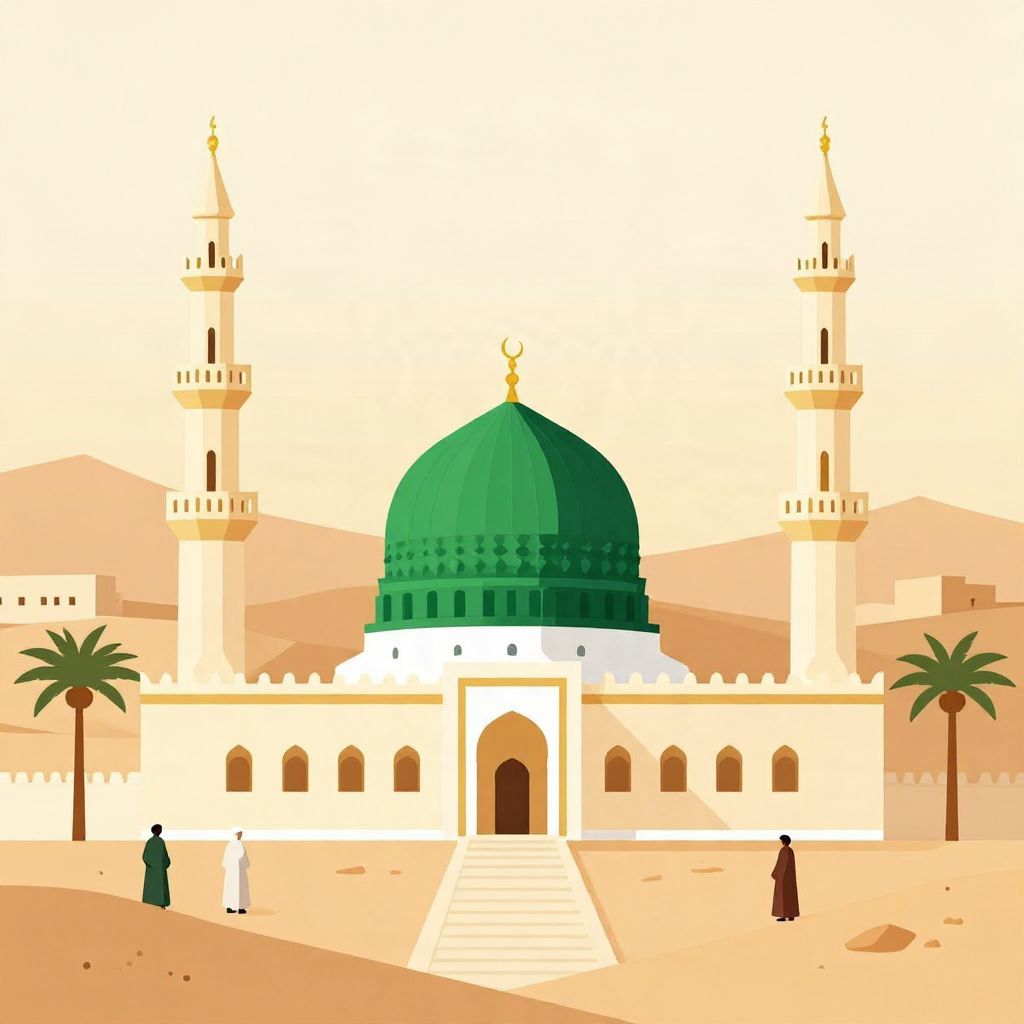
Where is Muhammad buried? The direct answer is that Muhammad is buried in Medina, in present-day Saudi Arabia, inside the chamber that became part of the Prophet’s Mosque. His tomb lies beneath the Green Dome area of the mosque complex, in the room where he died in 632 CE.
The location is historically significant because Muhammad was buried where he passed away, in the house of his wife Aisha. Over time, that private chamber became part of one of Islam’s holiest sites, making the burial place both a religious focal point and a carefully protected historical space.
Where Is Muhammad Buried?
Muhammad is buried in Medina, Saudi Arabia, in the chamber of Aisha, now incorporated into the Prophet’s Mosque. He died in Medina in June 632 CE, and Islamic tradition holds that he was buried there rather than moved elsewhere. The burial site is inside the mosque complex and is not open as a public grave in the ordinary sense.
The exact place within Medina
According to long-established Islamic tradition, Muhammad was buried in the room where he died, the chamber of his wife Aisha. That chamber later became enclosed within the expanded mosque. The burial area is associated with the space beneath the Green Dome, though the grave itself is not directly visible to visitors.
Why Medina matters
Medina was the city to which Muhammad migrated from Mecca in 622 CE, an event known as the Hijra. It became the center of the early Muslim community and the place where he led the emerging Muslim polity for the final decade of his life. Because he died there, Medina became the natural and traditional burial place.
What Is the Historical Background of Muhammad’s Burial?
Muhammad died in Medina after a short illness in 632 CE. Islamic sources describe a period of mourning and discussion among his companions about succession and burial. The decision to bury him in the place where he died reflected both practical custom and a reluctance to move the body from the city that had become the heart of the early Muslim community.
Death and burial in 632 CE
Historical tradition places Muhammad’s death in June 632 CE. After his death, the community faced urgent questions: who would lead after him, and where should he be buried? The burial took place in his wife Aisha’s chamber, and the tradition that he was buried there became firmly established in early Islamic memory.
Why he was not buried in Mecca
Although Mecca was Muhammad’s birthplace and the site of the Kaaba, he was not buried there. By the time of his death, Medina had become the center of his mission and leadership. Burying him in Medina also aligned with the practical reality that he died there, and Islamic tradition generally emphasizes burial near the place of death when possible.
How Did the Burial Site Become Part of the Prophet’s Mosque?
The burial chamber was originally a private room attached to Muhammad’s household. As the Muslim community expanded, the mosque in Medina was enlarged several times. These expansions eventually enclosed the chamber within the mosque complex, turning a domestic space into one of the most revered places in Islam.
Early mosque expansions
The Prophet’s Mosque began as a modest structure during Muhammad’s lifetime. After his death, later rulers expanded it repeatedly. As the mosque grew, the chamber containing the graves of Muhammad and the first caliphs was preserved within the larger sacred enclosure. This helped protect the site while also making it a center of pilgrimage and devotion.
The Green Dome and the protected tomb area
The well-known Green Dome is a later architectural feature, not part of the original burial. It marks the area associated with the Prophet’s tomb and the adjacent graves of the first caliphs, Abu Bakr and Umar. The visible dome is a historical symbol layered over a much older burial chamber.
Who Is Buried There?
The burial chamber in Medina is traditionally understood to contain the graves of Muhammad, Abu Bakr, and Umar ibn al-Khattab. These three figures are among the most important in early Islamic history: Muhammad as the Prophet, Abu Bakr as the first caliph, and Umar as the second caliph.
Muhammad
Muhammad is buried in the chamber where he died. This is the central historical answer to the question. His burial site is the most revered part of the chamber and the reason the location draws such deep religious attention.
Abu Bakr and Umar
According to Islamic tradition, Abu Bakr was buried beside Muhammad after his death in 634 CE, and Umar was buried there after his death in 644 CE. Their presence in the same chamber reflects their close historical connection to Muhammad and their leadership of the early Muslim community.
How Reliable Is the Tradition About the Burial Place?
The tradition that Muhammad is buried in Medina is one of the most firmly established elements of Islamic historical memory. It is supported by early Muslim tradition and by the continuous veneration of the site over centuries. While historians may study the development of later architectural layers, the burial location itself is not treated as a major historical controversy.
Historical evidence and tradition
For the early Islamic period, much of what is known comes through religious tradition, later historical writing, and the continuity of communal practice. In this case, those sources strongly agree that Muhammad was buried in Medina. There is no serious historical basis for alternative burial locations such as Mecca or Jerusalem.
What historians can and cannot verify
Historians can trace how the site developed, how the mosque expanded, and how the burial chamber was incorporated into sacred architecture. They cannot directly inspect the original burial in the way one might examine an archaeological site open to excavation, because the area has long been protected and treated as sacred.
Why Is the Burial Site So Important in Islamic History?
Muhammad’s burial place is important not only because it marks the end of his life, but because it became a symbol of continuity after his death. The early Muslim community had to move from prophetic leadership to communal governance, and the burial in Medina anchored that transition in a single sacred place.
A site of memory and reverence
The tomb area became a place of remembrance for Muslims around the world. Its significance lies in the combination of biography, sacred geography, and early Islamic state formation. The burial site connects the Prophet’s final days to the growth of Islam after his death.
Protection of the site over time
Because the site is so revered, Muslim rulers and scholars historically treated it with great care. Architectural changes were made to preserve the chamber and regulate access. This protective approach helped ensure that the burial site remained intact through centuries of political change in the region.
Common Misunderstandings About Muhammad’s Burial
Questions about Muhammad’s burial often arise because the site is famous but not publicly displayed in the way some tombs are. That can lead to confusion about whether the grave is in a mosque, whether it is visible, or whether its exact location is known. In fact, the traditional location is well established, even though access is restricted.
Is the grave visible?
No, the grave is not openly visible to visitors. The burial chamber is enclosed within the mosque complex and protected from direct public access. Pilgrims may visit the mosque and pray there, but the tomb itself remains physically separated from ordinary view.
Is the site the same as the mosque?
Yes and no. The burial chamber is inside the larger Prophet’s Mosque complex, but it began as a private room separate from the mosque. The mosque expanded around it over time. So the tomb is historically distinct from the mosque, even though today it is enclosed within it.
Timeline of Muhammad’s Burial and the Site’s Development
The story of the burial site can be understood through a short chronology:
- 622 CE — Muhammad migrates from Mecca to Medina.
- 632 CE — Muhammad dies in Medina and is buried in Aisha’s chamber.
- 634 CE — Abu Bakr is buried beside him.
- 644 CE — Umar is buried in the same chamber.
- Later centuries — The Prophet’s Mosque is expanded, enclosing the chamber within the mosque complex.
- Modern era — The burial area remains protected and central to Islamic devotion.
Why the Answer Still Matters Today
Asking where Muhammad is buried is not only a matter of geography; it is a way of understanding how sacred history is preserved. The answer points to Medina, but it also opens a larger story about the early Muslim community, the transition after Muhammad’s death, and the growth of one of the world’s most important religious sites.
In historical terms, the burial of Muhammad in Medina is both a precise location and a lasting symbol. The site marks the end of his life, the beginning of the caliphate, and the enduring importance of Medina in Islamic memory. For readers interested in related sacred-history questions, you may also want to explore where Moses is buried and where Mount Ararat is located.