
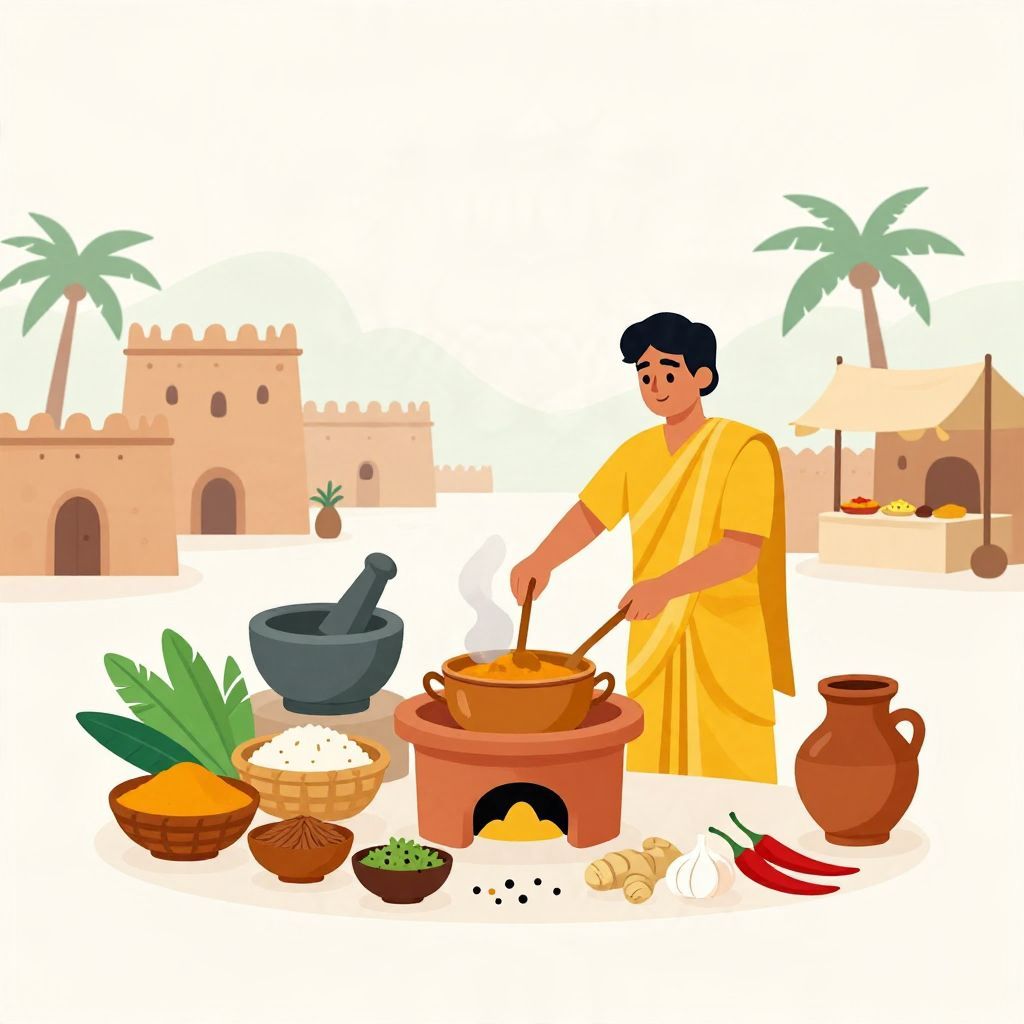
Where did curry originate? The short historical answer is that curry did not begin in one single moment or place. It emerged in the Indian subcontinent over many centuries, where cooks used local spices, herbs, and cooking techniques to create highly seasoned sauces and stews.
The word “curry” is much newer than the food traditions behind it. Its modern global meaning was shaped by South Asian, British, and wider imperial history, so the story of curry is both culinary and colonial.
Where Did Curry Originate?
Curry originated in the Indian subcontinent, especially in the long-standing food cultures of South Asia, where spiced sauces, vegetable dishes, meat curries, and lentil preparations developed over centuries. There is no single inventor or exact birthplace. The modern English word “curry” later grew out of South Asian food traditions and British colonial encounters.
The South Asian Roots of Curry
To understand curry’s origin, it helps to separate the dish from the word. South Asian cooking had long featured mixtures of spices, aromatics, and sauces before outsiders labeled them “curry.” Archaeological and historical evidence suggests that spice use in the region is ancient, and by the medieval period, many regional cuisines across India, Pakistan, Bangladesh, and Sri Lanka had developed rich traditions of seasoned gravies and dry spice blends.
Ancient and early medieval food traditions
Spices such as black pepper, ginger, turmeric, cumin, coriander, cardamom, and mustard seeds were used in South Asia for flavor, preservation, and medicinal beliefs. These ingredients were part of trade networks and local agriculture long before the modern era. While we should avoid claiming a single “first curry,” the foundations of curry-like cooking clearly existed in ancient South Asian foodways.
Cookbooks and culinary references from later periods show that spiced sauces and prepared dishes were common across the region. These traditions varied by climate, religion, available ingredients, and social class. In coastal areas, coconut and seafood became important; in inland regions, dairy, legumes, and meat played larger roles. This diversity is one reason curry cannot be reduced to one recipe.
How the Word “Curry” Developed
The English word “curry” is not an ancient Indian term. It likely comes from the Tamil word kari, meaning a sauce, relish, or accompaniment for rice. British merchants and colonial administrators encountered South Indian food in the early modern period and adapted local terms into English. Over time, “curry” became a broad label for many spiced dishes from South Asia.
From local term to global label
As British influence expanded in India, English speakers began using “curry” to describe a wide range of dishes that did not necessarily share a single style. This was a simplification. In South Asia, people usually identified food more specifically by ingredient, region, or method, rather than using one umbrella term for everything. The English word flattened that diversity into one category.
By the 18th and 19th centuries, “curry” appeared in British cookbooks and in colonial domestic cooking. These recipes often adapted South Asian flavors to European kitchens, sometimes using premade curry powder rather than fresh spice blends. That development helped spread the idea of curry as a standardized dish, even though South Asian cooking remained far more varied.
Why India Is the Main Answer, But Not the Whole Story
India is the main answer because the culinary traditions that gave rise to curry were rooted in the Indian subcontinent. However, curry’s history also includes Sri Lanka, Bangladesh, Pakistan, Nepal, and the broader Indian Ocean world. Spice trade connected these regions to Southeast Asia, the Middle East, and eventually Europe, shaping how ingredients and cooking methods moved and changed.
Trade, migration, and religious influence
Food history rarely stays within modern national borders. Merchants, pilgrims, soldiers, and migrants carried recipes and ingredients across regions. Hindu, Jain, Buddhist, Muslim, and later colonial food practices all influenced what people cooked and ate. For example, Islamic courtly cuisines in parts of South Asia contributed new techniques, ingredients, and presentation styles, while local traditions continued to shape everyday meals.
This means curry was not “invented” by one culture alone. It was formed through centuries of interaction among many communities. The result was a family of dishes rather than a single original recipe.
Curry in the Colonial Era
The global history of curry changed dramatically during British rule in India. British officials, traders, and travelers encountered local dishes and brought simplified versions back to Britain. There, curry became fashionable among some elites and later more widely available in restaurants and homes. The colonial period turned curry from a regional set of South Asian dishes into an international culinary category.
Curry powder and simplification
One of the most important colonial-era developments was curry powder. This was not a traditional South Asian ingredient in the way many people assume today. Instead, it was a British-made blend designed to imitate or approximate South Asian flavors in a convenient form. Its popularity shows how colonial consumers wanted the taste of South Asia while often stripping away its complexity.
As curry spread through British cookery, the term came to cover dishes from many places, including adaptations in Southeast Asia, the Caribbean, East Africa, and Britain itself. In each location, local ingredients and tastes reshaped the dish. Curry became global, but its meanings multiplied.
Different Regional Curries in South Asia
Because curry is a broad category, it is useful to think in regional traditions rather than one origin story. South Asian cuisines developed many distinct curry styles, each with its own history and techniques. These are not copies of one original dish; they are related expressions of a shared culinary heritage.
- North Indian curries often use dairy, tomatoes, onions, ghee, and ground spices.
- South Indian curries frequently feature coconut, tamarind, curry leaves, mustard seeds, and chili.
- Bengali curries may emphasize mustard oil, fish, and subtle spice balancing.
- Sri Lankan curries often use roasted spices, coconut, and strong heat.
- Pakistani curries reflect regional, Mughal, and local influences, with many meat-based dishes.
These traditions show that curry is best understood as a culinary family. The common thread is not one exact recipe but a method of building flavor through spices, aromatics, and a sauce or gravy.
What Historians Can Say with Confidence
Historians can say with confidence that curry originated in the Indian subcontinent as a broad food tradition, not as a single dish invented on one date. They can also say that the English word “curry” likely came from South Indian language contact, especially Tamil, and that British colonialism played a major role in turning curry into a global term.
What remains uncertain
What cannot be established precisely is a single birthplace, founder, or “first curry.” The evidence points instead to gradual development. Like many traditional foods, curry evolved through everyday cooking, trade, migration, and cultural exchange. That is why origin stories that name one inventor or one city are usually too simple to be historically accurate.
Why Curry’s Origin Matters Today
Understanding where curry originated helps correct a common misconception: that curry is one fixed dish from one country. In reality, it is a historical category shaped by South Asian culinary diversity and later global reinterpretation. Recognizing this makes the food’s history richer and more accurate, and it also respects the cultures that created it.
Curry’s journey from South Asia to the wider world reflects larger patterns in history: trade, empire, migration, adaptation, and the reshaping of local traditions for new audiences. Its story is not just about food. It is about how cultures meet, borrow, and transform one another over time.
So, where did curry originate? In the Indian subcontinent, through centuries of South Asian cooking traditions. The modern word and global idea of curry were shaped later, especially through British colonial history. If you want to explore more food-history questions, you may also enjoy where curry is from and the broader culinary background in where sushi originated.