
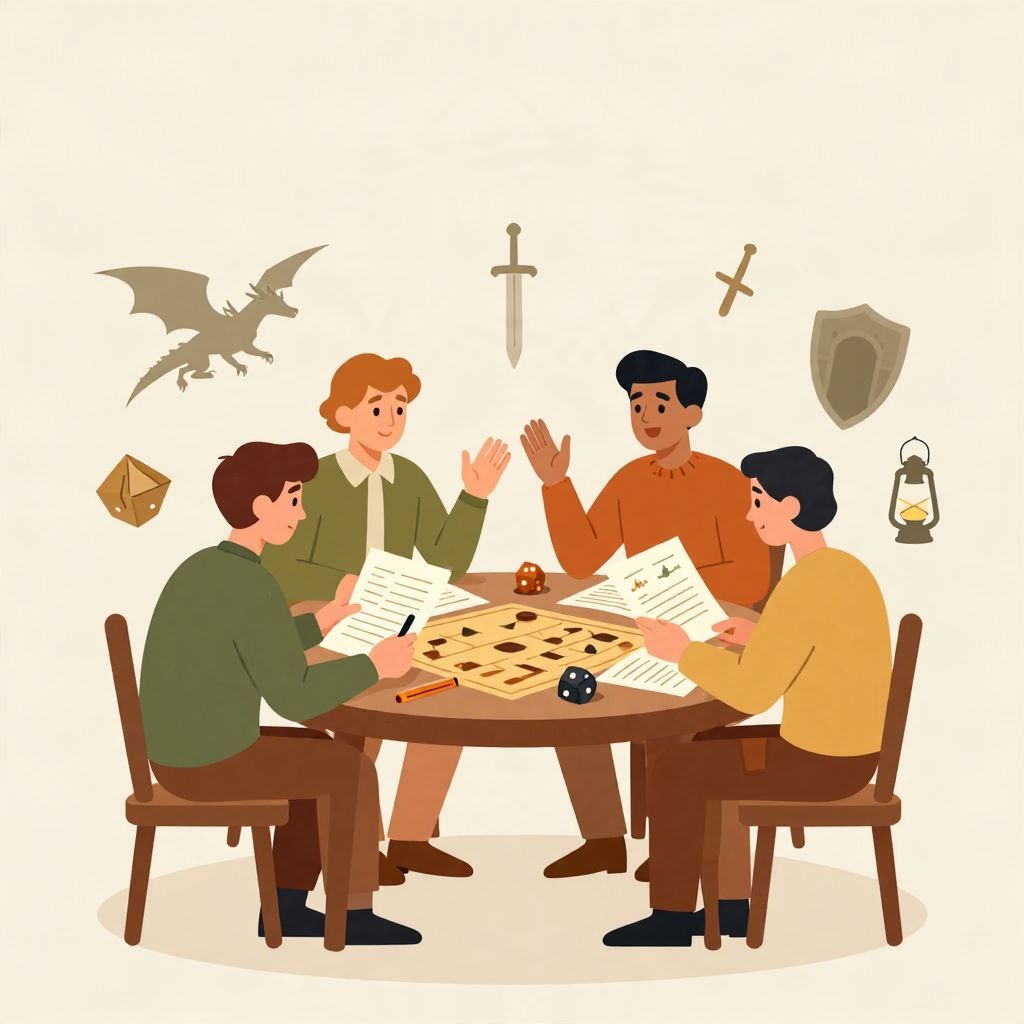
When was D&D created? The short answer is that Dungeons & Dragons was first published in 1974, after several years of development by Gary Gygax and Dave Arneson. It was the first widely successful tabletop role-playing game and quickly became a landmark in modern gaming history.
Its creation did not happen in a single moment. D&D grew out of earlier miniatures wargaming, experimental fantasy campaigns, and a new idea: instead of commanding armies, players would each control one character in an unfolding story.
When Was D&D Created?
Dungeons & Dragons was created in 1974, when the first boxed set was published by Tactical Studies Rules, commonly known as TSR. The game had been developed during the early 1970s, especially through the collaboration between Gary Gygax and Dave Arneson, whose ideas combined fantasy adventure, character progression, and rules for role-playing into a new kind of game.
The Origins of Dungeons & Dragons
D&D did not emerge from nowhere. It grew out of the hobby of tabletop wargaming, especially miniature battles that were popular in the United States and Britain in the 1960s and early 1970s. Players like Gygax were already experimenting with rules that added individual heroes, dungeon exploration, and fantasy elements to traditional military simulations.
From Wargames to Role-Playing
Before D&D, most tabletop strategy games focused on armies, movement, and combat. Gygax helped develop Chainmail, a medieval miniatures ruleset published in 1971, which included fantasy combat options. Dave Arneson, meanwhile, ran a campaign called Blackmoor that introduced a more personal style of play, where players took on the roles of individual characters exploring a persistent world.
The crucial innovation was not just fantasy setting, but perspective. Instead of moving units across a battlefield, players spoke and acted as their characters. That shift helped define the role-playing game genre.
The Gygax-Arneson Collaboration
Arneson’s Blackmoor campaign and Gygax’s design work came together in the early 1970s. Their collaboration produced the first D&D rules, though the relationship later became complicated by disagreements over credit and royalties. Historians of gaming generally agree that both men were essential to the game’s creation, even if their contributions were different.
A Brief Timeline of D&D’s Creation
The origin of D&D is best understood as a sequence of developments rather than a single invention date. Here is the basic timeline:
- 1960s: Tabletop miniatures wargaming grows in popularity among hobbyists.
- 1971: Chainmail is published, giving fantasy combat rules a more formal shape.
- Early 1970s: Dave Arneson develops the Blackmoor campaign, emphasizing individual characters and adventure.
- 1973: The first D&D manuscript circulates among players and hobbyists.
- 1974: Dungeons & Dragons is officially published as a boxed set by TSR.
- 1975 and after: Supplements and revisions expand the game, helping it spread far beyond its original audience.
What Made the 1974 Release So Important?
The 1974 release matters because it transformed an experimental hobby into a new cultural form. D&D introduced rules for character classes, levels, hit points, experience, dungeon exploration, and a referee-like game master. These ideas became the foundation of tabletop role-playing games and influenced video games, fantasy fiction, and popular culture more broadly.
The First Edition Was Modest, but Revolutionary
The original D&D boxed set was not a mass-market blockbuster at first. It was a small, unusual product aimed at hobbyists already familiar with miniatures gaming. Yet its design was revolutionary because it invited improvisation. The rules were often open-ended, leaving room for imagination, house rules, and storytelling.
That flexibility helped the game spread. Players could adapt it to different settings, invent new monsters, and build campaigns that lasted for months or years. In that sense, D&D was less a fixed game than a framework for collaborative fantasy adventure.
Who Created D&D?
The most accurate answer is that Gary Gygax and Dave Arneson created Dungeons & Dragons together, with important contributions from others in the early hobby scene. Gygax is often associated with the formal publication and systematization of the rules, while Arneson is strongly linked to the role-playing concept and the Blackmoor campaign that helped inspire the game.
Gary Gygax
Gygax was a leading figure in early tabletop gaming and one of the founders of TSR. He helped turn fantasy miniatures rules into a publishable system and played a major role in bringing D&D to market in 1974.
Dave Arneson
Arneson’s Blackmoor campaign is widely recognized as a crucial step toward the modern role-playing game. His approach emphasized character-driven adventure, dungeon exploration, and a living campaign world, all of which became central to D&D.
Other Early Influences
Although Gygax and Arneson are the main names associated with the game, D&D also drew from a wider community of hobbyists, fantasy literature, and earlier rule systems. Tolkien, Howard, Vance, and other fantasy authors influenced the game’s tone and imagery, though D&D was not simply an adaptation of any one book or mythological source.
How D&D Changed After 1974
After its initial publication, D&D quickly evolved. Early supplements expanded the rules, and different editions later clarified or revised the system. The game’s growth reflected both its popularity and the challenge of defining a new genre as it spread to new players.
Early Expansion
Within a few years, D&D had moved beyond its original boxed set. Supplementary rulebooks added more monsters, spells, classes, and settings. This expansion helped standardize the game while also encouraging creativity among players and referees.
From Hobby to Cultural Phenomenon
By the late 1970s and 1980s, D&D had become the best-known tabletop role-playing game in the world. It inspired imitators, competitors, and eventually computer and console games that borrowed its ideas about character progression, quests, and fantasy worlds.
Why the Exact “Creation Date” Can Be Confusing
People sometimes ask when D&D was “created” because the answer depends on what is meant by creation. If the question refers to the first official publication, the date is 1974. If it refers to the earliest development of the ideas behind the game, then the story begins earlier, in the early 1970s and even in the 1960s wargaming scene.
That distinction matters in history. Many cultural works have a long gestation period before their public debut. D&D is a good example: the published product appeared in 1974, but the creative process that made it possible was already underway for years.
Historical Facts About D&D’s Creation
- First publication: 1974
- Main creators: Gary Gygax and Dave Arneson
- Company: Tactical Studies Rules (TSR)
- Key precursor: Fantasy miniatures wargaming, especially Chainmail
- Major innovation: Players control individual characters in a shared narrative world
- Historical significance: D&D helped create the modern role-playing game genre
Why D&D Still Matters
D&D remains important because it changed how people think about games. It showed that a game could be about storytelling, cooperation, improvisation, and character growth rather than only competition. Its influence can be seen in tabletop gaming, digital games, fantasy media, and the broader language of pop culture.
So, when was D&D created? Officially, in 1974—but its real origin lies in the years of experimentation that led to that publication. For readers interested in the broader history of tabletop gaming and fantasy culture, D&D is a landmark worth understanding as both a product of its time and a force that reshaped the decades that followed.