
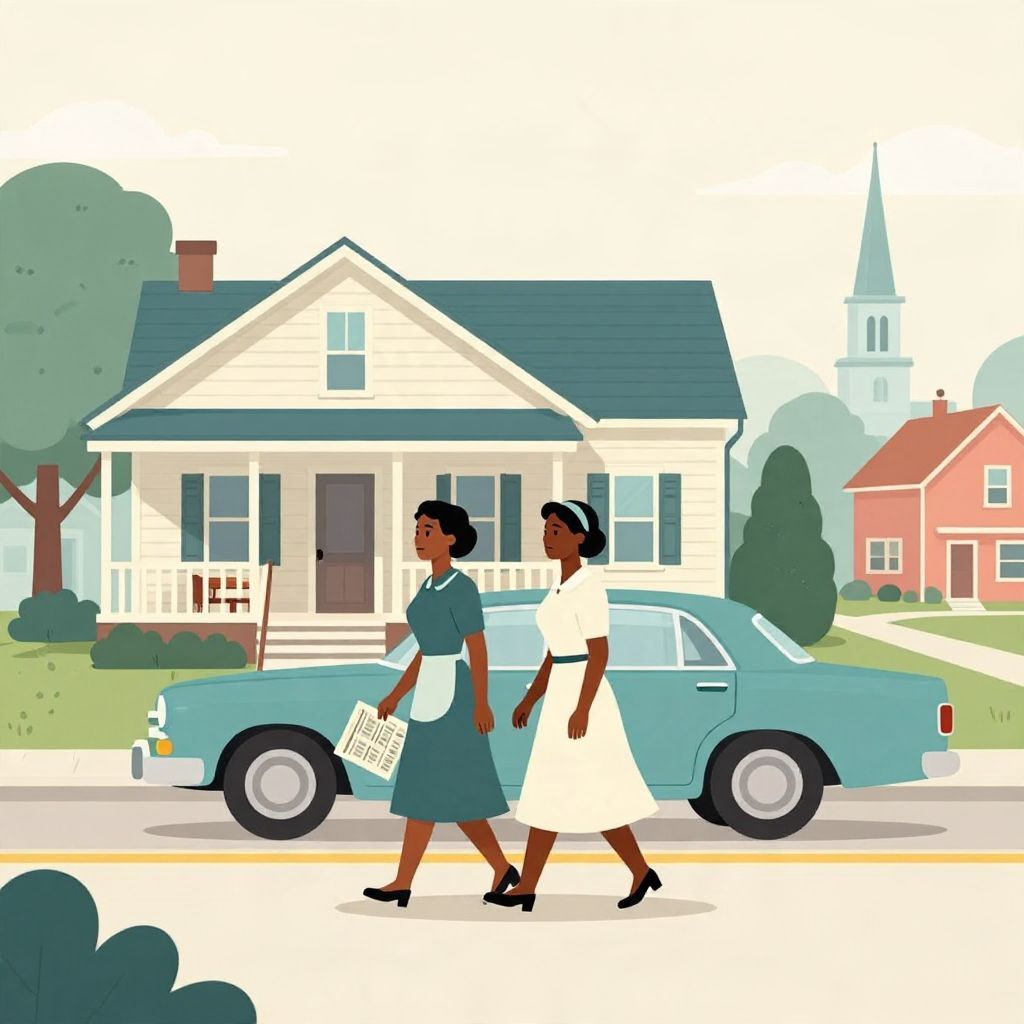
Is The Help a true story? The short answer is no: Kathryn Stockett’s 2009 novel and the 2011 film are works of historical fiction, not direct retellings of a single real-life event or person. But they are rooted in the real social world of Jackson, Mississippi, during the early 1960s, when Black domestic workers labored under Jim Crow segregation and white households depended on their work.
That mix of invention and historical reality is why the story feels believable. To understand what is true, what is fictionalized, and why the book and film remain controversial, it helps to look at the history of domestic labor, race relations, and civil rights in the American South.
Is The Help a true story?
The Help is not a true story in the strict historical sense. It is a fictional novel set in a real place and time, inspired by the segregation-era South and by the experiences of Black maids and white families in Mississippi. Some details reflect documented history, but the main characters, plot, and central events were created by Kathryn Stockett.
What parts of The Help reflect real history?
The book and film draw on genuine conditions in the early 1960s South: legal segregation, unequal wages, restricted public spaces, and the vulnerability of Black women working in white households. These conditions were not invented for the story. They were part of the everyday structure of Jim Crow society, especially in Mississippi, one of the most rigidly segregated states in the United States.
Domestic labor in Jim Crow Mississippi
Black women in the South often worked as cooks, nannies, housekeepers, and caregivers for white families. Many were employed informally, with little legal protection and few opportunities for advancement. Their labor was essential to household life, yet it was undervalued and shaped by racial hierarchy. The novel captures that dependence, even though it dramatizes it through fictional characters and dialogue.
Segregation and racial fear
The story’s atmosphere of intimidation is historically grounded. In the early 1960s, Mississippi was a dangerous place for Black people who challenged segregation. Civil rights activism met harassment, job loss, violence, and sometimes murder. The book’s setting overlaps with the broader struggle that included voter registration drives, sit-ins, boycotts, and the Freedom Summer campaign of 1964.
Changing ideas about race and class
The Help also reflects a real moment when some white Southerners, especially younger women, began to question inherited racial attitudes. That does not make the book a documentary, but it does place the story within a historical transition. By the early 1960s, the civil rights movement was forcing white Americans to confront the moral and political costs of segregation.
What is fictionalized in the story?
The main characters in The Help are fictional, and the plot is not based on a single documented incident. The central relationship between Skeeter, Aibileen, and Minny is an invented narrative device that allows the author to explore race, memory, and power. The book is best understood as historical fiction that borrows from a real era rather than as biography or reportage.
Not a memoir or a documented case study
Although the novel presents itself as emotionally plausible, it is not a memoir by a Black domestic worker or a white civil rights activist. That distinction matters. A memoir would be anchored in one person’s verified life story; The Help instead combines imagined characters with historical themes drawn from the broader period.
Composite experiences, not one person’s life
Many historical novels use composite characters to represent common experiences. In that sense, Aibileen and Minny can be read as literary composites of many Black maids whose names were never recorded in public history. Still, readers should not assume that any one character exactly matches a real woman from Mississippi.
The historical setting behind the novel
To judge the story accurately, it helps to understand the world it depicts. Jackson, Mississippi, in the early 1960s was part of a segregated social order enforced by law, custom, and violence. White and Black residents lived under different rules in schools, transportation, public accommodations, and political life. The domestic sphere was not separate from this system; it was one of the places where it was most visible.
Why Black domestic work mattered
White households in the South often relied on Black women for childcare, cooking, and cleaning. This created a paradox: white families depended on Black labor while still treating Black workers as socially inferior. That contradiction is one of the strongest historical truths behind The Help. It was a system built on intimacy and inequality at the same time.
The civil rights backdrop
The early 1960s were a turning point in American history. The sit-in movement had begun in 1960. The Freedom Rides followed in 1961. In Mississippi, the struggle for voting rights and desegregation intensified in the years leading up to the Civil Rights Act of 1964 and the Voting Rights Act of 1965. The novel’s atmosphere of pressure and change belongs to this broader historical moment.
How accurate is the film adaptation?
The 2011 film adaptation preserves the basic fictional framework of the novel, but it also simplifies history for dramatic effect. Like many adaptations, it sharpens characters, compresses timelines, and centers emotional arcs that are easier to film than the messier realities of the period. As a result, it communicates some historical truths while leaving out others.
What the film gets right
- The centrality of Black domestic labor in Southern white households.
- The everyday presence of segregation in social life.
- The atmosphere of fear surrounding racial dissent in Mississippi.
- The fact that white women’s domestic spaces were deeply tied to racial power.
What the film leaves out or softens
- The broader scale of Black activism and organizing in Mississippi.
- The extent to which Black women were already speaking for themselves through churches, clubs, and civil rights networks.
- The structural nature of racism, which was larger than any one household conflict.
- The risk of centering white moral awakening over Black political struggle.
Why has The Help been controversial?
Even though many readers and viewers find the story moving, it has also drawn criticism from scholars, writers, and some civil rights observers. The main concern is not whether racism existed—of course it did—but whether the narrative frames Black suffering mainly through a white protagonist’s growth. That is a common issue in historical fiction about race.
The “white savior” critique
Some critics argue that the story gives too much narrative authority to Skeeter, the young white journalist, while Black characters become vehicles for her moral development. In historical terms, this criticism points to a larger pattern in American storytelling: stories about racial injustice are sometimes told from the perspective of those least harmed by it.
Limits of representation
Another criticism is that the novel can make segregation seem like a collection of personal prejudices rather than a system supported by law, labor, and violence. That does not mean the work is useless; it means readers should separate emotional truth from historical completeness. A novel can reveal one dimension of the past without fully explaining the whole system.
Did real people inspire the characters?
There is no widely accepted historical evidence that the main characters are direct portraits of specific, identifiable people. Kathryn Stockett has said the novel was inspired by her own upbringing in Mississippi and by the domestic workers around her. That is different from saying the book is based on one true case. Inspiration is not the same as documentation.
Why inspiration is not the same as evidence
Many historical novels begin with personal memory, family stories, or local atmosphere. Those influences can shape a believable setting without producing a factual account. Unless a work can be tied to named individuals, dates, and corroborated events, it should be treated as fiction informed by history, not as a historical record.
How should readers think about the book today?
The best way to read The Help is as a fictional entry point into a real historical world. It can encourage interest in Black women’s labor, Jim Crow segregation, and the civil rights era. But it should not be used alone as evidence of what life was like in Mississippi or as a substitute for memoirs, oral histories, or scholarship by Black historians and writers.
A useful but incomplete window
The story works best when readers ask two questions at once: what does it reveal about the emotional reality of segregation, and what does it leave out about Black agency, organizing, and daily survival? That double reading makes the novel more historically useful and less misleading.
Conclusion: the historical verdict
The Help is not a true story, but it is built on a true historical setting: segregated Mississippi in the early 1960s, where Black domestic workers lived under racial inequality and white households depended on their labor. Its value lies in fiction shaped by history, not in documentary accuracy. For readers interested in similar questions of fact and adaptation, see also whether Fury is a true story and whether Sarah’s Oil is a true story.