
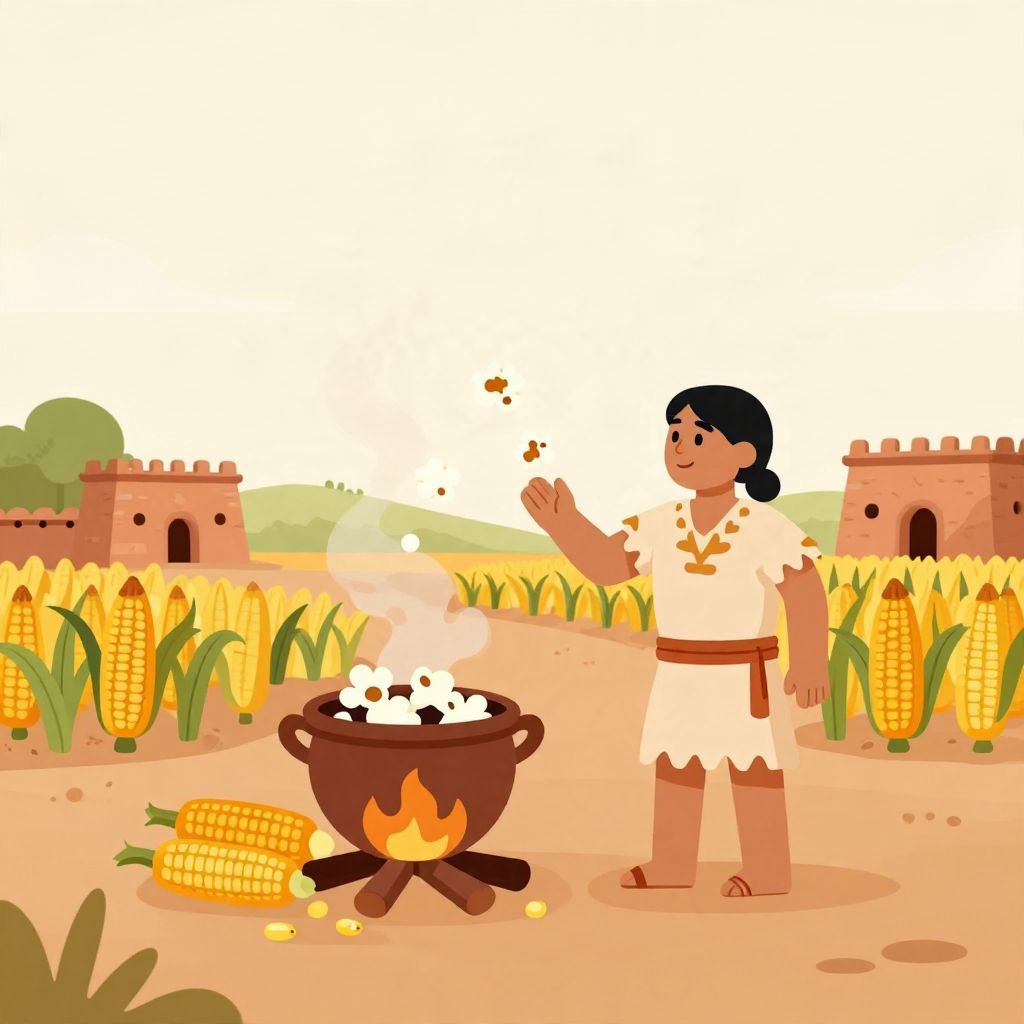
How was popcorn discovered? The short answer is that popcorn was not invented in a single moment. It emerged when people in the Americas learned that certain kinds of corn kernels burst open when heated, and Indigenous communities were using and valuing popped maize thousands of years before Europeans arrived.
The history of popcorn is therefore a story of ancient agriculture, experimentation with fire, and the long survival of Native food traditions. Archaeology shows that popcorn-like maize was present in the Americas by at least several thousand years ago, making it one of the oldest snack foods still eaten today.
How Was Popcorn Discovered?
Popcorn was discovered through observation: when dry kernels of a special type of maize were heated, they expanded and burst because moisture inside the kernel turned to steam. Indigenous peoples of the Americas likely noticed this effect early and began intentionally cultivating popcorn varieties. It was not a modern invention, but a traditional food with deep pre-Columbian roots.
The Ancient Origins of Popcorn
Popcorn belongs to the broader history of maize, or corn, which was domesticated in Mesoamerica from a wild grass called teosinte. Over time, farmers selected plants with useful traits, including kernels that could pop. This meant popcorn was not an accident of nature alone; it was the result of long agricultural knowledge and careful seed selection.
Archaeological evidence
Archaeologists have found popcorn kernels and ears in ancient sites in the Americas, including regions of present-day Peru and the American Southwest. Some finds are several thousand years old, though exact dates vary by site and method. These discoveries show that popping corn was known long before the rise of European colonial societies.
One of the most important points is that popcorn was not discovered in one place by one person. Different Indigenous peoples across the Americas used maize in many forms, and popping was one of them. The evidence suggests a long process of experimentation rather than a single “eureka” moment.
Why popcorn pops
The science behind popcorn helps explain why ancient people could discover it so naturally. A popcorn kernel has a hard outer shell and a small amount of water inside. When heated, the water becomes steam, pressure builds, and the kernel eventually bursts, turning the starchy interior inside out. Only certain maize varieties have the right structure to pop well.
Who First Used Popcorn?
No single individual can be named as the first person to discover popcorn. The most accurate historical answer is that Indigenous peoples of the Americas discovered and developed it over many generations. Popcorn was part of Native foodways, ceremonial life, and daily eating long before it became a commercial snack.
Native American uses of popcorn
Popcorn was eaten plain, ground, or mixed with other ingredients. In some communities it was used in soups, porridge, or as a topping. It also had cultural and ceremonial significance in certain regions. This matters because popcorn was not simply a novelty food; it was integrated into a larger agricultural and social world.
European colonists encountered popcorn after arriving in the Americas, but they did not create it. They observed Indigenous peoples growing and preparing it, and over time they adopted some of these practices. The snack’s later popularity in North America grew from this cultural exchange, though the original knowledge belonged to Native farmers and cooks.
Key Events in Popcorn History
Popcorn’s history stretches across millennia, but a few broad developments help explain how it became the food we know today.
- Domestication of maize in Mesoamerica, beginning thousands of years ago.
- Selection of popping varieties by Indigenous farmers who recognized useful kernel traits.
- Spread across the Americas through trade, migration, and local agricultural traditions.
- European contact after 1492, which introduced popcorn to wider colonial audiences.
- Commercial expansion in the 19th and 20th centuries, especially in the United States.
Popcorn in the colonial and early American periods
By the time English colonists and other Europeans settled in North America, popcorn was already established in Indigenous communities. Colonial households sometimes used it, and by the 18th and 19th centuries it appeared more often in American food culture. Still, it remained a regional and domestic food rather than a mass-market product.
The 19th-century boom
Popcorn became much more visible in the 1800s, especially with the rise of street vending and new cooking technology. Portable popcorn makers and later mechanical poppers made it easier to produce in larger quantities. This helped transform popcorn from a traditional food into a popular snack for fairs, theaters, and public events.
The growth of popcorn also reflected broader changes in American life: urbanization, industrial food processing, and the expansion of leisure culture. As people looked for inexpensive treats, popcorn fit the moment perfectly. Its low cost and dramatic popping action made it especially appealing.
The Science and Culture Behind the Discovery
Popcorn was discovered because people paid attention to how food behaved under heat. That kind of observation was central to many ancient food traditions. Indigenous agricultural knowledge did not separate science from cooking; it treated them as part of the same practical skill set.
Why only some corn pops
Not all corn can become popcorn. Popcorn kernels have a dense starch interior and a strong, moisture-retaining hull. Other corn types may dry out, split, or roast without expanding in the same way. Ancient farmers preserved the traits that made popping possible, which is one reason popcorn survived as a distinct variety.
From food to symbol
Over time, popcorn took on meanings beyond nourishment. In North America it became associated with celebration, entertainment, and affordability. In the 20th century, movie theaters helped cement its image as a classic snack. Yet its deeper history remains tied to Indigenous innovation and the agricultural heritage of the Americas.
Myths and Misunderstandings About Popcorn’s Origin
Because popcorn seems so simple, it is easy to imagine that it was “invented” by one clever person or discovered by chance in a modern kitchen. That is misleading. The historical record points instead to long-term Indigenous cultivation and use, followed by later commercialization in Europe and North America.
Another common misunderstanding is that popcorn is a recent novelty. In fact, the opposite is true: it is one of the oldest continuously used snack foods in the Western Hemisphere. Its modern popularity can obscure the much older history behind it.
What historians can say with confidence
- Popcorn comes from maize domesticated in the Americas.
- Indigenous peoples discovered and developed popping varieties long before European contact.
- Archaeological evidence shows popcorn was used thousands of years ago.
- Its mass popularity grew much later, especially in the 19th and 20th centuries.
Why Popcorn’s History Matters
The story of popcorn is more than a food history curiosity. It shows how Indigenous knowledge shaped global cuisine, often without receiving proper credit. It also demonstrates how a simple agricultural discovery can travel across centuries, changing form as societies change around it.
Popcorn’s journey from ancient maize fields to modern snack stands reflects continuity as much as change. The kernels may burst in seconds, but the history behind them stretches back thousands of years.
In the end, popcorn was discovered not by a single inventor but by generations of Indigenous Americans who cultivated maize, noticed its special properties, and made it part of their food traditions. For more on the history of traditional foods, you may also enjoy what succotash is and where sushi originated.