
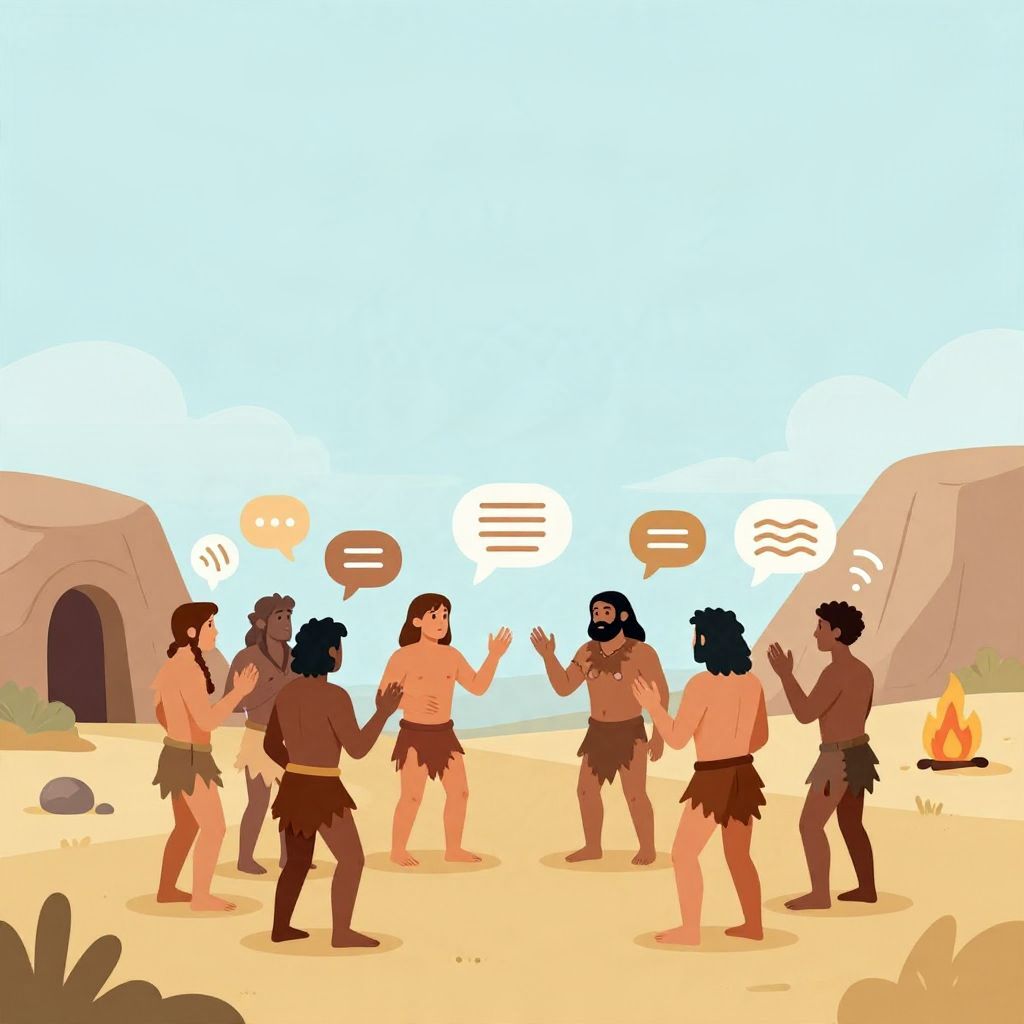
People often ask what the first language spoken was, hoping for a single ancient answer. History, linguistics, and archaeology, however, point to a more complicated truth: no one knows the exact first language, and it was almost certainly not a written one.
What we can say is that human language emerged gradually among early Homo sapiens in prehistoric Africa, probably tens of thousands of years before writing. The “first language” was likely an early spoken system that left no direct record, so scholars reconstruct its possibilities from anatomy, genetics, archaeology, and comparisons among later languages.
What Was the First Language Spoken?
There is no known single “first language spoken” that historians can identify by name. The earliest human language was almost certainly a prehistoric spoken language, developed gradually by early humans in Africa long before writing existed. Because speech leaves no fossils, its exact sounds, vocabulary, and grammar remain unknown.
Why there is no definitive answer
Language does not fossilize the way bones or tools do. Even if early humans spoke thousands of different languages, none survived unchanged for tens of thousands of years. By the time writing appeared, language was already fully developed and regionally diverse. This means the question is important, but the evidence cannot support a single named “first language.”
What scholars mean by “first language”
The phrase can mean different things:
- the first human capacity for language,
- the first spoken language system used by our species, or
- the oldest recorded language known from writing.
These are not the same. The first is a biological and evolutionary question; the second is prehistoric and unrecorded; the third belongs to history and archaeology. Most people asking the question are really asking about the second, but the surviving evidence is limited.
How Did Human Language Begin?
Most researchers think language developed gradually rather than appearing all at once. Early humans likely began with gestures, vocal calls, and shared social signals, then built increasingly complex speech over time. This process probably took place in Africa, where Homo sapiens evolved around 300,000 years ago.
Speech before writing
Writing is a very recent invention in human history. The earliest known writing systems appeared only around 3200 BCE in Mesopotamia and Egypt. By then, people had already been speaking for an unimaginably long time. That means the original spoken languages of humanity existed in prehistory, not in the historical record.
What made language possible
Human language depends on several abilities working together:
- fine control of breathing and vocal sounds,
- brain systems for memory and symbolic thought,
- social cooperation and shared meaning,
- the ability to learn and transmit patterns across generations.
No single moment explains the origin of language. Instead, language likely emerged as early humans became more socially complex, more dependent on cooperation, and better able to communicate abstract ideas.
Where Did the First Spoken Language Likely Emerge?
Most evidence suggests that language emerged among early humans in Africa, though no specific location can be proven. This is because Homo sapiens arose in Africa, and the deepest branches of human genetic and linguistic diversity are also found there. Still, the exact place and date remain uncertain.
African origins and human evolution
Since modern humans evolved in Africa, it is the most likely region for the earliest spoken language. Some scholars argue that language may have begun before the full spread of Homo sapiens, possibly among earlier human species or shared ancestors. Others believe fully modern language appeared later, after the emergence of anatomically modern humans.
Why the evidence is indirect
Archaeology can show symbolic behavior, such as ornaments, cave art, or ritual burials, which may suggest advanced communication. But these finds do not prove the existence of a specific language. They only indicate that humans were capable of complex symbolic thought, which language probably supported.
Did the First Language Have a Name?
No surviving evidence identifies the first language by name. Popular ideas sometimes imagine a single “original language” from which all others descended, but history does not support that simple picture. Human language likely diversified very early, producing many languages and dialects as groups spread and separated.
The myth of one original tongue
Many cultures have legends about a first language. In some traditions, humanity once shared a common speech before it was divided. The best-known example in the Judeo-Christian tradition is the story of Babel, where languages are said to have been confused. Such stories are culturally important, but they are not historical proof.
What linguists can and cannot reconstruct
Linguists can sometimes reconstruct older forms of languages by comparing related languages and identifying shared patterns. This method has limits, though. It works for relatively recent language families, not for the deepest prehistoric stage of human speech. The farther back one goes, the less certain reconstruction becomes.
What Is the Oldest Language We Know From History?
If the question is changed from “first spoken language” to “oldest written language,” then the answer is more concrete. The earliest written languages include Sumerian and Egyptian, both appearing around the late fourth millennium BCE. These were not the first languages ever spoken, but they are among the first languages we can actually study directly.
Early written languages
- Sumerian in Mesopotamia, attested by the late 4th millennium BCE,
- Egyptian, also attested around the same period,
- Akkadian, a Semitic language written in cuneiform, appearing soon after,
- Chinese, with oracle bone inscriptions from around 1200 BCE.
These languages are ancient, but they are still far removed from the first spoken language. They are simply the earliest languages preserved in writing.
Why written evidence matters so much
Written texts let historians track grammar, vocabulary, law, religion, trade, and politics. Without writing, language history becomes speculative. That is why the oldest known languages are not necessarily the oldest spoken languages; they are merely the first ones that entered the historical record.
How Did Languages Spread and Change?
Once humans spread across Africa and into Eurasia, Australia, and the Americas, their languages changed over time. Small communities developed distinct speech forms, and over generations those differences became new languages. Migration, isolation, trade, conquest, and intermarriage all shaped this process.
Language change is constant
Languages are not fixed systems. Pronunciation shifts, words are borrowed, meanings change, and grammar evolves. A language spoken thousands of years ago would not remain identical even if the same community continued speaking it. This is one reason the search for a single first language is so difficult: language is always changing.
Families, branches, and deep time
Modern linguists group related languages into families such as Indo-European, Afroasiatic, Niger-Congo, Austronesian, and others. These families help explain later history, but they do not lead back to a recoverable “first language.” At very deep time depths, the branches become too old and too obscured to trace with confidence.
Did Everyone Once Speak the Same Language?
There is no scientific evidence that all humans shared one historically identifiable language in the way a single nation might share one official tongue. However, because all modern humans descend from African populations, there may have been an early stage when the number of languages was small. That is still not the same as one universal language.
Monogenesis and competing ideas
Some scholars have explored the idea that all human languages may ultimately descend from one ancestral system, a theory sometimes called monogenesis. Others caution that the evidence is too weak to prove it. Because language is ancient and constantly changing, any such ancestor would be extremely difficult to reconstruct beyond broad speculation.
The problem of deep ancestry
Even if a single ancestral language once existed, it would have been spoken so long ago that its exact form is beyond recovery. It may have differed greatly from any language known today. In historical terms, then, asking for the first language is a bit like asking for the first song ever sung: the human capacity is real, but the original version is lost.
Why the Question Still Matters
Although the exact first language cannot be named, the question matters because it reveals how humans became human. Language made it possible to share knowledge, organize communities, preserve memory, and build culture across generations. It is one of the most important developments in human history.
Language and civilization
Once language existed, it became the foundation for law, religion, diplomacy, literature, and state power. Civilizations could not have formed in the same way without speech. Written languages later preserved those achievements, allowing historians to study ancient societies in detail.
What the uncertainty teaches us
The lack of a single answer is not a failure of history; it is a reminder of how deep human prehistory goes. Some of the most important developments in our species happened before writing, before cities, and before named rulers. Language belongs to that older world.
So, What Was the First Language Spoken?
The most accurate answer is that we do not know the exact first language spoken. The earliest human language was a prehistoric spoken system, probably developed gradually among early humans in Africa long before writing. It left no direct record, so its name, sound, and grammar are lost to time.
What history can say with confidence is that language is ancient, human, and foundational. If you want to explore how later languages developed in recorded history, you might also read about what language the Romans spoke and what language the Bible was originally written in.