
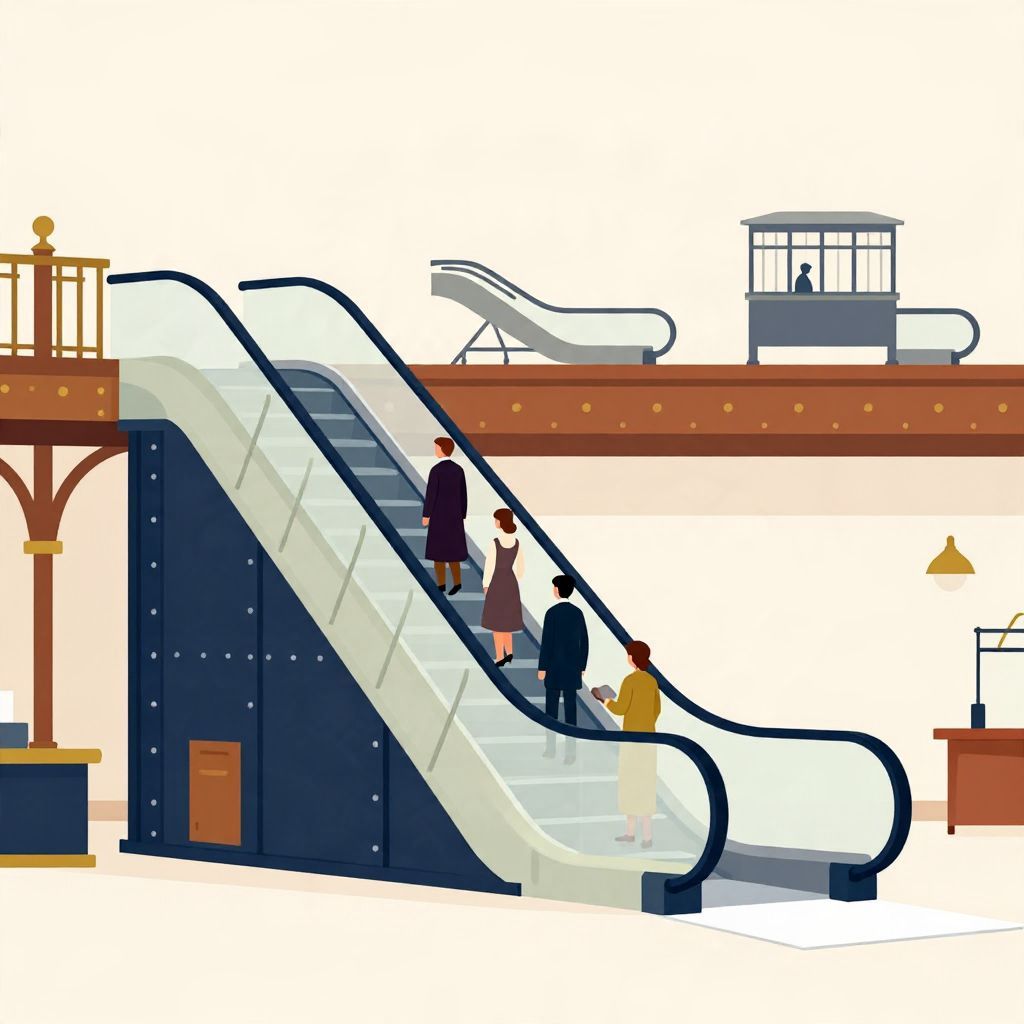
When were escalators invented? The short answer is that the idea emerged in the late 19th century, but the modern escalator was developed in stages. Early moving stair devices appeared in the 1890s, and the first commercially successful escalator was introduced in 1896 by inventor Jesse W. Reno.
Because “escalator” can mean either the earliest patent, the first working machine, or the first practical public installation, the exact answer depends on how you define invention. The history is a story of experimentation, patents, and rapid urban modernization at the turn of the 20th century.
When were escalators invented?
Escalators were invented in the 1890s, with the key breakthrough coming in 1896 when Jesse W. Reno demonstrated a practical moving stairway at Coney Island. Earlier patents and prototypes appeared in the same decade, but Reno’s design was the first to gain wide attention and commercial use. Later improvements by other inventors turned the escalator into the familiar machine used in department stores and transit systems.
The origins of the escalator idea
The escalator did not appear suddenly. It grew out of a broader 19th-century fascination with mechanized movement, especially in cities where elevators, trains, and factory machinery were changing everyday life. As buildings grew taller and public spaces became busier, inventors looked for ways to move people more efficiently without requiring them to climb stairs.
Early concepts before the modern escalator
Before the 1890s, there were already ideas for moving stairways and inclined conveyor systems. Some were more theoretical than practical, and others were closer to novelty rides than to a reliable public transport device. These early efforts show that the escalator was part of a larger age of industrial invention, not a single isolated breakthrough.
The word escalator itself came later than the basic concept. The term eventually became associated with a specific type of moving staircase, but the machine’s development involved several inventors and companies over time.
The 1890s: the decisive decade
The 1890s were the crucial years in escalator history. During this decade, inventors refined the moving stairway from an experimental novelty into a machine that could carry passengers safely and continuously. Two names matter most in this early story: Jesse W. Reno and George A. Wheeler.
Jesse W. Reno and the first practical model
Jesse W. Reno patented a moving stairway in the 1890s and unveiled a working version in 1896 at Coney Island in New York. His machine was not yet the enclosed, smooth escalator seen today, but it was a genuine passenger-moving device and a major step forward. Reno’s design used an inclined belt with cleats rather than the later interlocking steps.
Reno’s machine is often treated as the first escalator because it was the first to operate publicly in a way that resembled the modern experience: people stood on a moving incline and were carried upward. It was also commercially visible, which helped establish the idea in the public imagination.
George A. Wheeler’s patent and the modern step form
Another important inventor was George A. Wheeler, who patented a moving stairway in the 1890s that more closely resembled the later escalator design. Wheeler’s work is significant because it helped shape the familiar stepped structure, even though his version was not the one that became most famous in public use. In historical terms, the escalator was not the product of a single genius but of overlapping inventions.
From novelty to urban technology
At first, escalators were often seen as attractions. Their earliest public appearances drew curiosity because they looked futuristic and even a little strange. But as cities expanded and commercial buildings became larger, the escalator’s practical value became obvious. It could move large numbers of people continuously, reducing crowding and making upper floors easier to reach.
Why escalators mattered in the age of department stores
Escalators fit perfectly into the late 19th and early 20th centuries, when department stores were becoming major urban landmarks. These stores needed to draw customers upward through multiple floors, and a moving staircase encouraged shoppers to explore the whole building. In that sense, the escalator was not just a machine; it was a tool of modern retail culture.
Transit systems also benefited. As subways and elevated railways expanded, escalators helped move passengers between street level and platforms. This made them especially valuable in crowded cities where stairs alone were too slow and elevators too limited.
How the escalator evolved after its invention
The early escalator was only the beginning. Over the following years, engineers improved safety, speed, reliability, and design. The machine gradually shifted from an open, novelty-like structure to the enclosed, standardized system familiar today. These improvements were essential for making escalators safe enough for heavy daily use.
Key developments in the early 20th century
- 1890s: Early patents and working prototypes appear, including Reno’s practical moving stairway.
- Late 1890s to early 1900s: Designs become more stable and more suitable for public buildings.
- 20th century: Escalators spread through department stores, train stations, and subways.
- Modern era: Standardized safety features and mass production make escalators a routine part of urban infrastructure.
One major shift was the move from novelty to standard equipment. Once architects and transit planners realized that escalators could handle steady passenger flow, the machine stopped being a curiosity and became an expected part of modern buildings.
Was there a single inventor?
Not really. The escalator’s history is best understood as a sequence of inventions rather than a single moment of creation. Jesse W. Reno is often credited with the first practical escalator, but other inventors contributed important ideas, patents, and design improvements. If you ask who invented the escalator, the honest answer is that several people helped shape it.
Why invention histories can be complicated
Technologies like the escalator often develop in layers. One person may patent an idea, another may build a working prototype, and a third may create the version that becomes commercially successful. Historians therefore distinguish between the first concept, the first patent, the first public demonstration, and the first widespread use. Each can matter in a different way.
That is why the date 1896 is so important, but not the whole story. It marks the moment when the escalator became a visible, practical machine rather than just an engineering idea.
The historical significance of the escalator
The escalator mattered because it changed how people moved through buildings and cities. Like the elevator before it, it altered architecture by making vertical space more usable. It also reflected a broader historical trend: the late 19th and early 20th centuries were an age of machines designed to reorganize daily life, not just production.
Impact on architecture and public life
Buildings could now be designed with greater vertical circulation in mind. Stores, stations, and public venues no longer depended solely on stairs or elevators. Escalators made upper levels more accessible and helped shape the flow of crowds in modern urban spaces.
They also changed expectations. Once people became used to being carried between floors, stairs began to seem less central in certain public settings. The escalator became part of the everyday experience of modernity, even though its origins lay in a highly inventive and experimental era.
So, when were escalators invented?
If you want the simplest historically accurate answer, escalators were invented in the 1890s, with the first widely recognized practical escalator appearing in 1896. Earlier patents and prototypes laid the groundwork, but Reno’s demonstration marked the breakthrough that made the moving staircase a real public technology.
In historical terms, the escalator is a late 19th-century invention that emerged from industrial innovation, urban growth, and the demand for faster movement in crowded buildings. Its story is a reminder that many famous inventions are not born in a single instant but assembled through years of experimentation, refinement, and use. For more on related everyday technologies, see when stairs were invented and when the umbrella was invented.