
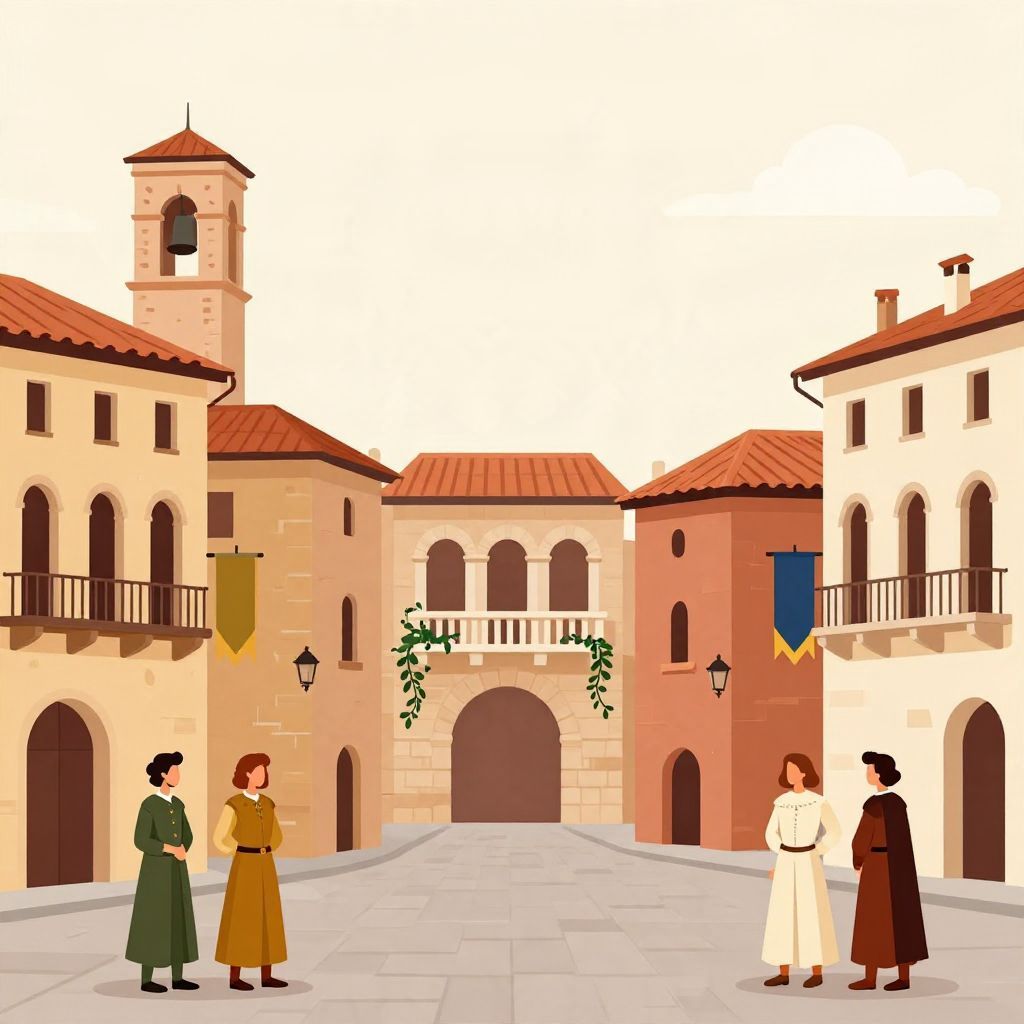
When does Romeo and Juliet take place? Shakespeare sets the tragedy in Renaissance Verona, in a compressed span of just a few days, but he never gives a precise calendar year. The play’s action feels like the late 15th or early 16th century, shaped by Italian city-state politics, dueling culture, and aristocratic family rivalry.
That historical setting matters because it helps explain the speed, violence, and social pressure that drive the story. Although the lovers are fictional, the world around them reflects ideas and customs associated with early modern Italy rather than medieval England.
When Does Romeo and Juliet Take Place?
Romeo and Juliet is set in Verona, Italy, during the Renaissance, probably in the late 1400s or early 1500s. Shakespeare does not name an exact year, and the play is best understood as a dramatic Italian past rather than a carefully dated historical event. The action unfolds over a very short period, roughly four to five days.
The play’s historical setting is approximate, not exact
Unlike a chronicle play based on a specific king or battle, Romeo and Juliet is not anchored to a documented date. Shakespeare drew on an Italian tale that had already circulated in earlier versions, and he used Verona as a believable backdrop for a romance shaped by honor, family feud, and impulsive violence. The result is historically suggestive rather than strictly factual.
Scholars generally place the atmosphere of the play in the Renaissance because of its Italian setting, noble households, street duels, and references to social customs associated with early modern urban life. Still, Shakespeare was writing for an Elizabethan audience in the 1590s, so the play reflects both Renaissance Italy and English theatrical imagination.
The Timeline of the Tragedy
The story moves very quickly. Shakespeare compresses the action into a few intense days, which heightens the sense that youthful passion and family hatred are racing toward disaster. This rapid timeline is one of the play’s most important dramatic features.
A simplified sequence of events
- Day 1: The feud erupts in public, Romeo and Juliet meet at the Capulet feast, and they fall in love.
- Day 2: Romeo and Juliet secretly arrange their marriage with Friar Laurence.
- Day 3: Tybalt kills Mercutio; Romeo kills Tybalt and is banished from Verona.
- Day 4: Juliet is pressured toward marriage with Paris, and Friar Laurence devises the sleeping potion plan.
- Day 5: The potion scheme fails, Romeo believes Juliet is dead, and both lovers die.
This compressed structure is not accidental. Shakespeare uses time itself as a dramatic force. The lovers barely have time to understand their feelings before they are forced into secrecy, marriage, exile, and death. The speed of events makes the tragedy feel inevitable, even though it depends on a series of human choices and misunderstandings.
What Historical Period Does the Play Evoke?
Romeo and Juliet evokes the late medieval to early Renaissance world of northern Italy, especially the kind of urban noble culture associated with city-states such as Verona. The play includes dueling, arranged marriage, family honor, and public violence, all of which fit a society where elite families could wield great influence and private conflict could spill into the streets.
Why Verona matters
Verona gives the story a specific Italian identity. In Shakespeare’s time, Italy was often imagined by English writers as sophisticated, passionate, politically fragmented, and dangerous. That image helped make the setting plausible for a tale of secret marriage, romantic intensity, and fatal vendetta. Verona also had a long literary association with the story before Shakespeare adapted it.
It is important, however, not to confuse literary setting with historical documentation. The play is not a record of one real Verona family feud. Instead, it uses a recognizable Italian backdrop to explore themes that would have resonated with Shakespeare’s audience: the instability of youth, the power of family obligation, and the danger of pride.
Where Did Shakespeare Get the Story?
Shakespeare did not invent the plot from scratch. He adapted earlier European versions of the tale, especially an English poem by Arthur Brooke published in 1562 and a prose version by William Painter in the 1560s. Those works, in turn, drew on earlier Italian stories. The narrative tradition predates Shakespeare by decades and probably reflects a much older blend of romance, moral warning, and tragic love.
From Italian tale to English stage
The story’s movement from Italy to England helps explain why the play feels both foreign and familiar. Shakespeare kept the Italian names and setting, but he sharpened the pace, deepened the emotional conflict, and made the lovers’ relationship more central than in earlier versions. In doing so, he transformed a cautionary tale into one of the most famous tragedies in world literature.
Because the source tradition is literary rather than strictly historical, the question “when does Romeo and Juliet take place?” has two answers. In literary terms, it is set in Renaissance Verona. In theatrical terms, it was written and first performed in Elizabethan England in the 1590s. Those two timeframes are part of the play’s meaning.
How the Time Period Shapes the Story
The setting is not just decorative. The historical world of the play shapes nearly every major event. Social expectations, family honor, and the role of marriage all depend on the values of an aristocratic early modern society. Shakespeare uses that world to show how private love collides with public duty.
Honor culture and violence
In the play, insults can quickly become duels, and duels can become deaths. That reflects a culture in which masculine honor was closely tied to reputation and retaliation. The feud between the Montagues and Capulets is exaggerated for dramatic effect, but it mirrors a real historical concern: elite families and their followers could treat conflict as a matter of status as much as law.
Marriage as family strategy
Juliet’s expected marriage to Paris reflects the importance of marriage as a social and economic alliance. In the world of the play, marriage is not simply a personal choice. It is a family decision, especially for noble households. Juliet’s secret marriage to Romeo therefore becomes not only a romantic act but also a challenge to parental authority and social order.
Religion and secrecy
The presence of Friar Laurence also places the story in a Catholic Italian environment, even though Shakespeare’s England was Protestant. The friar’s role as counselor, mediator, and secret planner fits the play’s setting, but it also gives the tragedy a moral and spiritual dimension. His attempts to solve the conflict through secrecy and timing ultimately fail, showing how fragile human plans can be.
Why the Exact Date Is Unknown
There is no reliable historical evidence that fixes the action of Romeo and Juliet to a particular year. Shakespeare was not writing historical drama in the modern sense. He was adapting a popular story whose power came from emotion, conflict, and fate, not from documentary precision.
What we can say with confidence
- The play is set in Verona, Italy.
- The social world resembles the Renaissance, especially the late 15th or early 16th century.
- The action lasts only a few days.
- Shakespeare wrote the play in the 1590s.
- The story comes from earlier literary sources, not a verified historical event.
So if you are looking for a single date, the honest answer is that there is none. If you are looking for the era, the best answer is Renaissance Italy, imagined through Shakespeare’s late-Elizabethan lens.
Historical Significance of the Play’s Setting
The setting of Romeo and Juliet has lasting significance because it helped define how later audiences imagine “the Renaissance” in drama: elegant, dangerous, emotional, and ruled by family honor. The play also shows how historical atmosphere can be used to explore universal themes without being tied to a single event.
Its Italian setting gave Shakespeare distance from English life, allowing him to dramatize courtship, rebellion, and generational conflict in a way that felt both exotic and recognizable. That blend of specificity and universality is one reason the play has endured. The city of Verona becomes less a literal historical site than a symbolic stage for love and loss.
Bottom Line
Romeo and Juliet takes place in Renaissance Verona, probably in the late 1400s or early 1500s, but the play does not identify an exact year. Its action unfolds over only a few days, and that compressed timeline is central to the tragedy. For more on the ages of the lovers, see how old Romeo and Juliet are and, for the setting itself, where Romeo and Juliet take place.