
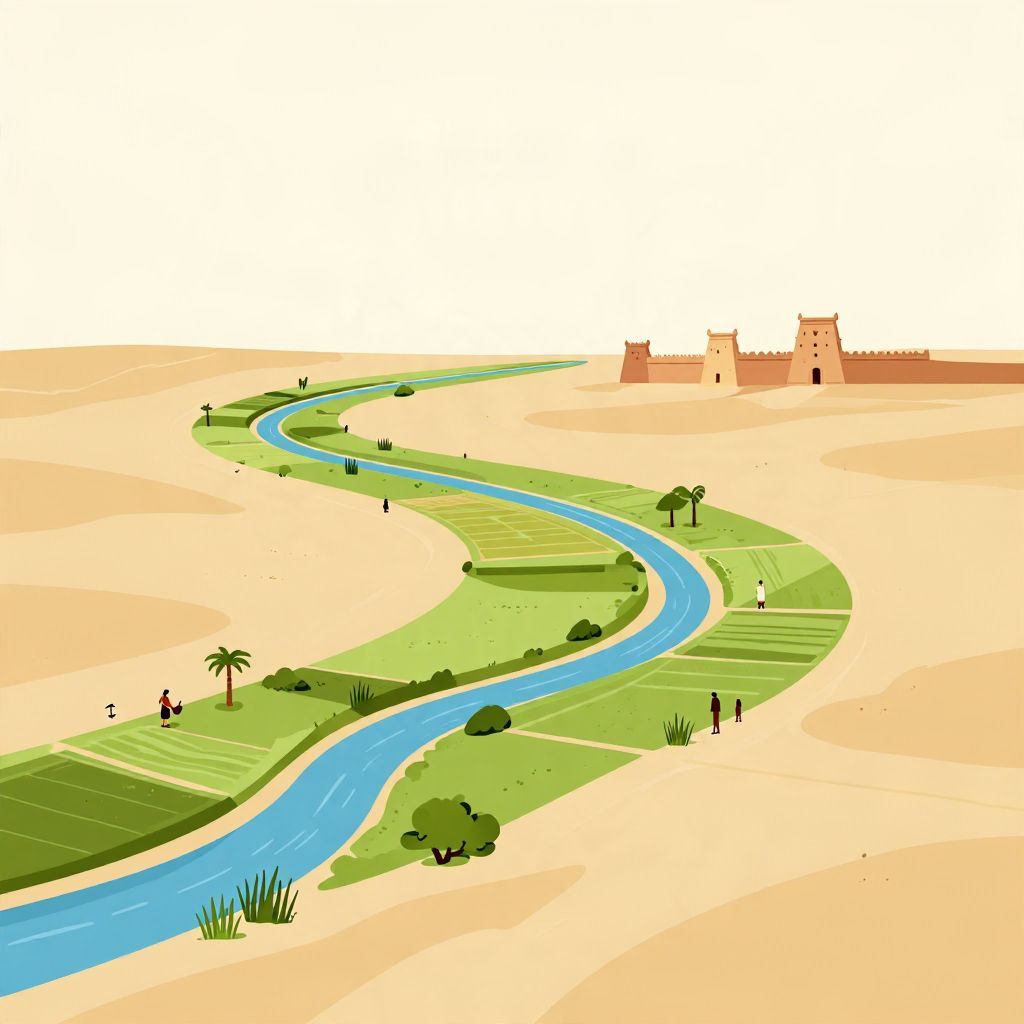
What is the Fertile Crescent? It is the broad, arc-shaped region of the ancient Near East where some of the world’s earliest farming communities, towns, and states emerged. Stretching from the eastern Mediterranean through parts of modern-day Syria, Lebanon, Israel, Palestine, Jordan, Iraq, and southeastern Turkey, it became famous for its rich soils, rivers, and early urban life.
The term is modern, but the region’s historical importance is ancient. It is often called the “cradle of civilization” because early agriculture, writing, cities, law codes, and empires developed there over thousands of years.
What Is the Fertile Crescent?
The Fertile Crescent is a crescent-shaped zone in Southwest Asia where reliable water, fertile floodplains, and varied landscapes supported early agriculture and urban civilization. The phrase was coined in the early 20th century by archaeologist James Henry Breasted. It describes a historical region, not a single political unit or a fixed border.
Where Is the Fertile Crescent Located?
The Fertile Crescent extends from the eastern Mediterranean coast and the Levant into Mesopotamia, especially the valleys of the Tigris and Euphrates rivers. Its exact edges are debated, but it generally includes parts of modern Israel, Palestine, Lebanon, Jordan, Syria, Iraq, and southeastern Turkey, with links to neighboring highlands and river basins.
Main geographic zones
- The Levant — the eastern Mediterranean coast and inland hill country
- Upper Mesopotamia — the northern Tigris-Euphrates region
- Lower Mesopotamia — the southern river plain of modern Iraq
- Adjacent highlands — areas that supplied water, stone, timber, and animals
The region was not uniformly lush. Much of it was semi-arid, and survival depended on seasonal rains, river flooding, irrigation, and careful land use. What made it “fertile” was not endless abundance, but the fact that it offered more dependable conditions for farming than surrounding deserts and steppe lands.
Why Is It Called the Fertile Crescent?
The name refers to the region’s curved shape and its relative agricultural productivity. “Fertile” points to the soils and water sources that made cultivation possible, while “crescent” describes the arc formed by the land from the Levant around northern Mesopotamia. The term is useful, though it can oversimplify a highly varied landscape.
A modern label for an ancient region
Historians and archaeologists use the term as a convenient shorthand, but ancient peoples did not call their homeland the Fertile Crescent. They identified themselves by city, kingdom, language, or local region. In other words, the phrase is a scholarly map term, not an ancient name.
Why Was the Fertile Crescent So Important in History?
The Fertile Crescent mattered because it was one of the earliest places where humans shifted from hunting and gathering to farming. That transition, beginning roughly around 10,000 BCE in several areas, led to permanent settlements, population growth, craft specialization, trade networks, and eventually the first cities and states.
The Neolithic revolution
After the end of the last Ice Age, people in parts of the Fertile Crescent began domesticating plants and animals. Wheat, barley, lentils, peas, sheep, and goats were among the key species associated with early farming in the region. This change did not happen overnight or in one place only; it unfolded over centuries and in multiple communities.
From villages to cities
As farming produced more reliable food supplies, some settlements grew larger and more complex. Villages such as Jericho and later sites in Mesopotamia show how communities developed storage, labor organization, ritual life, and social hierarchy. By the fourth millennium BCE, cities like Uruk had emerged in southern Mesopotamia, marking a major step in urban history.
How Did Civilization Develop in the Fertile Crescent?
Civilization in the Fertile Crescent developed through a long sequence of agricultural innovation, environmental adaptation, trade, and political centralization. Rivers made farming possible, but they also required cooperation for irrigation and flood control. That cooperation encouraged administration, record-keeping, and stronger institutions.
Key developments over time
- Early farming communities appeared in the Neolithic period, especially after about 10,000 BCE.
- Permanent villages grew as people settled near reliable water and cultivated crops.
- Urban centers expanded in Mesopotamia by the fourth millennium BCE.
- Writing systems developed, including cuneiform in Mesopotamia around the late fourth millennium BCE.
- States and empires formed as rulers controlled land, labor, trade, and armies.
These developments were not inevitable, and they were not unique to one ethnic group or one kingdom. Rather, they emerged from many local experiments in agriculture, governance, and exchange across a broad region.
What Civilizations Arose in the Fertile Crescent?
Several major civilizations developed in the Fertile Crescent, especially in Mesopotamia and the Levant. Among the best known are the Sumerians, Akkadians, Babylonians, Assyrians, Canaanites, Phoenicians, and, later, Arameans and Israelites. Each contributed to the region’s political and cultural history in different ways.
Mesopotamia
Mesopotamia, meaning “land between rivers,” was home to some of the earliest city-states. The Sumerians built cities such as Ur, Uruk, and Eridu. Later, the Akkadian Empire under Sargon expanded political control over large parts of the region around the 24th century BCE, though exact dates and details depend on the chronology used.
The Levant
The Levant was a crossroads of trade and migration. Cities and coastal communities there connected inland agriculture with Mediterranean exchange. Phoenician traders later became famous for maritime commerce, while inland kingdoms and tribal groups shaped the political landscape of Syria, Canaan, and surrounding areas.
Later empires
Over time, the Fertile Crescent came under the control of larger empires, including the Assyrians, Babylonians, Persians, Greeks, Romans, and later Islamic caliphates. This long succession of powers shows that the region was not static; it remained central to imperial politics for millennia.
What Made the Fertile Crescent Suitable for Early Farming?
Several environmental factors made the region especially favorable for early agriculture. Seasonal rainfall in some areas supported wild cereals, while river valleys allowed irrigation in drier zones. The region also had diverse ecological zones, which meant people could gather plants, hunt animals, and eventually domesticate both crops and livestock.
Important environmental advantages
- Wild ancestors of crops such as wheat and barley grew naturally in parts of the region
- Rivers and streams supplied water for cultivation
- Varied terrain supported different crops, animals, and settlement patterns
- Trade routes connected inland and coastal communities
Still, the region also posed challenges. Floods could be destructive, rainfall could fail, and irrigation required maintenance. In southern Mesopotamia especially, agricultural success depended on collective labor and careful water management. That need for organization helped shape early states.
What Is the Historical Significance of the Fertile Crescent Today?
The Fertile Crescent is significant because it helps explain how human societies moved toward agriculture, cities, writing, and state power. It is central to the history of the ancient Near East and to the broader story of world civilization. Many later religious, legal, and cultural traditions also have roots in this region.
Religion, law, and culture
The Fertile Crescent was the setting for some of the oldest written legal traditions and for the early histories of Judaism, Christianity, and Islam. It also produced myths, epics, and administrative texts that reveal how ancient people understood kingship, divine authority, and the natural world. The Epic of Gilgamesh, for example, survives from Mesopotamian literary tradition and offers insight into early urban society.
A region of continuity and change
Although empires rose and fell, the Fertile Crescent remained important because of its geography and strategic position. It linked Anatolia, Iran, Arabia, Egypt, and the Mediterranean world. That crossroads role made it a place of exchange, conquest, and cultural blending for thousands of years.
Common Misunderstandings About the Fertile Crescent
One common misunderstanding is that the Fertile Crescent was uniformly fertile. In reality, its productivity varied greatly by location and season. Another is that civilization began there in one sudden leap. In fact, agriculture, towns, and states developed gradually and unevenly across many communities over a long period.
What the term does and does not mean
The Fertile Crescent is best understood as a historical and geographic framework, not a claim that every major ancient innovation started in one perfect zone. Some neighboring regions also played important roles in early human history. The term remains useful because it highlights a cluster of early developments that shaped the ancient world.
Conclusion
The Fertile Crescent is the ancient Near Eastern region where farming, villages, cities, writing, and early states first took shape in lasting ways. Its importance lies not in a simple story of one birthplace of civilization, but in the long interaction of environment, human labor, and cultural innovation. For related ancient history topics, you may also want to explore how Islam spread and what the Dust Bowl was.