
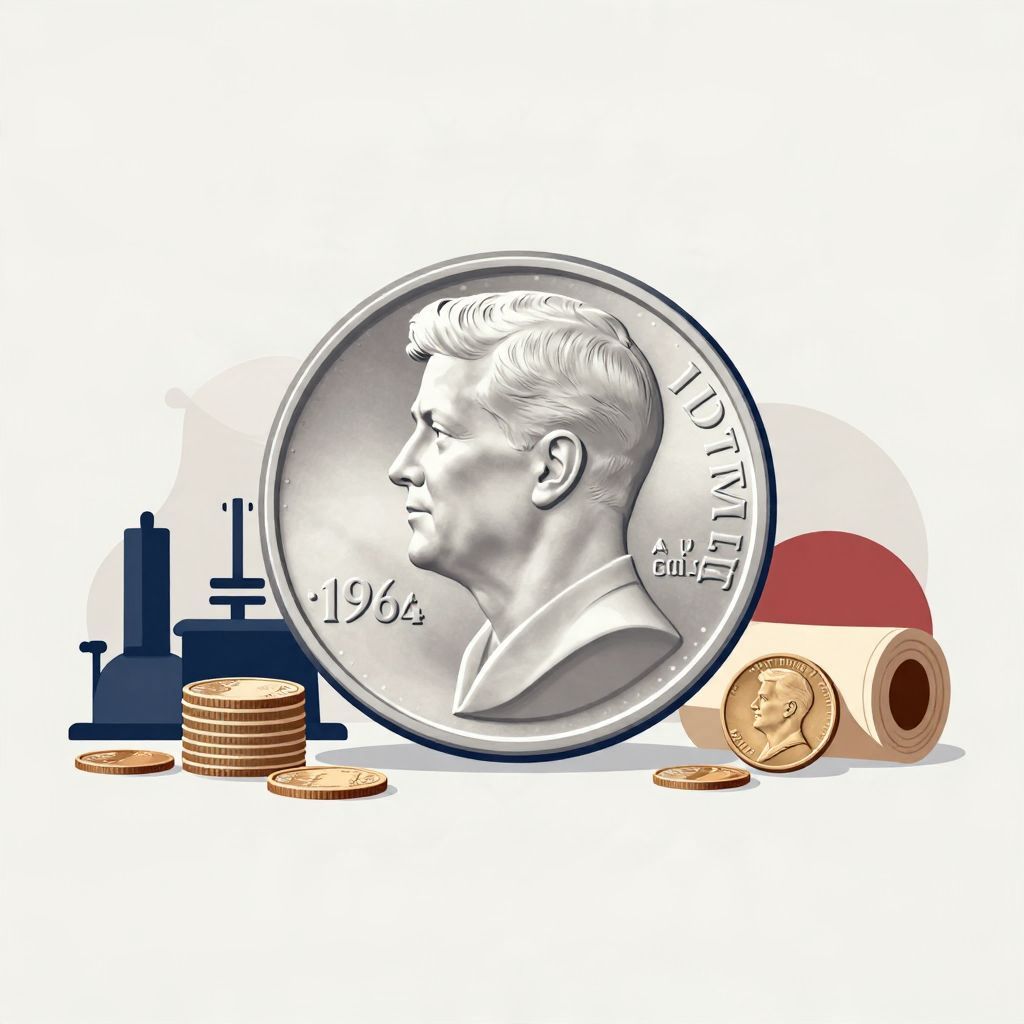
The 1964 Kennedy half dollar is one of the most recognized U.S. coins, and many collectors ask why it is considered rare. The short answer is that it is not rare in the strictest sense by mintage, but certain versions, conditions, and varieties are scarce enough to command strong collector interest.
Its rarity comes from a mix of history, public emotion after President John F. Kennedy’s assassination, the coin’s unique silver content, and the survival of high-grade examples. Understanding those factors helps explain why some 1964 Kennedy half dollars are common while others are genuinely hard to find.
What makes a 1964 Kennedy half dollar rare?
The 1964 Kennedy half dollar is “rare” mainly in special forms: superb uncirculated grades, prooflike pieces, and certain varieties such as the Accented Hair proof. Ordinary circulated examples are common, but coins with exceptional preservation, sharp detail, or unusual mint characteristics are much scarcer and therefore more valuable.
The historical origins of the 1964 Kennedy half dollar
The Kennedy half dollar was created in the immediate aftermath of President Kennedy’s assassination on November 22, 1963. Public mourning was intense, and Congress moved quickly to honor him on a circulating coin. The design was approved in late 1963, and the first coins entered circulation in 1964.
The coin replaced the Franklin half dollar and was struck in 90% silver, continuing the traditional composition of earlier U.S. half dollars. That silver content mattered historically because it made the coin more than a memorial issue: it was also part of the older precious-metal coinage system that was soon to disappear from everyday use.
Why the first year matters
First-year coins often attract special attention because they mark the beginning of a new design type. In the case of the Kennedy half dollar, the emotional significance of the assassination, the speed of the redesign, and the large public demand for souvenirs all helped make the 1964 issue especially famous. Fame, however, is not the same as rarity.
Why 1964 Kennedy half dollars are not all rare
Millions of 1964 Kennedy half dollars were minted, so ordinary examples are not scarce in the broad historical sense. The Philadelphia Mint alone produced a very large number, and the Denver Mint also struck substantial quantities. Because so many were made, circulated pieces in average condition remain relatively easy to obtain.
What creates rarity is not the year alone, but the combination of condition, variety, and collector demand. A worn coin from pocket change is common. A sharply struck, fully lustrous coin with minimal marks is much harder to find. The market often treats those top-end survivors as rare because so few remain in that condition.
Common versus scarce forms
- Circulated 1964 Kennedy half dollars: generally common and widely available.
- Uncirculated examples: less common, especially with strong eye appeal.
- High-grade certified coins: scarce because most coins picked up marks in handling and storage.
- Proof coins: made for collectors, but some varieties are notably scarcer than others.
- Special varieties: certain die or design differences can be rare and highly sought after.
The role of silver and the end of an era
The 1964 Kennedy half dollar was the last regular U.S. half dollar struck in 90% silver for circulation. That fact gives it an important place in monetary history. Soon after, rising silver prices and coin shortages pushed the United States toward reduced-silver coinage and, eventually, clad coinage for the half dollar.
This transition increased collector interest in the 1964 issue because it represents the final chapter of a long silver-coin tradition. Many people saved the coin at the time, which means it survived in large numbers. Yet saving also created a split market: many pieces exist, but truly pristine pieces are much harder to locate because they were handled, stored poorly, or spent repeatedly before collectors recognized their long-term value.
Which 1964 Kennedy half dollar varieties are rare?
Not every 1964 Kennedy half dollar is equally collectible. A few specific varieties and production characteristics are especially important to numismatists. These are the issues most likely to be described as rare in the marketplace.
The Accented Hair proof
One of the best-known varieties is the Accented Hair proof. This early proof design shows more pronounced hair detail above Kennedy’s ear. It is associated with the first proof production of the series and is widely discussed by collectors because it differs from the later, more common proof appearance.
It is important to note that “rare” here does not mean unknown or mythical. Rather, it means that compared with standard proof Kennedy half dollars, the Accented Hair variety is scarcer and more desirable, especially in high grade or with original surfaces.
Special mint state and prooflike pieces
Some 1964 half dollars survive with exceptional luster and near-prooflike surfaces. These are not separate official issues, but they stand out because their appearance is unusually sharp and reflective. Since many coins from this era were handled heavily, examples with clean fields and strong strike quality are much less common.
High-grade certified coins
Modern grading services have shown that the population of top-grade 1964 Kennedy half dollars is limited. A coin may be plentiful at lower grades, yet genuinely scarce at the highest grades because even tiny contact marks reduce its grade. This is one of the main reasons collectors and investors pay premiums for certified gems.
How minting and handling affected survival
The rarity of a 1964 Kennedy half dollar often comes down to what happened after it left the Mint. Half dollars were bulky and less convenient than smaller coins, so many were saved, hoarded, or put aside as keepsakes. At the same time, they were also used in commerce and often picked up scratches and bag marks during transport and storage.
The Mint’s production process also mattered. Coins were struck in large batches, bagged, shipped, and handled in ways that could leave contact marks before they ever reached the public. As a result, a coin may be historically important without being visually exceptional. Collectors tend to prize those that escaped the usual wear and damage.
Why condition matters so much
- Most 1964 halves were saved or used, not preserved carefully.
- Heavy handling reduced the number of pristine survivors.
- Silver coins often toned, spotted, or developed marks in storage.
- Top-grade examples became scarce relative to the total mintage.
Historical significance versus numismatic rarity
Collectors sometimes use “rare” in two different ways. Historically, the 1964 Kennedy half dollar is significant because it reflects national mourning, rapid legislative action, and the final year of 90% silver circulation. Numismatically, however, only certain versions are truly scarce. The distinction matters.
A coin can be historically famous and still be common in the marketplace. The 1964 Kennedy half dollar is a strong example of that pattern. Its story is rooted in one of the most emotional moments in modern American history, but its abundance means that only select pieces rise to the level of rarity collectors usually mean.
How the 1964 Kennedy half dollar became a collector favorite
From the start, the coin was more than pocket change. Many Americans saved it as a memorial to Kennedy, and that emotional connection helped create a large collector base. The coin’s large size, silver content, and presidential portrait also made it visually appealing and easy to recognize.
Over time, the 1964 issue became a cornerstone of modern U.S. coin collecting. Its popularity helped drive demand for mint-state examples, proof varieties, and certified top-population coins. In other words, collector interest itself helped transform some ordinary survivors into sought-after pieces.
Key reasons collectors seek it out
- It was the first Kennedy half dollar issue.
- It contains 90% silver.
- It is tied to a major national tragedy and memorial response.
- It has notable varieties and condition rarities.
- It marks the end of an important era in U.S. coinage.
What to look for if you are evaluating one
If you are trying to judge whether a 1964 Kennedy half dollar is rare, the date alone is only the starting point. Look closely at the coin’s preservation, strike quality, and whether it matches a known variety. A circulated coin is usually not rare, but a pristine proof, a top-grade mint state piece, or an Accented Hair example may be much more desirable.
Because grading and variety attribution can be technical, many collectors rely on third-party certification for higher-value coins. That is especially true for pieces that appear unusually sharp, show unusual proof characteristics, or seem to fit a known scarce subtype.
Conclusion
What makes a 1964 Kennedy half dollar rare is not the year by itself, but the combination of historical importance, special varieties, and scarcity in top condition. Most are common, yet the best-preserved examples and certain proof types stand out as genuinely scarce. For collectors, that blend of history and survival is exactly what makes the coin so enduringly interesting.