
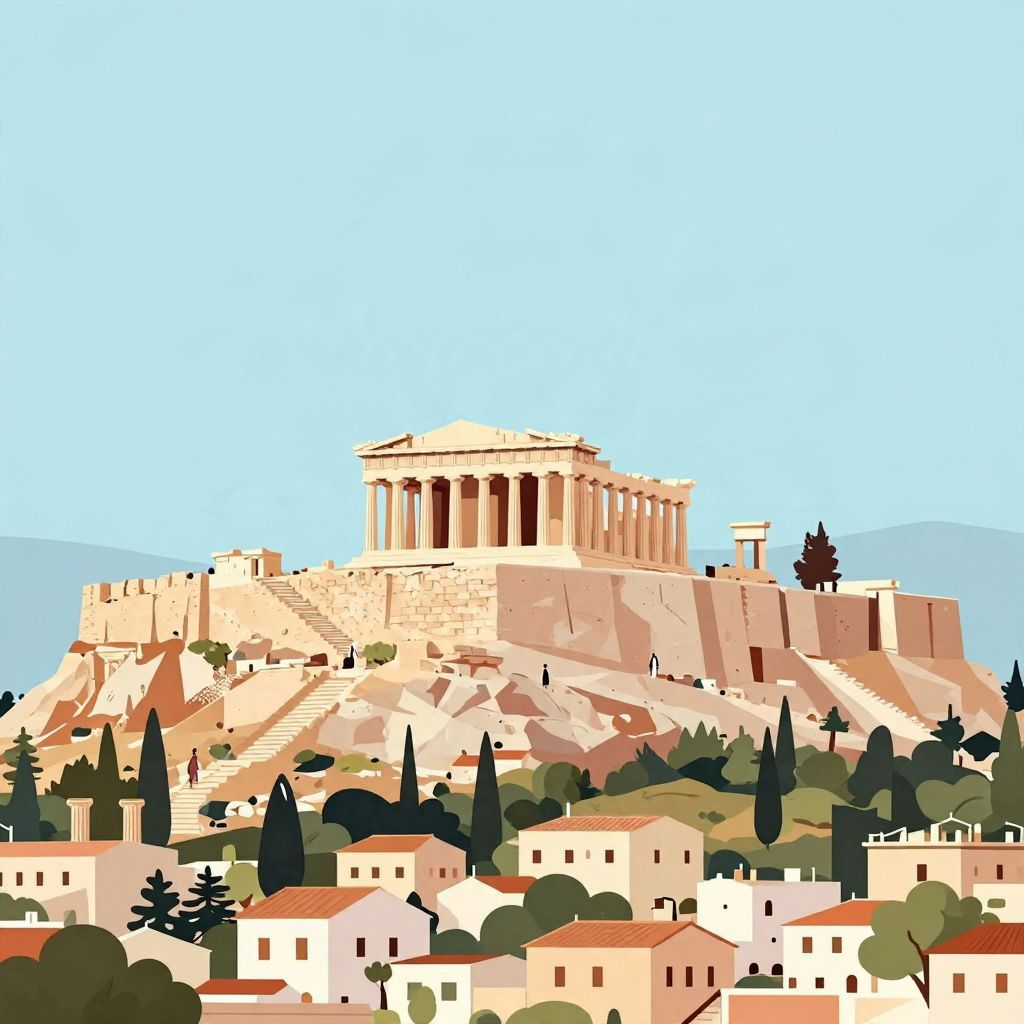
What is the Acropolis? In the simplest sense, it is a high, fortified hilltop in an ancient Greek city. In the most famous case, the Acropolis means the rocky citadel above Athens, crowned by temples that became symbols of classical Greek art, religion, and civic identity.
Its history stretches from prehistoric settlement to ancient sanctuary, from war and rebuilding to modern heritage site. To understand the Acropolis is to understand how the Greeks used sacred space, how Athens rose to power, and why this ancient hill still matters today.
What Is the Acropolis?
The Acropolis is a raised, defensible part of a city, usually the site of important buildings, shrines, and public monuments. The word comes from Greek: akros meaning “highest” and polis meaning “city.” The Acropolis of Athens is the most famous example, but many Greek cities had one.
Origins and Meaning of the Word “Acropolis”
Long before it became a tourist landmark, the Acropolis was a practical and symbolic place. In early Greek communities, a hilltop offered protection in times of danger and a commanding view of the surrounding land. Over time, these elevated spaces also took on religious and political importance.
A fortified high point
In the Bronze Age and early Iron Age, hilltops were often easier to defend than low-lying settlements. Walls, gates, and strong points could be added to protect rulers, temples, or stores of grain and valuables. In other words, the acropolis began as a strategic center before becoming a monumental one.
Why the Acropolis mattered in Greek life
For the ancient Greeks, sacred and civic life were closely linked. A city’s acropolis could hold shrines to local gods, treasuries, and symbols of collective identity. It was not merely a military refuge; it was also a visible statement of a city’s power, piety, and continuity.
The Acropolis of Athens: The Most Famous Example
The Acropolis most people mean today is the Acropolis of Athens, a limestone hill rising above the city. Archaeological evidence shows human activity there from very early times, and by the Mycenaean period, roughly the second millennium BCE, it had already become an important stronghold. Later, it developed into the sacred center of Athens.
From prehistoric fortress to sacred precinct
In the Mycenaean era, the hill likely served as a fortified royal center. After the collapse of Mycenaean palatial society, the site remained significant. By the Archaic period, Athens had turned the Acropolis into a religious landscape, with sanctuaries and offerings dedicated to Athena and other deities.
The rise of Athena’s hill
Athena, the city’s patron goddess, became inseparable from the Acropolis. The Athenians associated the hill with divine protection, civic pride, and the city’s destiny. The famous contest between Athena and Poseidon for patronage of Athens is a myth, not a historical event, but it reflects how deeply the site was tied to identity and local tradition.
The Acropolis in the Classical Age
The Acropolis reached its most famous form in the 5th century BCE, after the Persian Wars. In 480 BCE, Persian forces destroyed many buildings on the hill. Rather than simply restoring what had been lost, the Athenians eventually created a grand new monumental complex that expressed the city’s confidence and imperial power.
Pericles and the building program
Under the leadership of Pericles, Athens undertook an ambitious rebuilding program in the mid-5th century BCE. The result was not just a set of temples, but a carefully designed sacred landscape. The architecture and sculpture of the Acropolis became a showcase for Athenian wealth, artistic skill, and political ambition.
Main monuments on the Acropolis
- The Parthenon — the best-known temple, dedicated to Athena Parthenos, built between 447 and 432 BCE.
- The Propylaea — the monumental gateway that formed the formal entrance to the sacred precinct.
- The Erechtheion — a complex and asymmetrical temple associated with older cults and sacred traditions.
- The Temple of Athena Nike — a smaller temple celebrating victory and divine favor.
- The statues and votive offerings — numerous dedications that filled the sacred space and reinforced communal memory.
Art, religion, and politics together
The Acropolis was never just “architecture.” It was a place where religion, civic pride, and political messaging overlapped. The Parthenon’s sculptural program, for example, has been interpreted as celebrating Athena, Athens, and the order the city believed it brought to the Greek world. Scholars debate details of meaning, but few dispute that the monument was meant to impress.
What the Acropolis Was Used For
The Acropolis served several functions across time. It was a sanctuary, a treasury, a ceremonial center, and in earlier periods a fortress. Its uses changed as Athens changed, but its elevated position always made it a place of visibility and authority.
Religious center
Most importantly, the Acropolis was sacred ground. Festivals, sacrifices, and offerings connected the city to Athena and other divine powers. The Panathenaic festival, one of Athens’ greatest civic celebrations, culminated in rituals linked to the Acropolis and the goddess’s cult.
Symbol of civic identity
The Acropolis also expressed what Athens believed about itself. It was a physical reminder that the city was not only a settlement but a community with shared gods, laws, and history. For citizens, the hill represented continuity across generations; for visitors, it announced Athens’ prestige.
Strategic refuge
Although the Acropolis became increasingly sacred and monumental, its height still made it useful in times of crisis. In earlier periods especially, hilltop fortification offered defense. Even when it was no longer a primary military stronghold, its commanding position retained symbolic power.
Later History: Roman, Byzantine, Ottoman, and Modern Eras
The Acropolis did not freeze in the classical past. It continued to change for nearly two thousand years after the Parthenon was built. Different rulers and religions adapted the site to their own needs, leaving layers of history visible in the ruins today.
Under Rome
During the Roman period, Athens remained culturally important, and the Acropolis continued to be admired. Roman emperors and elites sometimes supported building projects or restorations, though the site’s classical monuments already dominated its appearance. The Acropolis became part of a wider Mediterranean memory of Greek greatness.
Byzantine and medieval transformation
In the Christian Byzantine era, some ancient temples were converted into churches. This was a common pattern across the eastern Mediterranean, where older sacred buildings were reused rather than abandoned. The Acropolis shifted from a pagan sanctuary into a Christian landscape while retaining its central position in the city.
Ottoman period
After the Ottoman conquest, the Acropolis again changed function. The Parthenon was converted into a mosque, and other structures were adapted for military and administrative use. In 1687, during a Venetian bombardment of Athens, the Parthenon suffered catastrophic damage when an explosion inside the building destroyed much of its structure.
Modern Greece and preservation
Following Greek independence in the 19th century, the Acropolis became a national symbol as well as an archaeological site. Restoration and excavation projects aimed to uncover and protect the ancient monuments, though conservation has always involved difficult choices about what to preserve, reconstruct, or leave as ruin.
Myths, Facts, and Misconceptions
Because the Acropolis is so famous, it is often surrounded by simplified stories. Some are rooted in ancient tradition; others are modern assumptions. Separating them helps explain the site more clearly.
Myth versus history
- Myth: The Acropolis was built all at once as a single project. Fact: It developed over centuries, with major phases of construction and destruction.
- Myth: The Parthenon was always a museum-like monument. Fact: It was originally a temple and part of a living religious complex.
- Myth: The Acropolis only matters because of one building. Fact: Its importance comes from the whole sacred and civic landscape.
- Myth: The Acropolis is unique because no other city had one. Fact: Many Greek cities had acropoleis, though Athens is the most famous.
Why the Athens Acropolis stands out
The Acropolis of Athens is exceptional because of the survival, fame, and influence of its monuments. The Parthenon in particular became a global symbol of classical architecture. Yet its fame can obscure the fact that the site was once a living religious center, not merely a ruin to be admired from a distance.
Why the Acropolis Still Matters
The Acropolis matters because it condenses a long history into one place. It shows how ancient Greeks linked landscape, religion, and politics. It reveals the ambitions of classical Athens, the transformations of later empires, and the modern effort to preserve the past. Few sites illustrate continuity and change so clearly.
Today, the Acropolis is both an archaeological monument and a reminder that history is layered. Its stones preserve traces of prehistoric fortification, classical devotion, later conversion, destruction, and restoration. If you want to explore more about the wider world that produced it, you may also enjoy reading about what Greece is known for and what ancient Greeks looked like.