
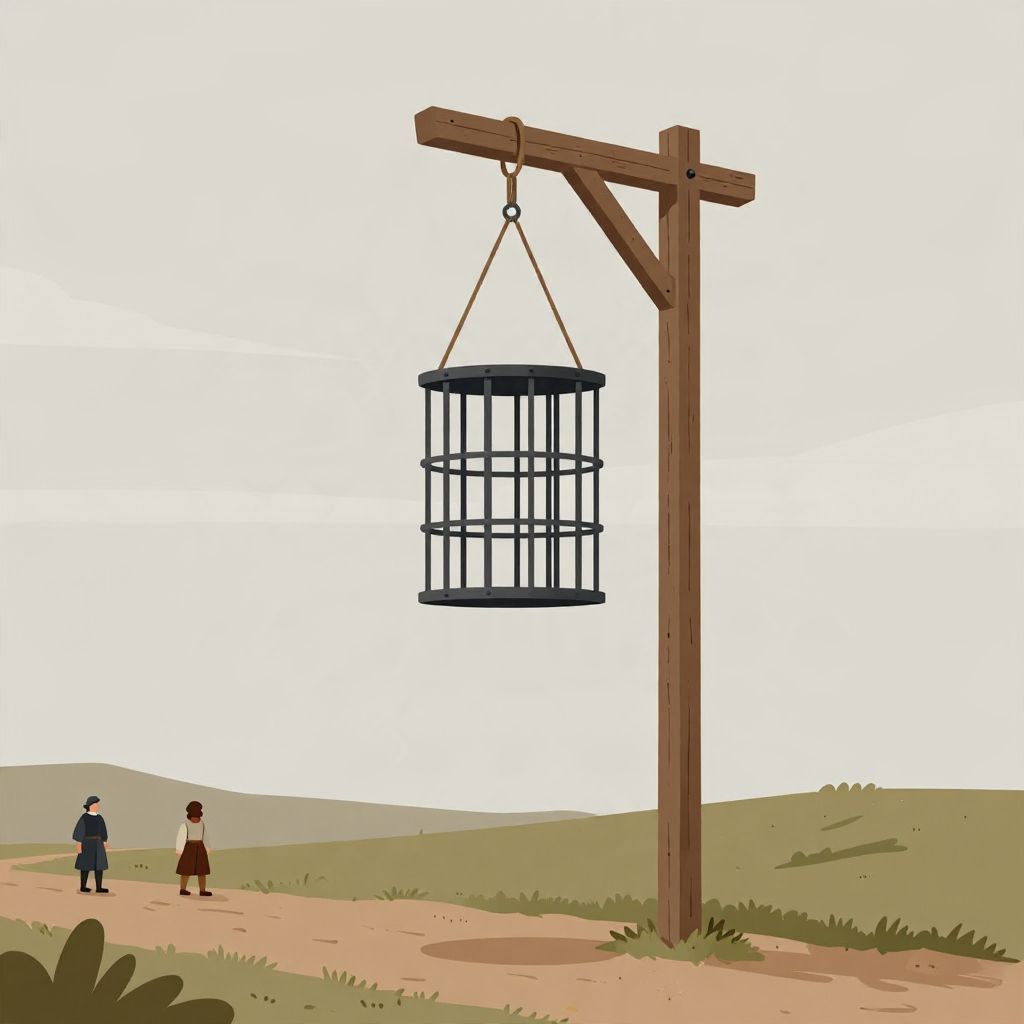
What is a gibbet? In history, a gibbet was a device used to display the bodies of executed criminals, usually in an iron cage or on a wooden frame, as a warning to others. It became especially associated with public punishment in medieval and early modern Europe, though similar practices appeared in different places and periods.
The gibbet was not simply a method of execution. More often, it was a posthumous display meant to shame the condemned, deter crime, and demonstrate the power of the state or local lord. Its history reveals how punishment once relied as much on spectacle and fear as on confinement or rehabilitation.
What is a gibbet?
A gibbet was a structure used to hang or cage the bodies of executed offenders in public view, often at crossroads, roadsides, or hilltops. Unlike the gallows, which could be used to carry out an execution, the gibbet usually served after death as a permanent or long-lasting warning. It was both a punishment and a public message.
Origins and meaning of the word “gibbet”
The word gibbet entered English from Old French, and its deeper roots likely lie in medieval Latin terms for a hanging frame or forked support. Over time, the word came to refer both to the structure itself and, more broadly, to hanging by the neck. In English usage, however, the most distinctive meaning is the display of a corpse in chains or an iron cage.
From execution device to warning sign
In medieval and early modern Europe, public punishment was designed to be seen. Authorities believed that visible suffering could reinforce law, hierarchy, and moral order. A gibbet placed a criminal’s body in the landscape for days, months, or even years, turning the remains into a public lesson.
How were gibbets used historically?
Gibbets were most often used after a person had already been executed, usually by hanging. The body might then be placed in an iron cage or suspended from a wooden frame. In some cases, the entire body was displayed; in others, only the skeleton or remains were left to weather away. The exact practice varied by region and period.
Common locations
- Road junctions, where travelers would see the warning.
- Coastal areas, especially where piracy or smuggling was a concern.
- Town outskirts, keeping the display visible but away from churches and homes.
- Hilltops and marsh edges, where the body could remain exposed for a long time.
Why public display mattered
Before modern policing and prisons became widespread, rulers had limited ways to enforce authority. Public punishment helped project power. A gibbet was meant to frighten would-be offenders, but it also communicated that certain crimes—such as murder, robbery, piracy, or treason—were seen as attacks on the whole social order.
Gibbets in medieval and early modern Europe
Gibbets were used across parts of Europe from the Middle Ages into the eighteenth century, though their form and frequency differed. They were especially associated with English and Scottish legal culture, but similar displays of executed bodies existed elsewhere. The broader tradition belonged to a world in which punishment was public, theatrical, and deeply symbolic.
England and Scotland
In Britain, gibbeting became particularly notorious in the early modern period. Courts could order a criminal’s body to be hung in chains after execution, especially for crimes considered shocking or socially disruptive. The practice was not universal, but it was memorable enough to leave a strong mark on historical memory and literature.
Pirates, smugglers, and highwaymen
Some of the most famous gibbeted bodies were those of pirates and highway robbers. Coastal and roadside displays were intended to warn others who might prey on travelers, merchants, or shipping. Smuggling, in particular, was treated as a serious threat in places where customs duties and state revenue depended on controlling trade.
Gibbet versus gallows: what is the difference?
The gallows and the gibbet are related but not identical. A gallows was the structure used for hanging a living person during execution. A gibbet usually referred to the frame or cage used to display a dead body afterward. In everyday language, the terms were sometimes blurred, but historically the distinction matters.
Simple comparison
- Gallows: used to execute.
- Gibbet: used to display the body after execution.
That said, some historical sources used “gibbet” more loosely to mean any hanging frame. The exact meaning depended on context, region, and period.
Why did governments use gibbets?
Gibbets were part of a wider system of punitive spectacle. In societies without modern prisons, authorities relied on public shame, bodily pain, and visible examples to maintain order. The goal was not only to punish the offender but also to shape the behavior of everyone who saw the display.
Deterrence and intimidation
The logic was simple: if people saw the consequences of crime, they might avoid it. Whether gibbets actually reduced crime is harder to prove. They certainly created fear and reinforced official authority, but they could also provoke disgust, sympathy, or even acts of defiance.
Honor, shame, and social control
In many premodern societies, honor mattered as much as physical punishment. To be denied burial, left exposed to birds and weather, or displayed in chains was a profound disgrace. A gibbet stripped the condemned of dignity and placed them outside the community even after death.
Famous historical examples
Some gibbets became notorious because of the crimes involved or because the display lasted unusually long. Exact details can vary in surviving accounts, but the general pattern is well established in historical records and local memory.
The case of Captain Kidd
The pirate William Kidd, executed in 1701, became associated with gibbeting in later legend and popular retellings. His case reflects the broader fear of piracy in the age of empire and maritime trade. Even where the details are muddled in popular memory, the association shows how strongly gibbets entered the cultural imagination.
Roadside displays in Britain
In Britain, gibbeted criminals were sometimes left in place for years until the body decayed or the structure collapsed. Travelers passing such sites often recorded the sight in diaries, letters, or local folklore. These places could become landmarks, remembered long after the legal purpose had faded.
What did a gibbet look like?
There was no single design. Some gibbets were simple wooden posts with an iron arm or crossbar. Others used iron cages shaped to fit the body, especially the torso. The body was sometimes tarred or wrapped to slow decay, though exposure to weather, animals, and time usually did the work quickly.
Materials and construction
- Wood for the main frame or post.
- Iron chains or cages to suspend the body.
- Ropes or hooks for attachment.
- Raised platforms in some cases, to make the display more visible.
The visual effect was deliberate: the body was meant to be unmistakable, unsettling, and impossible to ignore.
How long were bodies left in gibbets?
There was no fixed rule. Some bodies were removed after a short period, while others remained until they had decayed beyond recognition. In certain cases, bones or remnants were left hanging for years. Weather, birds, insects, and local authorities all affected how long the display lasted.
What happened afterward?
Eventually, remains might be buried, taken down by officials, or destroyed by time. In some places, local people treated gibbet sites with a mixture of fear and fascination. Over time, the physical structure disappeared, but the memory of the punishment could survive in place names, stories, and local tradition.
When did gibbeting decline?
Gibbeting declined as legal systems changed. From the late eighteenth and nineteenth centuries onward, governments increasingly preferred imprisonment, transportation, and more regulated forms of punishment. Sensibilities about decency, public order, and the treatment of the dead also shifted. Public bodily display came to seem less acceptable and less effective.
The rise of prisons and modern penal systems
As states developed more centralized police forces and prison systems, punishment moved behind walls. The public spectacle of the gibbet no longer fit emerging ideas about law, reform, and state authority. By the nineteenth century, it had become rare or obsolete in much of Europe.
Gibbets in memory, folklore, and popular culture
Even after the practice faded, the gibbet remained a powerful symbol. It appears in historical fiction, ghost stories, local legends, and discussions of “old-time” justice. Because it combined death, public shame, and landscape, it left a strong imprint on cultural memory.
Why it still fascinates people
The gibbet captures something unsettling about past punishment: the body itself was used as a public warning. That makes it a vivid reminder that justice in earlier centuries often aimed to terrify as much as to punish. Modern readers may find the practice shocking, but it made sense within the legal and social world that created it.
So, what is a gibbet in historical terms?
Historically, a gibbet was a public display device used to hang the bodies of executed criminals, usually as a deterrent and symbol of authority. It belonged to an era when punishment was visible, communal, and often brutal. Understanding the gibbet helps explain how premodern societies used spectacle to enforce law and order.
For more on related historical terms and social roles, you may also find what is a buccaneer and what is a duchess useful. The gibbet is a stark reminder that history’s legal systems were shaped as much by fear and display as by written law.