
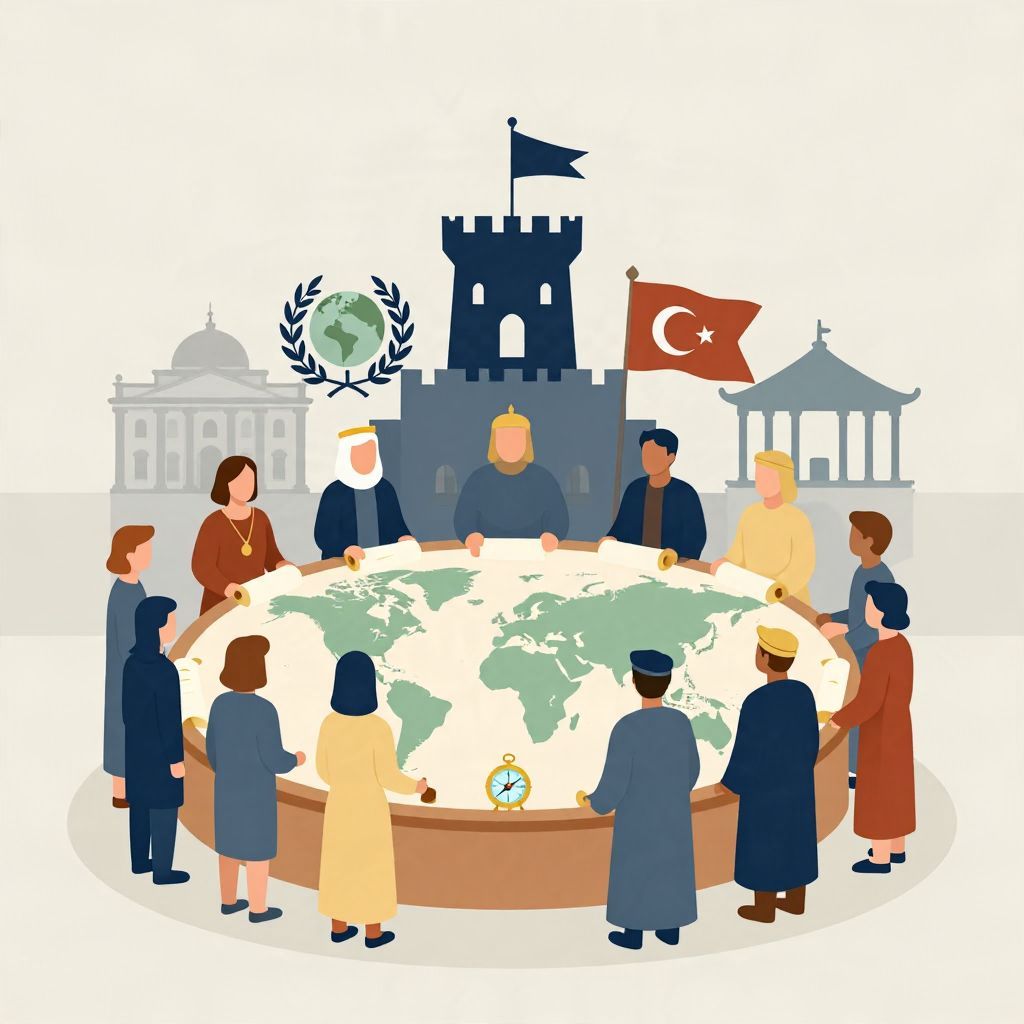
International politics shapes wars, alliances, trade, diplomacy, and the balance of power between states. But what is international politics, exactly, and how did it become such a central part of modern history?
At its simplest, international politics is the study and practice of how countries interact across borders. Its history stretches from ancient empires and dynastic diplomacy to the modern system of sovereign states, global institutions, and international law.
What Is International Politics?
International politics is the way states, rulers, and other global actors pursue power, security, influence, and cooperation beyond their own borders. It includes war and peace, treaties, diplomacy, trade, alliances, empires, and international organizations. Historically, it emerged as a distinct field from the development of the modern state system in Europe, especially after the 17th century.
The Historical Origins of International Politics
International politics did not begin at one single moment. People and states have negotiated, fought, traded, and made alliances for thousands of years. What changed over time was the scale, rules, and institutions governing those relationships. The modern idea of international politics grew out of older patterns of imperial rivalry, diplomatic exchange, and statecraft.
Ancient and medieval roots
Long before modern nation-states, ancient kingdoms and empires practiced forms of international politics. Egypt, Assyria, Persia, China, India, Greece, and Rome all managed relations with neighbors through war, tribute, marriage alliances, envoys, and treaties. The Amarna letters from the 14th century BCE, for example, show rulers corresponding across the eastern Mediterranean in a language of status, gifts, and diplomacy.
In the medieval world, international politics was shaped by religion, dynastic legitimacy, and empire. The Byzantine Empire, the Islamic caliphates, the Holy Roman Empire, and Chinese dynasties all influenced wide regions through diplomacy and military force. Yet these systems were not based on the modern idea that each state had equal legal sovereignty. Authority was often layered, overlapping, and personal rather than strictly territorial.
The rise of the modern state system
The clearest turning point came in early modern Europe, especially after the Peace of Westphalia in 1648, which ended major phases of the Thirty Years’ War. Historians often treat Westphalia as a landmark because it reinforced the idea that rulers had authority within defined territories and that states should not interfere too deeply in one another’s internal affairs. This was not the start of all diplomacy, but it helped shape the modern international order.
From the 17th century onward, European powers increasingly competed through standing armies, overseas expansion, commercial rivalry, and formal diplomacy. These developments linked international politics to colonialism, maritime trade, and the balance of power. As European empires expanded, international politics became global in scope, affecting Africa, Asia, the Americas, and the Pacific.
How International Politics Developed Over Time
The history of international politics is a history of changing rules and expanding scale. It moved from court diplomacy and imperial rivalry to a world of nation-states, world wars, decolonization, and international institutions. Each stage changed how power was exercised and how states understood their interests.
Balance of power and diplomacy in Europe
In the 18th and 19th centuries, European states developed a system often described as the balance of power. No single state should dominate the continent; if one grew too strong, others would form coalitions to restrain it. This logic shaped wars such as the War of the Spanish Succession, the Napoleonic Wars, and later the alliances that formed before World War I.
Diplomacy became more regular and professional during this period. Permanent embassies, foreign ministries, and congresses allowed states to negotiate more systematically. The Congress of Vienna in 1814–1815 is especially important because it attempted to restore stability after Napoleon’s defeat and created a framework for cooperation among major European powers. It did not end conflict, but it influenced international politics for decades.
Empire, colonialism, and global inequality
International politics cannot be understood without empire. European expansion transformed the world by forcing unequal relationships on colonized societies. The British, French, Spanish, Portuguese, Dutch, and later other empires used military conquest, trade monopolies, and administrative rule to control territory and resources. In many regions, local rulers were absorbed into imperial systems or forced into unequal treaties.
This meant that international politics was never only about equal states bargaining with one another. It also involved domination, resistance, and the struggle of colonized peoples for autonomy. Anti-colonial movements in Asia, Africa, and the Middle East eventually reshaped the international order in the 20th century.
The 20th century: world wars and global institutions
The two world wars changed international politics dramatically. World War I exposed the fragility of alliance systems and imperial competition. In response, leaders tried to create a more organized framework for peace through the League of Nations, founded in 1920. The League was an important experiment, but it lacked the power to stop aggression in the 1930s.
World War II led to an even deeper rethinking of international politics. After 1945, the United Nations was created to encourage collective security, diplomacy, and cooperation. New institutions such as the International Monetary Fund and World Bank also linked politics to economics on a global scale. International politics now included not only war and diplomacy but also development, human rights, and reconstruction.
What International Politics Includes Today
Modern international politics is broader than traditional diplomacy between governments. It includes a wide range of actors and issues that cross borders and affect global stability. States remain central, but they are no longer the only important players.
Main actors in international politics
- States — the primary actors, responsible for foreign policy, defense, and treaties.
- International organizations — such as the United Nations, NATO, the European Union, and the World Trade Organization.
- Non-state actors — including multinational corporations, rebel groups, terrorist organizations, and NGOs.
- Individuals — leaders, diplomats, activists, and public figures who can influence events.
Major issues in international politics
International politics now covers security, trade, migration, climate change, nuclear weapons, cyber conflict, public health, and humanitarian crises. These issues are interconnected. For example, war can trigger refugee movements, sanctions can reshape trade, and climate change can intensify competition over resources.
Because of globalization, decisions made in one country often have consequences far beyond its borders. This is one reason international politics remains so important in the modern world: it helps explain why local events can become global crises, and why cooperation is often necessary even among rivals.
Why International Politics Matters in History
International politics matters because it helps explain the making of the modern world. Borders, alliances, empires, wars, and treaties have shaped the lives of ordinary people as much as the decisions of kings, presidents, and diplomats. It is also a field that shows how power works across space, not just within a single country.
Power, sovereignty, and legitimacy
One of the most important historical ideas in international politics is sovereignty—the claim that a state has authority over its own territory and population. Over time, sovereignty became a core principle of international law, but it has often been challenged by imperialism, occupation, intervention, and economic dependence. The history of international politics is partly the history of who gets to decide what happens within a territory.
Cooperation and conflict
International politics is often associated with war, but cooperation is equally important. Treaties, peace conferences, trade agreements, scientific collaboration, and humanitarian aid all show that states frequently need one another. Even during intense rivalry, governments have usually balanced competition with negotiation.
That tension between conflict and cooperation is what makes international politics such a durable historical subject. It is not simply the story of battles or diplomacy, but the larger pattern of how communities and states organize power beyond their borders.
International Politics in Historical Perspective
From ancient diplomacy to modern global governance, international politics has evolved alongside changes in state power, technology, empire, and ideology. Its history shows that the world order is not fixed. It is built, contested, and revised through conflict, negotiation, and changing ideas about authority and justice.
In that sense, international politics is both a subject of history and a force that makes history. To understand it more fully, it also helps to explore related ideas such as political ideology and political engagement, which show how beliefs and participation shape public life at home and abroad.