
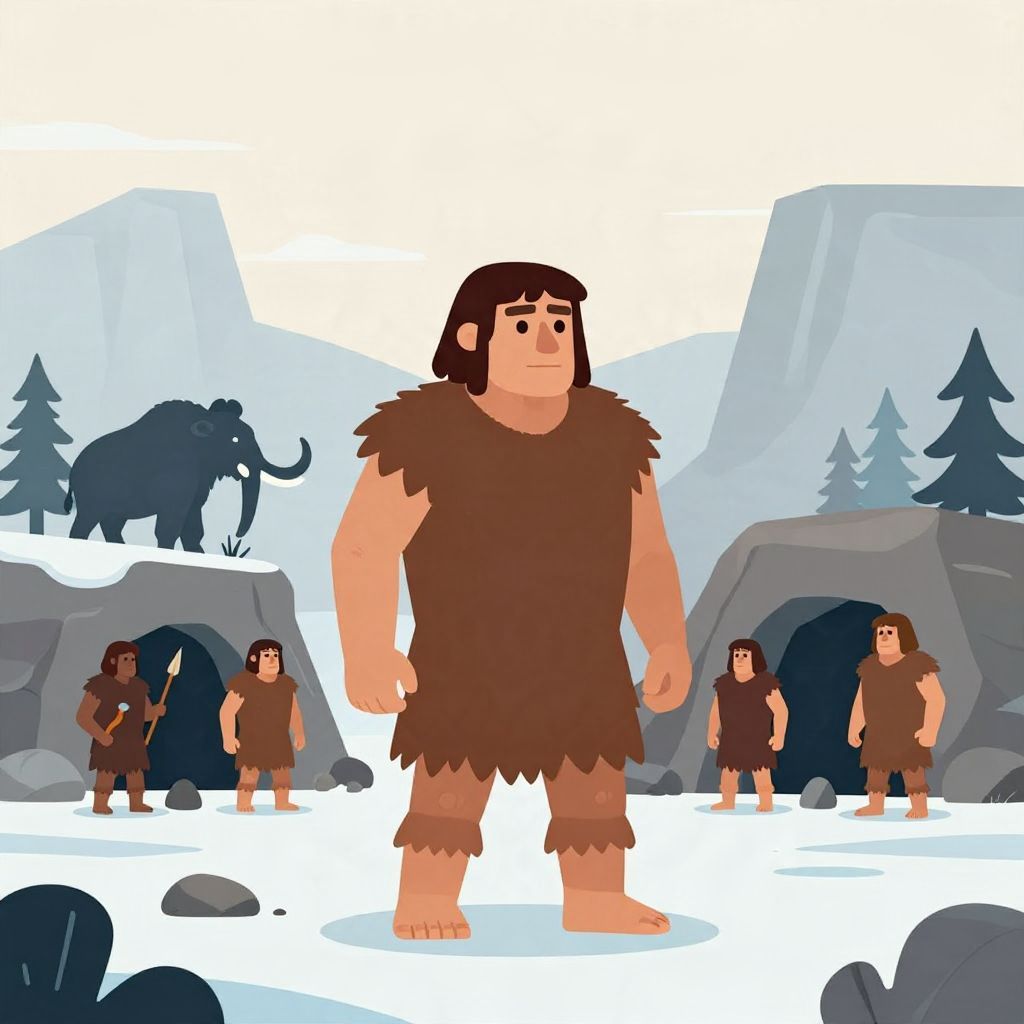
What did Neanderthals look like? They were human relatives with a stocky build, broad chest, strong limbs, heavy brow ridges, and a face adapted to cold climates. They were not “half-apes” or monsters, but a distinct human species, Homo neanderthalensis, closely related to modern humans and capable of toolmaking, hunting, and symbolic behavior.
Because Neanderthals lived across Ice Age Europe and western Asia for hundreds of thousands of years, their appearance varied somewhat by population and time. Still, fossil evidence, ancient DNA, and archaeological finds give a clear picture of their general body form, facial structure, and likely skin, hair, and overall look.
What Did Neanderthals Look Like?
Neanderthals were short, powerful, and heavily built, with long skulls, prominent brow ridges, large noses, and wide faces. Their bodies were adapted for cold, physically demanding environments: broad chests, thick bones, muscular limbs, and relatively short forearms and lower legs. They looked human, but more robust than most modern people.
Overall body shape
Most reconstructions show Neanderthals as compact and muscular rather than tall and slender. Adult males were often around 5 feet 5 inches to 5 feet 7 inches tall on average, though individuals varied, and females were generally shorter. Their average body mass was likely greater than that of early modern humans because of their dense skeletons and stocky proportions.
This build was not accidental. Neanderthals lived through repeated Ice Age conditions in Europe and western Asia, where conserving body heat mattered. A shorter, broader body loses less heat than a tall, narrow one, which helps explain their distinctive shape.
Head and face
Neanderthal skulls are among the most recognizable in human evolution. They had long, low crania, a sloping forehead, and very pronounced brow ridges above the eyes. The back of the skull often projected outward in a shape sometimes described as a “bun,” though that term can oversimplify the anatomy.
Their faces were also unusual. Compared with modern humans, Neanderthals had mid-faces that projected forward, large nasal openings, and wide cheekbones. Their noses were not necessarily “big” in a cartoon sense, but they were broad and prominent, likely helping warm and moisten cold, dry air. Their jaws were strong, and their chins were weak or absent compared with Homo sapiens.
Skin, hair, and eye color
Scientists cannot know the exact appearance of every Neanderthal, but ancient DNA has provided important clues. Some Neanderthals likely had dark hair and darker skin, while others may have had lighter skin or varied pigmentation depending on region and time. Genetic evidence also suggests that some may have had red hair or light eyes, though these traits were probably not universal.
It is best to think of Neanderthal coloring as diverse rather than uniform. Like modern humans, they were a population spread across a wide geographic range over a long period, so appearance likely differed significantly from group to group.
How Do We Know What Neanderthals Looked Like?
Scientists reconstruct Neanderthal appearance from fossils, skeletal measurements, ancient DNA, and comparisons with living humans and other primates. The evidence is strong for bone structure and body proportions, less certain for soft tissues like skin, hair, and eye color. Artistic reconstructions are useful, but they always involve interpretation.
Fossils and skeletal evidence
Neanderthal bones and skulls provide the most reliable information. Hundreds of remains have been found, especially in Europe and the Near East. These fossils show patterns that are consistent across many individuals: robust bones, thick joints, large muscle attachments, and distinctive cranial features.
Because bones preserve well, researchers can estimate height, body mass, chest shape, and muscle strength with reasonable confidence. Skull shape is also well documented. What cannot be measured directly from fossils includes skin tone, hair texture, facial soft tissue, and many details of expression.
Ancient DNA and genetics
Since the early 21st century, ancient DNA has transformed Neanderthal studies. Genetic research has shown that Neanderthals were closely related to modern humans and that many people today outside Africa carry a small amount of Neanderthal ancestry. DNA also helps identify traits related to pigmentation, immunity, and metabolism.
That said, genetics does not give a complete portrait. A gene associated with lighter skin in one context does not mean every Neanderthal looked the same. Appearance was biologically varied, just as it is among living humans.
Artistic reconstructions and their limits
Museum reconstructions often make Neanderthals appear very rugged, with heavy brows, coarse hair, and a stern expression. Some of this is accurate, but older depictions were sometimes exaggerated to make them seem brutish or primitive. Modern reconstructions aim for realism and usually show them as recognizably human, though different from us in face and build.
It is important to separate evidence from imagination. A reconstruction can suggest probable features, but it cannot capture exact hairstyle, complexion, or everyday grooming with certainty.
When and Where Did Neanderthals Live?
Neanderthals emerged in Europe and western Asia during the Middle Pleistocene, probably by around 400,000 years ago, though the evolutionary process that led to them stretches back further. They survived until roughly 40,000 years ago, with some regional populations possibly persisting a little later. Their long timeline helps explain why their appearance was not fixed in one single form.
Origins in Ice Age Eurasia
Neanderthals evolved from earlier human ancestors in a world of shifting climates. Their lineage developed in Europe and neighboring regions, where repeated glacial cycles favored bodies suited to cold and demanding conditions. They were not a side branch that lived briefly and vanished; they were a successful human population that endured for a very long time.
Geographic range
Neanderthal remains have been found from western Europe to the Levant and parts of western Asia. This broad range means they lived in forests, grasslands, mountain valleys, and colder steppe environments. Their bodies likely reflected adaptation to these varied but often harsh settings.
How Neanderthals Compared with Modern Humans
Neanderthals were not simply “less evolved” versions of modern humans. They were a sister group to us, sharing a common ancestor and many anatomical traits. The main differences were in body proportions, skull shape, and some aspects of physiology, not in a simple scale of intelligence or worth.
Key physical differences
- Neanderthals: shorter, stockier, broader-chested, and more heavily built.
- Modern humans: generally taller, more slender, with lighter bones and a higher, rounder skull.
- Neanderthals: prominent brow ridges, sloping foreheads, and mid-face projection.
- Modern humans: smaller brow ridges, flatter faces, and a distinct chin.
These differences were real, but they should not be exaggerated into a false contrast between “primitive” and “advanced.” Neanderthals made sophisticated tools, used fire, hunted large game, and likely cared for injured group members. Their bodies fit their environment and way of life.
Were they more muscular than us?
Probably yes, on average. Their skeletons show strong muscle attachments and thick limb bones. Studies of biomechanics suggest that Neanderthals were adapted for high physical exertion, especially close-range hunting and demanding movement in rugged terrain. That does not mean every Neanderthal was a bodybuilder, only that their species as a whole was powerfully built.
What Did Neanderthals Wear and How Did They Present Themselves?
We do not have Neanderthal clothing preserved in most cases, but archaeological evidence suggests they used animal hides and probably tailored garments for warmth. If so, their appearance would have been shaped not only by anatomy but also by practical Ice Age clothing, footwear, and possibly body decoration.
Clothing and grooming
Neanderthals almost certainly wore some form of hide clothing in colder regions, although the exact style is unknown. They also likely used tools to process skins. Evidence for personal ornaments and pigment use suggests they may have decorated themselves or their belongings, though the extent of such practices is still debated.
So while a bare-skinned reconstruction is useful for studying anatomy, the real Neanderthal appearance in daily life would have included furs, leather, and other material culture.
Expression and behavior
It is easy to imagine Neanderthals as grim or animal-like because of their heavy faces, but that impression is misleading. Facial structure does not determine personality. They were human relatives with social lives, likely capable of communication, cooperation, and emotional expression. Their appearance should be understood as part of a living human species, not a caricature.
Why Neanderthal Appearance Matters Historically
Neanderthal appearance matters because it helps us understand human evolution, adaptation, and diversity. Their bodies show how humans changed in response to climate and environment, while their close relationship to us reminds us that human history is not a straight line from “primitive” to “modern.” It is a branching family tree.
Changing ideas over time
For much of the 19th and 20th centuries, Neanderthals were often portrayed as brutish cavemen. That image reflected both limited evidence and cultural bias. As fossils, archaeology, and genetics improved, the picture changed dramatically. Neanderthals are now understood as intelligent, adaptable humans with a distinctive anatomy rather than a crude evolutionary failure.
What their look tells us about human evolution
Their appearance reveals adaptation to cold climates, physical endurance, and long-term survival in Eurasia. It also shows that human evolution produced multiple kinds of humans at once. Neanderthals were not our ancestors in a direct sense, but they were close relatives who overlapped with Homo sapiens and even interbred with some of our ancestors.
So, What Did Neanderthals Look Like in One Sentence?
Neanderthals looked like robust, cold-adapted humans: short and muscular, with broad faces, heavy brow ridges, large noses, strong jaws, and long skulls, though their exact skin, hair, and eye color varied and cannot be known for every individual.
In the end, the best answer to what Neanderthals looked like is that they were recognizably human, but built for a harsher Ice Age world. If you want to compare their appearance with other ancient peoples, you may also enjoy reading about what Vikings looked like and what ancient Greeks looked like.