
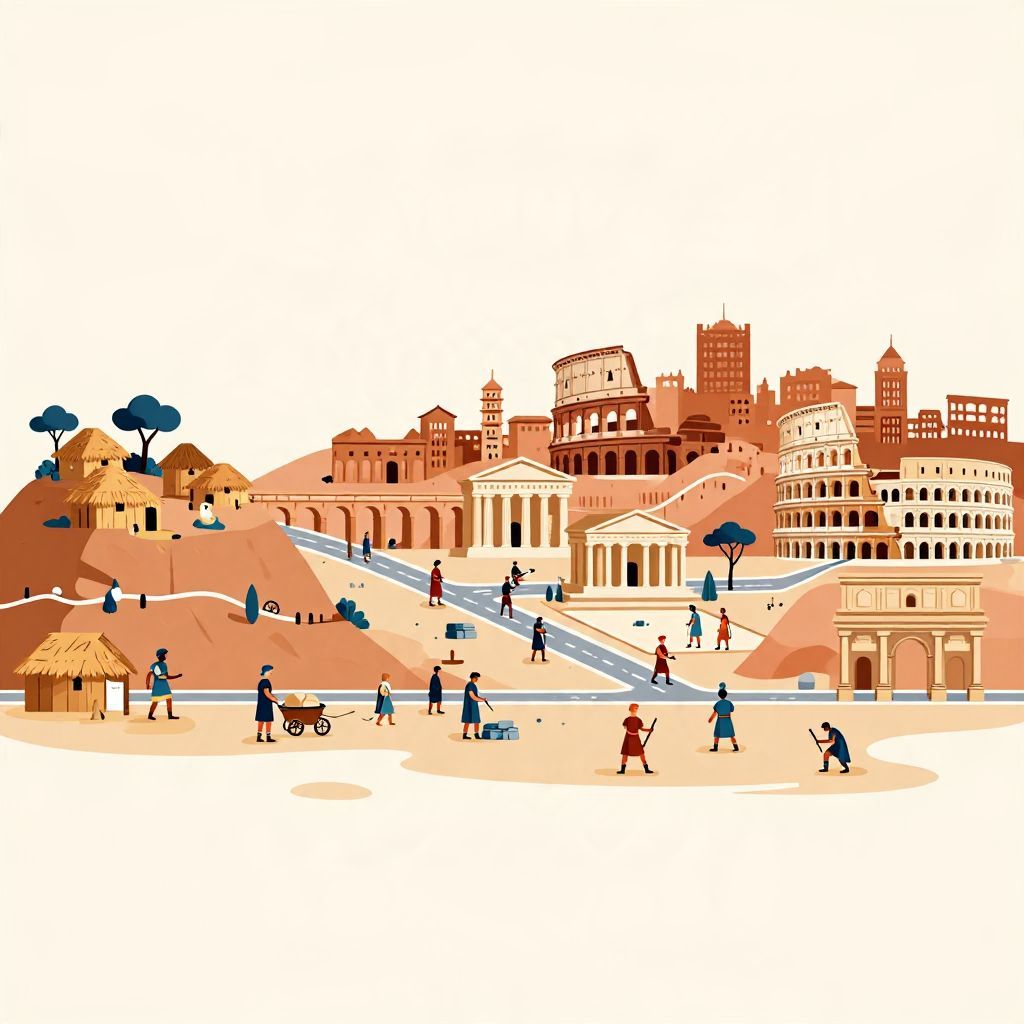
How long did it take to build Rome? The short answer is that Rome was not built all at once. According to Roman tradition, the city was founded in 753 BCE, but its growth into a major urban center took centuries. The earliest settlement formed gradually, while the monumental imperial city people often imagine emerged much later under the Republic and Empire.
So the real historical answer depends on what “Rome” means: a small Iron Age village, a city-state, or the imperial capital. Each stage had its own timeline, and each was shaped by geography, warfare, politics, engineering, and conquest.
How long did it take to build Rome?
Rome took centuries to build. If you mean the city’s legendary foundation, Romans placed that in 753 BCE; if you mean the grand marble-and-brick metropolis of the Empire, that developed over roughly 700 to 1,000 years. Even then, Rome was never “finished” in a single moment.
What “building Rome” really means
The question can mean three different things: the founding of the settlement, the expansion of the city, or the construction of its famous monuments. Historians usually treat Rome as a place that evolved from a cluster of hilltop communities into a powerful city-state and then an imperial capital. That long transformation is the key to understanding the timeline.
1. The legendary foundation: 753 BCE
Roman writers later said Rome was founded by Romulus in 753 BCE. This is a foundation myth, not a verified historical event. Archaeology suggests that people lived on the hills of Rome earlier than that, but the city as a unified political center likely emerged gradually in the 8th and 7th centuries BCE.
2. The early city: a slow merger of settlements
Before Rome became a true city, the area contained scattered villages on hills such as the Palatine, Capitoline, and Esquiline. Over time, these communities merged. Drainage projects, especially in the low-lying valley that later became the Forum, helped create shared public space. This process was slow and practical, not sudden and ceremonial.
3. The Republic and the first major urban expansion
After the monarchy ended around 509 BCE, the Roman Republic expanded Rome’s influence in Italy. As military victories brought wealth, the city grew larger and more organized. Temples, roads, markets, walls, and civic buildings multiplied. In this period, Rome began to look like the center of a rising state rather than a cluster of villages.
4. The imperial city: centuries of monumental construction
The Rome familiar from films and ruins—the city of forums, baths, amphitheaters, aqueducts, and palaces—was built largely under the Republic’s later centuries and the Empire, especially from the 1st century BCE through the 2nd century CE. Emperors such as Augustus, Nero, Trajan, Hadrian, and others reshaped the city with massive public works.
The timeline of Rome’s growth
Rome’s development is best understood as a sequence of long phases rather than a single building project. The city’s physical form changed repeatedly as its population, political power, and resources increased. Here is a simplified chronology:
- Before 753 BCE: Small settlements and hill communities existed in the area.
- c. 8th–7th centuries BCE: Villages began to coalesce into a more unified settlement.
- 6th century BCE: Early civic and religious structures appeared; Rome became more urbanized.
- 509 BCE onward: The Republic encouraged expansion, administration, and public architecture.
- 3rd–1st centuries BCE: Conquest of Italy and the Mediterranean brought wealth and new construction.
- 1st century BCE–2nd century CE: The imperial capital reached its greatest monumental scale.
- Later antiquity: The city continued changing, declining in some areas and being rebuilt in others.
Why Rome took so long to build
Rome took centuries to build because ancient cities were not planned and completed the way modern projects are. They grew through accumulation. Each generation added walls, roads, temples, houses, sewers, and public spaces. Political change, war, fire, and rebuilding also constantly altered the city’s shape.
Geography helped and complicated growth
Rome’s location on the Tiber River was strategic. It offered access to trade, water, and inland routes, while the hills provided defense. But the terrain also required engineering. Low areas had to be drained, roads had to be laid across uneven ground, and the city had to adapt to flooding and expansion.
War and conquest funded construction
Rome’s rise as a military power brought spoils, tribute, slaves, and taxes. These resources financed public works. After victories in Italy, against Carthage, and across the Mediterranean, Roman leaders could sponsor temples, basilicas, aqueducts, and forums. In this sense, Rome was built not just by labor, but by empire.
Fire, decay, and rebuilding were constant
Rome was repeatedly damaged by fires, neglect, and political turmoil. Wooden housing in crowded districts was especially vulnerable. Even famous monuments were repaired, rebuilt, or repurposed over time. So the city was never a finished object; it was a living urban landscape under continual reconstruction.
When did Rome become the “eternal city”?
The idea of Rome as an eternal city is symbolic rather than literal. By the late Republic and early Empire, Rome had already become the largest and most influential city in the western Mediterranean world. Its monumental core was especially impressive by the reign of Augustus and continued to expand under later emperors.
Augustus and the transformation of Rome
Augustus ruled from 27 BCE to 14 CE and famously claimed to have found Rome a city of brick and left it a city of marble. The statement is partly political propaganda, but it reflects a real transformation. Under Augustus and his successors, Rome gained new temples, forums, monuments, and administrative spaces that projected imperial power.
The city at its height
By the 2nd century CE, Rome had reached its greatest urban scale. Estimates of population vary widely, but it was clearly one of the largest cities in the ancient world. Aqueducts supplied water, roads connected the empire, and public buildings displayed Roman wealth and organization. This was the result of many centuries of layered development.
What archaeology says about early Rome
Archaeology supports the idea that Rome began as a gradual settlement rather than a city founded in a single year. Evidence from huts, burials, pottery, and fortifications points to occupation on the hills well before the traditional date. The famous foundation story survives because Romans valued origin myths, not because it is historically certain.
Myth and history together
The Romulus and Remus story helped Romans explain their origins, values, and institutions. It gave the city a heroic beginning and linked its identity to divine favor and conflict. Historians, however, separate this mythic tradition from the slower archaeological reality of urban formation.
So, how long did it take to build Rome in practical terms?
If you ask how long it took to create Rome as a city, the answer is roughly several centuries from early settlement to major urban center. If you ask how long it took to build the imperial city with its famous monuments, the answer is even longer: Rome was constructed, expanded, damaged, and rebuilt across nearly a millennium.
A simple way to think about it
- Founding tradition: 753 BCE
- Early urban formation: 8th–6th centuries BCE
- Major expansion: 5th–1st centuries BCE
- Imperial monumentality: 1st century BCE–2nd century CE
Why the question matters
Asking how long it took to build Rome reveals something important about ancient history: great cities are not made overnight. They emerge from layered decisions, conflicts, and investments over generations. Rome’s power came from that long process of growth, adaptation, and reinvention.
In the end, Rome was not “built” in a single period at all. It began as a small settlement, became a republic, and then developed into an imperial capital over many centuries. If you want to explore Rome’s broader world, you may also enjoy reading about how old the Colosseum is and what language the Romans spoke.