
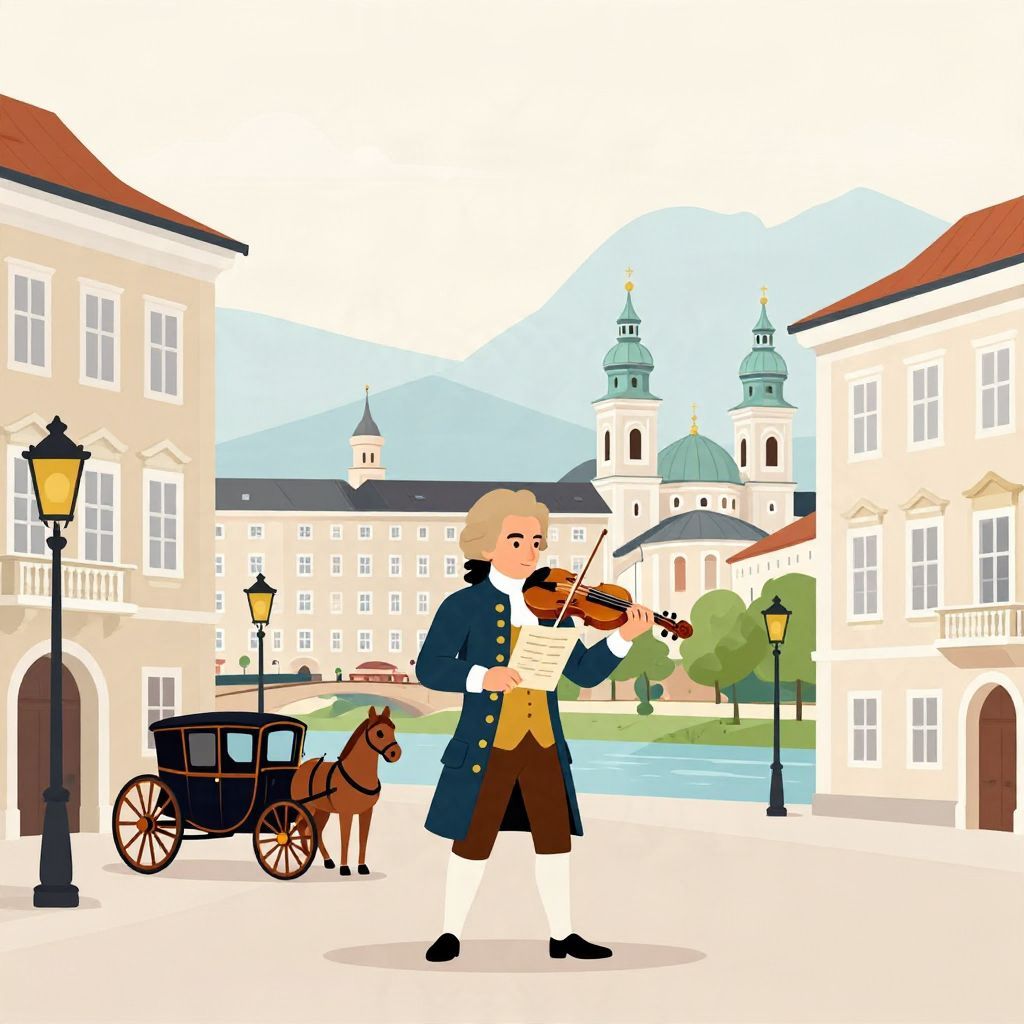
Where is Mozart from? The short answer is that Wolfgang Amadeus Mozart was born in Salzburg in 1756, a city that is now in modern-day Austria. At the time, Salzburg was not part of the modern Austrian republic but the capital of the Prince-Archbishopric of Salzburg, a church-ruled state within the Holy Roman Empire.
That makes Mozart’s origin both simple and historically layered: he was a Salzburg native, born into a German-speaking Central European world that was politically fragmented and culturally interconnected. Understanding where Mozart was from means looking at both the city of his birth and the changing map of eighteenth-century Europe.
Where Is Mozart From?
Mozart was born in Salzburg on January 27, 1756. Today Salzburg is in Austria, but in Mozart’s lifetime it was the seat of an ecclesiastical principality in the Holy Roman Empire. He is therefore best described as from Salzburg, in what is now Austria, with a cultural background shaped by the German-speaking lands of Central Europe.
Salzburg in Mozart’s Lifetime
In the mid-1700s, Salzburg was not a province of a modern nation-state. It was governed by a prince-archbishop, meaning a church leader who also held secular power. This political arrangement was common in the Holy Roman Empire, a loose collection of territories that included kingdoms, duchies, bishoprics, and free cities. Mozart grew up in this world of small states, court patronage, and intense local identity.
Because of that, saying Mozart was “Austrian” can be true in a modern geographic sense, but it needs context. The modern country of Austria did not exist in its present form in 1756. Salzburg’s later history also matters: it became part of the Habsburg lands only after Mozart’s birth, and much later part of the modern Austrian state.
What Was Salzburg Like in the 18th Century?
Salzburg was a compact but important cultural center. Its wealth came from trade, administration, and the long-standing importance of salt, which gave the city its name. The court of the archbishop supported musicians, composers, and performers, creating the kind of environment in which a gifted child like Mozart could be noticed early.
A Musical City with Court Patronage
Mozart’s father, Leopold Mozart, worked in Salzburg’s musical establishment. He was a violinist, composer, and teacher employed by the archbishop’s court. This gave young Wolfgang access to training, instruments, and professional networks that were essential for his development. Salzburg was not the largest musical capital in Europe, but it was a serious one, and it provided the foundation for Mozart’s early career.
The city’s religious and political culture also shaped daily life. Court ceremonies, church music, and formal patronage mattered greatly. Mozart’s earliest compositions were written for this environment, even though his later fame would come from traveling far beyond Salzburg.
Was Mozart Austrian or German?
The question of whether Mozart was Austrian or German depends on what is meant by those words. In Mozart’s own time, modern national identities were still developing. He was born in Salzburg, which is now in Austria, and he wrote in the German language. He is often called an Austrian composer today, but he was not “Austrian” in the modern national sense because Austria as a nation-state did not yet exist.
Why the Label Is Complicated
During the 18th century, people usually identified themselves by city, territory, ruler, religion, or estate rather than by modern nationality. Mozart’s world was shaped by the Holy Roman Empire, where political borders were complex and overlapping. He moved among Salzburg, Vienna, Munich, Prague, and other German-speaking centers, which is why both Austrian and broader German cultural traditions claim him.
Scholars generally avoid forcing a modern national label onto Mozart. The most precise answer is historical rather than nationalist: he was a Salzburg-born composer from the German-speaking lands of Central Europe, later associated with Vienna and the Habsburg world.
Mozart’s Early Life in Salzburg
Mozart’s Salzburg origins are not just a birthplace detail; they shaped his early education and musical path. He was born into a household already deeply involved in music, and his extraordinary talent was recognized when he was still a child. His father taught him, managed his early performances, and took him on tours across Europe.
Family Background
Wolfgang Amadeus Mozart was born to Leopold Mozart and Anna Maria Mozart. His family lived in Salzburg, where Leopold served at the archbishop’s court. This position gave the family a respectable but not luxurious place in society. Mozart’s upbringing was therefore a mixture of local court culture, disciplined training, and exposure to wider European music through travel.
His sister Maria Anna, known as Nannerl, was also musically talented. The family’s early performances helped establish Mozart as a child prodigy. Even so, his roots remained in Salzburg, and the city continued to matter throughout his life, both as a home base and as a place he eventually found restrictive.
How Mozart’s Origin Affected His Career
Mozart’s Salzburg background helped launch his career, but it also limited him. Court employment offered stability, yet it could be restrictive for a composer who wanted greater artistic freedom. This tension between provincial court service and broader European ambition became a recurring theme in his life.
From Salzburg to Vienna
As an adult, Mozart increasingly sought opportunities beyond Salzburg. He traveled widely and eventually settled in Vienna, where he built the career for which he is best known. Vienna offered a larger musical market, more patrons, and greater artistic independence than Salzburg could provide. Still, his Salzburg origins remained central to his identity and biography.
His move to Vienna did not erase his birthplace. Instead, it shows how a composer from a relatively small ecclesiastical state could become a major figure in European culture. Salzburg gave Mozart his start; Vienna gave him his widest audience.
Why People Ask “Where Is Mozart From?”
People often ask where Mozart is from because his name is associated with several places: Salzburg, Vienna, Austria, and sometimes Germany. The confusion is understandable. Mozart lived in a period before modern national borders stabilized, and his career crossed many political and cultural boundaries.
Birthplace, Identity, and Legacy
There are three useful ways to answer the question:
- Birthplace: Salzburg
- Modern country: Austria
- Historical context: the Prince-Archbishopric of Salzburg in the Holy Roman Empire
Each answer is correct in a different sense. If the question is about geography, Salzburg is the key location. If it is about modern maps, Austria is the answer. If it is about history, the political reality of the Holy Roman Empire matters most.
Salzburg’s Place in Mozart’s Legacy
Today Salzburg celebrates Mozart as one of its most famous sons. The city’s identity is closely tied to his memory, and visitors often encounter museums, concert halls, and commemorative sites associated with him. That modern association should not be mistaken for the exact political reality of his lifetime, but it does show how strongly Mozart remains linked to his birthplace.
Mozart’s origin also helps explain the broader cultural history of Central Europe. He emerged from a small court city, trained in a German-speaking musical tradition, and rose to international fame through travel, patronage, and extraordinary talent. His life reflects the mobility and complexity of eighteenth-century Europe.
So, where is Mozart from? He was born in Salzburg, in what is now Austria, when it was the capital of a church-ruled state within the Holy Roman Empire. That is the most historically accurate answer, and it captures both his birthplace and the world that shaped him. For related context, you may also want to read about what Germany is known for and where Prussia was.