
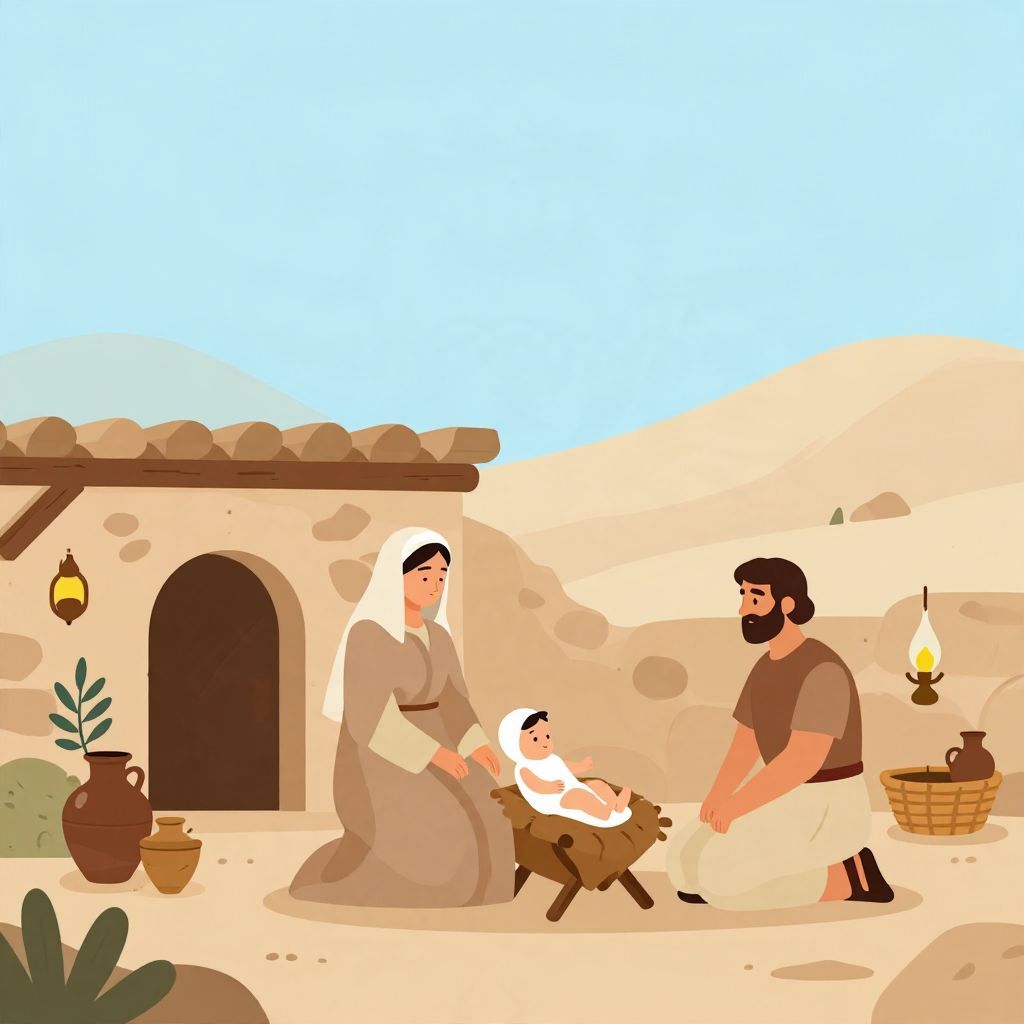
How old was Mary when Jesus was born? It is one of the most common questions people ask about the Nativity, but history cannot give a certain age. The Bible does not state Mary’s age, and the earliest Christian sources are silent on the point. Most estimates are based on what is known about marriage and girlhood in first-century Judea.
In other words, any exact number is a later reconstruction, not a documented fact. Still, historians can explain what is plausible, why many people assume Mary was young, and how the story fits the social world of the ancient Mediterranean.
How old was Mary when Jesus was born?
Mary’s exact age is unknown. A cautious historical estimate is that she was likely a teenager, probably somewhere in the mid-teens, though some traditions and modern readers imagine her as older. The Bible gives no age, and no early source provides a reliable number.
What the historical evidence actually says
The Bible does not give Mary’s age
The New Testament tells the story of Mary’s betrothal, pregnancy, and Jesus’ birth, but it never says how old she was. The Gospels of Matthew and Luke focus on theology and meaning, not biographical detail. That means any specific age is inferred from context rather than recorded directly.
Later traditions are not the same as historical proof
Over time, Christian tradition filled in many details about Mary’s life that the earliest texts do not provide. Some later writings and devotional traditions portray her as very young, while others emphasize her maturity and faith. These traditions are important for religious history, but they should not be mistaken for contemporary evidence.
Why many historians think Mary was probably young
Marriage customs in first-century Judea
In the Jewish world of Mary’s time, girls were often betrothed at a young age, sometimes soon after puberty. Betrothal was not the same as modern engagement; it was a legally binding stage that usually led to marriage later. Because of this social pattern, historians often think Mary may have been in her early to mid-teens when Jesus was conceived and born.
Life expectancy and family formation
People in the ancient world often married earlier than they do today, partly because social and economic life worked differently. That does not mean everyone married as soon as they became adolescents, but it does make a teenage Mary historically plausible. At the same time, life expectancy at birth was low largely because of infant mortality, so it should not be used simplistically to claim that everyone lived or married very young.
Why “about 14” is often mentioned
You may hear that Mary was about 14 years old. That figure is not a documented fact; it is a common estimate shaped by knowledge of ancient marriage patterns and later Christian imagination. It is possible, but it cannot be proven. A responsible historical answer is therefore “probably a teenager,” not “definitely 14.”
What the Nativity story suggests about Mary’s situation
Betrothal to Joseph
The Gospels say Mary was betrothed to Joseph when the angelic announcement came to her. In the ancient Jewish setting, betrothal carried serious social and legal obligations. This helps explain why the story presents Mary as a young woman entering adult family life, not as a child in the modern sense.
Pregnancy before marriage and its social risk
Mary’s pregnancy before the completion of marriage would have created real social tension in her community. That tension is part of why the Nativity narrative has such dramatic force. The story assumes a world in which family honor, legal status, and public reputation mattered deeply.
How historians approach the question
Separating history from devotion
Historians ask what can be established from sources and what belongs to later belief. For Mary’s age, the evidence is thin. That means the best answer is probabilistic rather than exact. Devotional traditions may picture Mary as especially youthful to highlight purity and obedience, but those images reflect theology and art as much as history.
Why certainty is impossible
The historical record for ordinary women in the Roman province of Judea is limited. Mary herself was not a political ruler or elite figure whose life would have been recorded in detail. Most women of her social class left no independent written record. As a result, historians must rely on the broader cultural setting rather than on a direct statement about her age.
Mary’s age in Christian tradition and art
Early Christianity and later imagination
As Christianity developed, Mary became one of its most important figures. Artists, preachers, and writers often portrayed her as very young, especially in scenes of the Annunciation and Nativity. This was not necessarily meant as a historical claim; it often served symbolic purposes, such as emphasizing innocence, humility, or divine favor.
The difference between symbol and biography
Religious art frequently communicates meaning through age, posture, clothing, and expression. A youthful Mary can symbolize purity and new beginnings. But symbolic youth is not the same as documentary evidence. When asking “How old was Mary when Jesus was born,” it is important to distinguish the image of Mary in tradition from Mary as a historical person in first-century Judea.
A simple historical timeline of Mary and Jesus
- Before Jesus’ birth: Mary is described as betrothed to Joseph in Nazareth.
- Annunciation: According to Luke, Mary receives the message that she will bear Jesus.
- Pregnancy and travel: The Nativity traditions place Mary in Bethlehem at the time of Jesus’ birth.
- Jesus’ early life: The family later returns to Nazareth, where Jesus grows up.
This timeline matters because it shows that Mary’s age is not the main point of the Gospel narratives. The writers were more interested in the meaning of Jesus’ birth than in precise demographic details.
What can be said with confidence?
- Mary’s exact age is not recorded in the New Testament.
- There is no universally accepted historical proof for a specific number.
- Most historians think she was likely young, probably a teenager.
- Claims that she was exactly 14 are speculative, not certain.
- Later traditions and artworks shaped popular ideas about her age.
Why this question still matters
People keep asking Mary’s age because it affects how they picture the Nativity story. Was she a child, a young bride, or a mature woman? The historical answer is that we do not know exactly, but the social world of ancient Judea makes a teenage Mary plausible. That gives the story historical context without pretending to have evidence that does not exist.
So, the best answer to how old Mary was when Jesus was born is: probably a teenager, but not certainly known. The Bible does not say, and later tradition cannot replace direct evidence. If you want to explore more biblical history, you may also find where Jesus lived and what a eunuch was in the Bible useful for broader context.