
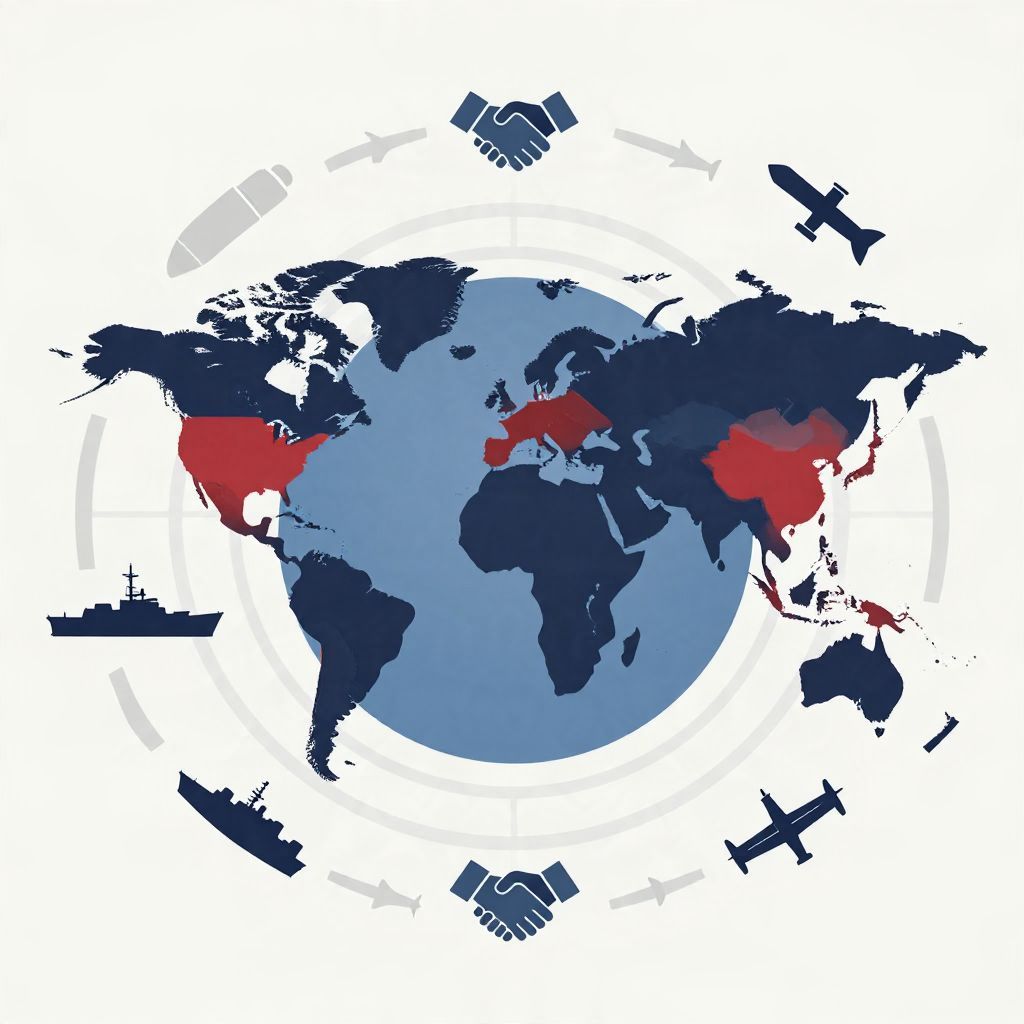
“When is WW3?” is a question people ask during periods of global tension, but history cannot give a date for a war that has not happened. World War III is not a scheduled event; it is a label historians and commentators use for a hypothetical future conflict that would be large enough, and international enough, to deserve comparison with the first two world wars.
The better historical question is why people keep expecting one. That answer lies in the twentieth century: the scale of industrial warfare, the rise of nuclear weapons, alliance systems, and the recurring fear that regional crises could widen into a global catastrophe.
When is WW3? There is no historical date for it
There is no established date for World War III because it has not occurred. The term refers to a possible future war, not a confirmed historical event. In historical writing, it is used cautiously to describe a hypothetical conflict that would involve multiple great powers, large-scale military mobilization, and worldwide consequences.
That means any answer to “when is WW3” must be framed honestly: no historian can predict the future with certainty. What history can do is explain the conditions that make people fear a third world war, and why the idea became so powerful after 1945.
Where the idea of World War III came from
The phrase emerged in the aftermath of World War II, when many people believed that another major war could be even more destructive than the first two. After 1945, the Cold War created a world divided between rival blocs led by the United States and the Soviet Union. Because both sides possessed massive conventional armies and, later, nuclear weapons, the possibility of a third world war became a constant public fear.
From total war to nuclear danger
World War I and World War II were “total wars,” meaning they involved entire societies, not just armies. Industry, propaganda, rationing, civilian labor, and mass casualties all became part of warfare. After 1945, the development of atomic weapons changed the meaning of global war again. A third world war was imagined not simply as another large conflict, but as a conflict that could threaten civilization itself.
The Cold War made the term familiar
During the Cold War, politicians, journalists, and ordinary citizens used “World War III” as shorthand for a feared superpower clash. Major crises such as the Berlin Blockade, the Korean War, the Cuban Missile Crisis, and later tensions in Europe and Asia all fed the sense that one miscalculation could trigger a global chain reaction. In this sense, “WW3” became less a historical event than a warning language of the nuclear age.
Why historians cannot give a WW3 timeline
Historians study causes, patterns, and consequences, but they do not forecast wars like weather reports. A world war depends on many unpredictable factors: diplomacy, military strategy, economic pressures, domestic politics, technology, and chance. Even when tensions are severe, history shows that leaders sometimes avoid war through negotiation, deterrence, or simple luck.
What history can identify instead
- Long-term rivalries between major powers.
- Alliance systems that can pull many states into one conflict.
- Arms races that increase fear and shorten decision time.
- Nationalism and propaganda that make compromise harder.
- Economic shocks that destabilize governments and societies.
These are not guarantees of world war, but they are recurring ingredients in crises that become broader conflicts. The historical lesson is not that war is inevitable; it is that escalation can happen quickly when states misread each other’s intentions.
How World War I and World War II shaped the fear of a third world war
The first two world wars are essential to understanding why the phrase “When is WW3?” resonates so strongly. World War I, beginning in 1914, spread from a Balkan crisis into a continent-wide and then global war because European powers were tied together by alliances, imperial commitments, and military plans. World War II, beginning in 1939, emerged from unresolved grievances, authoritarian expansion, and the failure of collective security.
World War I: escalation from a regional spark
World War I showed how quickly a local assassination and diplomatic crisis could become a general war. Serbia, Austria-Hungary, Russia, Germany, France, and Britain were drawn into a conflict that soon reached the Middle East, Africa, and the oceans. The war’s scale convinced later generations that modern states, once mobilized, could unleash destruction far beyond the original dispute.
World War II: ideological and global conflict
World War II deepened that lesson. It was not only a military struggle but also a fight over empire, fascism, democracy, and survival. The war involved Europe, North Africa, the Atlantic, the Pacific, and parts of Asia and the Middle East. Its outcome reshaped borders, governments, and international institutions. After 1945, the world understood that another global war might be even more catastrophic because of nuclear weapons.
Could a future war be called World War III?
Possibly, but only if historians later judged it to be a truly global conflict. The label “World War III” is not official; it is a retrospective historical category. A future war would likely need to involve several major powers, multiple theaters of combat, and broad economic and political disruption across continents. A regional war, even a devastating one, would not automatically qualify.
What would make a conflict “worldwide”?
Historically, world wars have had several features in common:
- Multiple great powers fighting directly.
- Alliances that expand the conflict beyond its original region.
- Military operations across several continents or oceans.
- Severe civilian impact through bombing, blockade, occupation, or economic collapse.
- Consequences that reshape the international order.
If a future conflict met those conditions, people might call it World War III. But until then, the term remains speculative rather than factual.
Historical moments that made people fear WW3
Several twentieth- and twenty-first-century crises have revived public anxiety about a third world war. These moments did not become world wars, but they show how close the world has sometimes come to wider conflict.
The Cuban Missile Crisis, 1962
For thirteen days in October 1962, the United States and the Soviet Union confronted one another over Soviet missiles in Cuba. This was one of the most dangerous moments of the Cold War. The crisis ended through negotiation, but it demonstrated how quickly nuclear powers could approach catastrophe.
Proxy wars during the Cold War
Conflicts in Korea, Vietnam, Afghanistan, and parts of Africa and the Middle East were shaped by superpower rivalry. These wars were not World War III, but they reflected the global reach of Cold War competition. They also showed how major powers could fight indirectly, reducing the chance of direct confrontation while still causing immense suffering.
Post-Cold War tensions
After the Soviet Union collapsed in 1991, some observers hoped the danger of world war had diminished. Yet new tensions emerged over NATO expansion, regional wars, terrorism, cyber conflict, and renewed great-power rivalry. These developments have not produced a world war, but they have kept the question alive in public debate.
Why the phrase “When is WW3” spreads so easily online
In the digital age, fear travels quickly. Social media can make isolated incidents seem like signs of an approaching global war. Images of missile tests, troop movements, and diplomatic breakdowns are often circulated without context, encouraging speculation. Historically, this is not new: rumor and alarm have always shaped wartime anxiety. What is new is the speed and scale of that anxiety.
Separating evidence from speculation
A responsible historical approach distinguishes between genuine warning signs and dramatic predictions. Evidence of rising tension may include military buildups, failed diplomacy, and repeated crises. But no one can responsibly assign a date to a future world war. History teaches caution, not certainty.
The historical significance of asking the question
Asking “When is WW3?” reveals more than curiosity about the future. It reflects the enduring memory of the twentieth century, when industrialized war killed millions and changed the political map of the world. It also shows how deeply nuclear weapons transformed modern thinking: the fear is no longer only of war, but of irreversible global damage.
In that sense, the question is historically significant even though it has no date. It reminds us that the world wars were not isolated events; they were turning points that permanently altered diplomacy, military planning, and public imagination. The very possibility of another world war is part of the legacy of 1914 and 1939.
So, when is WW3?
The historical answer is simple: there is no known date, and no evidence that World War III has begun. It is a hypothetical label for a future conflict that historians would only apply after the fact. What history can tell us is why people fear it, how previous world wars began, and why preventing escalation has become one of the central challenges of the modern age.
For readers who want more context, it can help to explore how earlier global conflicts developed, including how imperialism helped lead to World War I and why Russia left World War I. The past does not predict the future, but it does explain why the fear of another world war remains so powerful.