
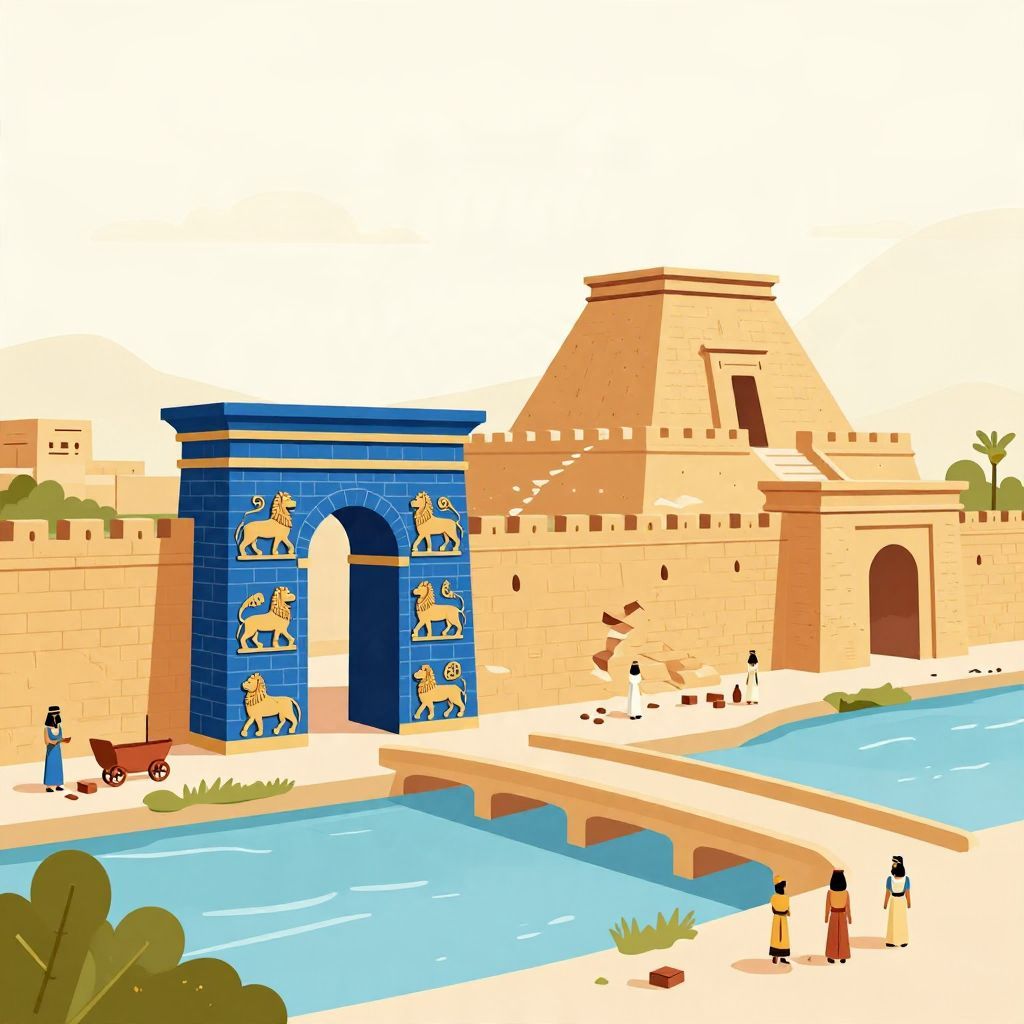
What happened to Babylon is a story of rise, conquest, decline, and long survival as a place remembered more than inhabited. Babylon was once the most famous city in Mesopotamia, but it did not disappear in a single moment. Its political power faded over centuries as empires changed, rivers shifted, trade patterns moved, and new capitals rose elsewhere.
Today, Babylon survives as an archaeological site in modern Iraq and as a powerful symbol in religion, literature, and political memory. Its history is best understood as a long timeline rather than a sudden fall.
What happened to Babylon?
Babylon rose to imperial greatness in the second millennium BCE, was destroyed and rebuilt more than once, and gradually lost importance after the Persian, Greek, and Roman periods. By late antiquity, it was largely abandoned as a major city. Its ruins remained, but Babylon’s role as a living political center had ended.
Babylon’s rise: from city-state to imperial capital
Babylon began as a modest city in southern Mesopotamia, near the Euphrates River. Its early history is tied to the broader world of Sumerian and Akkadian civilization, where city-states competed for land, water, and power. Babylon was not always dominant; its greatness came later, especially under the Amorite dynasty in the early second millennium BCE.
Hammurabi and the Old Babylonian Empire
Babylon’s first major era of prominence came under Hammurabi (reigned c. 1792–1750 BCE, though exact dates vary by chronology). He expanded Babylon through war and diplomacy, turning it into the center of a regional empire. Hammurabi is also associated with one of the best-known legal codes from the ancient world, though it was not the first law code and was not a modern “constitution” in the later sense.
Under Hammurabi, Babylon became a political and cultural capital. Its influence rested on control of irrigation, agriculture, trade routes, and administration. But like many ancient empires, this one was vulnerable to succession problems and outside pressure. After Hammurabi’s death, Babylon’s power weakened.
The city was conquered, rebuilt, and conquered again
Babylon’s history is marked by repeated conquest rather than one final collapse. The city endured invasions, foreign rule, and periods of recovery. This is one reason the question “What happened to Babylon?” has no simple answer.
Hittite sack and Kassite rule
In the 16th century BCE, Babylon was attacked by the Hittites, who sacked the city. This did not end Babylonian civilization, but it shattered the old dynasty. Babylon later came under the Kassites, who ruled for centuries and helped restore stability. During this period, Babylon remained important, though not always politically dominant.
Assyrian domination and destruction
In the first millennium BCE, Babylon often stood in rivalry with Assyria. Assyrian kings claimed Babylonian legitimacy, but Babylon also resisted Assyrian control. The most dramatic destruction came in 689 BCE, when the Assyrian king Sennacherib devastated the city after repeated rebellions. Ancient sources portray this as a shocking act, and later traditions remembered it as a catastrophe.
Yet Babylon was rebuilt. This pattern is crucial: Babylon was not a city that vanished once and for all. It was repeatedly damaged, then restored because of its strategic location and symbolic importance.
The Neo-Babylonian Empire: Babylon’s last great age
Babylon reached its greatest fame under the Neo-Babylonian Empire in the 7th and 6th centuries BCE. This was the period when Babylon became one of the most powerful cities in the ancient Near East and the setting for many later legends.
Nebuchadnezzar II and monumental building
The best-known ruler of this era was Nebuchadnezzar II (reigned 605–562 BCE). Under him, Babylon expanded into a grand imperial capital. The city was fortified, temples were restored, and monumental building projects reshaped its appearance. Ancient writers and later tradition associated Babylon with the Ishtar Gate, processional ways, and the famous Hanging Gardens, though the gardens’ exact location and even their existence in Babylon remain debated by scholars.
Babylon also became central to biblical memory because of the Babylonian conquest of Judah and the exile of part of the Judean elite in 586 BCE. In Jewish and later Christian tradition, Babylon came to symbolize imperial oppression, exile, and pride.
The Persian conquest changed Babylon’s fate
Babylon’s political decline accelerated when Cyrus the Great of Persia conquered the city in 539 BCE. This was a major turning point. Babylon did not collapse in ruins overnight, but it ceased to be the capital of an independent empire.
The Persians used Babylon as an important administrative center. The city remained wealthy and populous for a time, and its temples still mattered. But the center of power had moved. Under Persian rule, Babylon became one city among many in a much larger imperial system.
Why the Persian conquest mattered
The Persian takeover changed Babylon in three ways:
- Political status: Babylon lost sovereignty and became part of a foreign empire.
- Administrative role: It remained useful, but no longer controlled its own imperial destiny.
- Symbolic meaning: It began to live more strongly in memory, religion, and literature than in state power.
Decline under the Greeks and later empires
Babylon remained inhabited after the Persian conquest, but its long decline continued under later rulers. When Alexander the Great took Babylon in 331 BCE, he reportedly saw it as an important city and planned to use it as a base. After his death, however, the Seleucid rulers founded new centers of power, especially Seleucia on the Tigris, which drew people, trade, and administration away from Babylon.
Shifting trade and political centers
Babylon’s decline was not caused by conquest alone. Cities survive when they remain useful. Babylon gradually lost that usefulness as political authority moved elsewhere and as new urban centers attracted merchants and officials. The Euphrates also changed course over time, which likely affected agriculture, transport, and settlement patterns. In Mesopotamia, water management was always tied to urban survival.
By the Parthian and Roman periods, Babylon had become a diminished settlement. Ancient authors still knew the name, but the city was no longer a major power. Some inhabitants remained, yet the great imperial Babylon of earlier centuries was gone.
Why Babylon faded: the main causes
Babylon’s decline had multiple causes, and historians usually avoid reducing it to a single event. The city fell because its political, economic, and environmental foundations changed over time.
1. Conquest and imperial turnover
Babylon was repeatedly conquered by stronger states. Each conquest weakened local autonomy and shifted decision-making elsewhere. Even when the city was rebuilt, it was often rebuilt for someone else’s empire.
2. Loss of capital status
Babylon’s greatest strength was being a capital. Once Persian, Greek, and later imperial centers developed elsewhere, Babylon lost the administrative concentration that had sustained it.
3. Environmental and river changes
Southern Mesopotamian cities depended on canals, irrigation, and stable river systems. Over time, changes in the Euphrates and in local water management likely made some areas less favorable for large-scale urban life. This kind of environmental shift did not “destroy” Babylon by itself, but it made decline more likely.
4. Economic redistribution
Trade routes and markets moved. New cities offered better strategic or political advantages. Babylon’s location remained important, but not enough to preserve its ancient centrality.
What happened to the city itself?
Babylon did not vanish instantly. It continued as a settlement for centuries, but it shrank. Buildings fell into disrepair, materials were reused, and later occupation became less dense. In the Islamic period, the ancient city was no longer a major urban center. Over time, the ruins became a source of bricks, stories, and archaeological interest.
Modern Babylon is located near Hillah in Iraq, and the ancient site has been studied by archaeologists for more than a century. Excavations have helped reconstruct the city’s layout, walls, temples, and gates, although much remains uncertain because of damage, looting, rebuilding, and the limitations of the archaeological record.
Babylon in memory: myth, religion, and politics
Babylon’s afterlife in human memory may be even more influential than its political history. In the Hebrew Bible, Babylon became a symbol of exile and imperial arrogance. In later Christian tradition, “Babylon” could represent corruption or worldly power. In popular culture, the name has often stood for decadence, mystery, or lost grandeur.
That symbolic legacy sometimes blurs the historical city. Popular imagination often treats Babylon as if it were destroyed in one dramatic event, but the real history is more complex. Babylon was conquered, rebuilt, repurposed, and slowly diminished over many centuries.
Timeline of Babylon’s major turning points
- c. 19th–18th centuries BCE: Babylon rises under the Amorite dynasty.
- c. 1792–1750 BCE: Hammurabi expands Babylon into a major power.
- 16th century BCE: The Hittites sack Babylon.
- c. 1595–1155 BCE: Kassite rule helps stabilize the city.
- 689 BCE: Sennacherib of Assyria devastates Babylon.
- 626–539 BCE: Neo-Babylonian Empire restores Babylon’s greatness.
- 586 BCE: Babylon conquers Judah and destroys Jerusalem.
- 539 BCE: Cyrus the Great conquers Babylon.
- 331 BCE: Alexander the Great enters Babylon.
- After 300 BCE: Babylon declines as new centers rise nearby.
The historical impact of Babylon
Babylon’s importance did not end when its political power faded. It left a deep mark on law, urbanism, religion, architecture, and imperial memory. The city’s name became shorthand for grandeur and downfall, while its ruins continued to attract attention from scholars and travelers.
Historically, Babylon shows how ancient cities could be both durable and fragile. They could survive conquest, but not always the long-term shift of power, resources, and environment. Babylon’s story is therefore not just about destruction. It is about transformation across more than two millennia.
So, what happened to Babylon? It became a conquered imperial capital, then a provincial city, then a ruin, and finally a symbol. If you want to place Babylon in the wider ancient world, it also helps to understand the region around it in the Fertile Crescent and the larger history of empires that rose and fell across Eurasia, including later examples such as Prussia.