
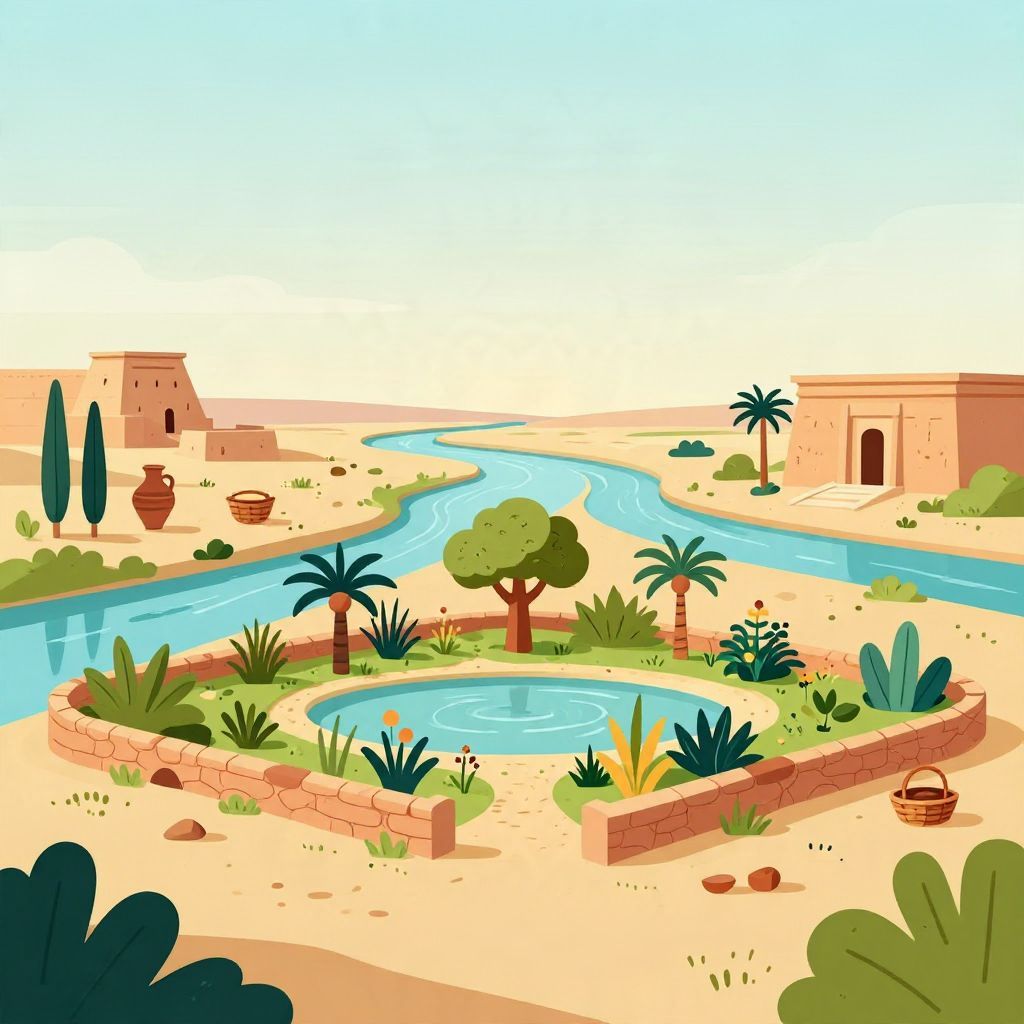
Where was the Garden of Eden located? The honest historical answer is that no one can verify a single exact location. The Garden of Eden belongs to sacred tradition, especially the Book of Genesis, and has been interpreted for centuries as both a real place and a symbolic origin story.
Still, the biblical clues have led readers and scholars to look toward Mesopotamia, especially the region of the Tigris and Euphrates rivers. That makes the question a fascinating mix of geography, religion, and ancient history.
Where Was The Garden Of Eden Located?
The most common historical and scholarly interpretation places the Garden of Eden somewhere in or near ancient Mesopotamia, the land between the Tigris and Euphrates rivers, in what is now Iraq and surrounding areas. However, the text is not precise enough to identify a confirmed archaeological site, so Eden remains an interpretive and theological location rather than a proven one.
What the Biblical Text Actually Says
The main source for Eden is Genesis 2–3. The text describes a garden watered by a river that divides into four branches: Pishon, Gihon, Tigris, and Euphrates. Two of those rivers are clearly identifiable today, while the other two are not. That combination is one reason the location has remained uncertain for so long.
The four rivers in Genesis
- Tigris and Euphrates: real rivers in Southwest Asia, central to ancient Mesopotamia.
- Pishon: unidentified; proposed links include Arabia, the Persian Gulf, or older river systems.
- Gihon: also unidentified; some traditions linked it to regions in Africa or elsewhere, but without consensus.
Because the text names two known rivers and two unknown ones, scholars have long debated whether Genesis preserves a memory of a real landscape, uses familiar geography symbolically, or combines both.
Why Mesopotamia Is the Leading Candidate
Mesopotamia is the strongest historical candidate because it matches the biblical river names and because it was one of the world’s earliest centers of agriculture, settlement, and urban life. The word “Mesopotamia” means “land between the rivers,” referring to the Tigris and Euphrates. For ancient audiences, this region represented fertile, life-giving land in contrast to surrounding deserts.
The Fertile Crescent connection
Many people connect Eden with the broader Fertile Crescent, the arc of productive land stretching from the eastern Mediterranean through Mesopotamia. This is not proof that Eden was literally there, but it explains why the region has often been associated with humanity’s beginnings. Early farming, domestication, and permanent villages emerged in this wider zone during the Neolithic period, roughly from 10,000 BCE onward.
That historical setting matters. A story about a garden, rivers, cultivation, and human exile would have resonated strongly in a world where fertile land meant survival and barren land meant hardship.
Could Eden Have Been a Real Place?
Some historians and biblical scholars think the Eden story may preserve a memory of an actual place or landscape, later shaped into theological narrative. Others argue that it functions primarily as a mythic or symbolic account of human origins, not a map. Both views are common in serious scholarship, and neither can be proven conclusively.
Three major interpretations
- Literal geographic reading — Eden was a real garden in a specific place, now lost.
- Symbolic reading — Eden is a theological image of harmony, innocence, and divine order.
- Mixed reading — the story draws on real geography but reshapes it into sacred narrative.
The mixed reading is often the most historically cautious. Ancient writers commonly used real places as the setting for stories that carried moral or religious meaning. In that sense, Eden may reflect a remembered world of rivers and cultivation without being traceable to a single archaeological site.
How Ancient Peoples Understood Paradise
In the ancient Near East, gardens were powerful symbols. Kings created enclosed gardens as signs of order, wealth, and divine favor. Water was especially important because it transformed dry land into productive space. A garden “in the east,” watered by rivers, would have suggested abundance, sacredness, and closeness to the source of life.
Why a garden mattered
For ancient readers, a garden was not just a pleasant place. It represented a controlled, fruitful environment where nature and human labor worked together. In Genesis, Eden is the opposite of wilderness and scarcity. It is the place where humanity begins in intimacy with God before exile and toil enter the story.
This is one reason the question “Where was the Garden of Eden located?” cannot be answered like a modern atlas problem. The story is doing religious and cultural work as well as geographic work.
Other Proposed Locations
Over the centuries, many locations have been proposed for Eden, often based on attempts to identify the mysterious rivers or to connect the story with local traditions. Most of these theories are speculative and none has gained universal acceptance.
Common proposals
- Southern Mesopotamia — near the Persian Gulf, where ancient river systems may once have looked different from today.
- Armenian Highlands — some traditions place the source of the rivers in mountainous headwaters.
- Persian Gulf region — a few theories suggest Eden was in now-submerged lands when sea levels were lower.
- East Africa or Arabia — proposed because of uncertain identifications of the Pishon and Gihon.
These ideas are interesting, but they remain hypotheses. The main obstacle is that the Genesis account does not provide enough detail to match a modern map with confidence.
Eden in Jewish, Christian, and Islamic Tradition
The Garden of Eden has had a long afterlife in religious interpretation. In Judaism, Christianity, and Islam, the garden became a foundational symbol for humanity’s relationship with God, innocence, temptation, and loss. Each tradition developed its own emphases, but all treated Eden as deeply meaningful.
Judaism
In Jewish interpretation, Eden is tied to creation, moral responsibility, and the human condition. The story helps explain why life involves labor, mortality, and distance from divine presence.
Christianity
Christian writers often connected Eden to themes of sin and redemption. The fall of Adam and Eve became central to later theological debates about human nature and salvation.
Islam
Islam also includes the story of Adam, Eve, and the garden, though the details and theological framing differ from Genesis. The garden is part of a broader account of human testing, mercy, and guidance.
Because these traditions read Eden through theological lenses, the garden’s location has often mattered less than its meaning.
What Archaeology Can and Cannot Tell Us
Archaeology has greatly improved our understanding of ancient Mesopotamia, but it has not uncovered a verified Garden of Eden. That is not surprising. A sacred garden from a primeval narrative may never be identifiable in material remains, especially if the story is symbolic or if the landscape has changed dramatically over millennia.
Limits of the evidence
- Rivers change course over time.
- Ancient place names can be lost or transformed.
- Mythic narratives often preserve meaning rather than exact geography.
- No excavation has produced a universally accepted “Eden site.”
What archaeology does show is that the ancient Near East was full of irrigated settlements, river-based agriculture, and garden imagery. That context helps explain why Eden was imagined as a lush, watered place.
Why the Question Still Matters
People continue to ask where Eden was located because the story sits at the intersection of faith, memory, and early civilization. It raises larger questions: Where did humans imagine their beginnings? Why do so many cultures describe a lost golden age? And how did ancient peoples understand the relationship between land, water, and divine order?
In historical terms, Eden is important not because it can be pinned to one excavated site, but because it reveals how ancient writers used geography to express profound ideas about human life. The setting matters, but the message matters more.
Conclusion
The most responsible answer is that the Garden of Eden cannot be located with certainty. The strongest historical association is with Mesopotamia and the broader Fertile Crescent, especially because Genesis names the Tigris and Euphrates. Yet Eden is best understood as a sacred origin story shaped by real ancient geography, not as a proven archaeological site. If you want to explore the world that shaped the Eden narrative, a good next step is learning about the Fertile Crescent and the biblical landscapes that later traditions held sacred, including the Western Wall.