
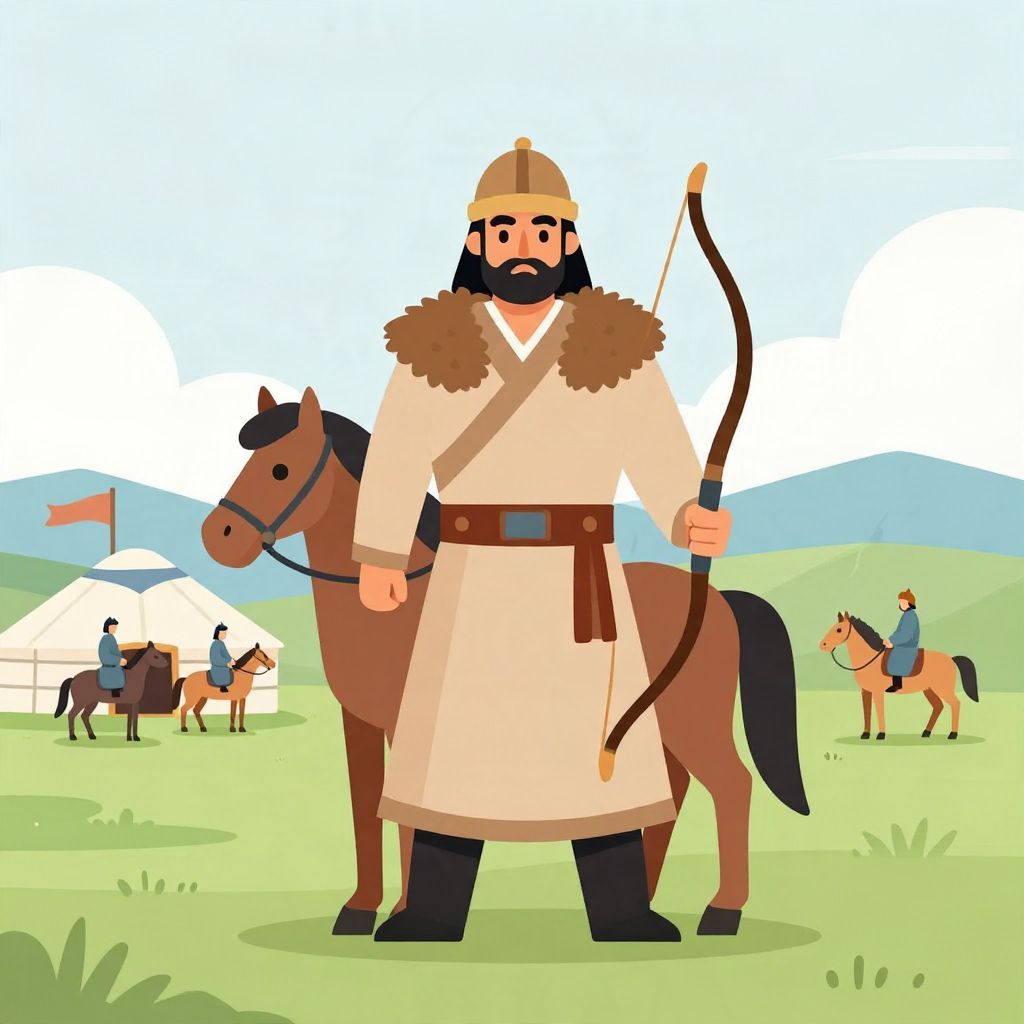
What did Genghis Khan look like? The honest answer is that we do not know with certainty. No securely identified portrait from his lifetime survives, and most images made later reflect Mongol, Chinese, Persian, or modern artistic traditions rather than a firsthand likeness.
What historians can say is that Genghis Khan, born Temüjin around 1162, was remembered as a steppe ruler of the Mongol world whose appearance was shaped by the peoples and cultures around him. The evidence suggests a Central Asian steppe man, but the exact details of his face, height, hair, and clothing remain partly uncertain.
What Did Genghis Khan Look Like?
Genghis Khan’s exact appearance is unknown because no verified contemporary portrait exists. He was likely a man of the Mongol steppe: probably broad-faced, with features common among Inner Asian populations, and dressed in practical riding clothes. Later portraits are useful for studying how people imagined him, but they are not reliable photographs of his real face.
Why historians cannot give a precise face
The main problem is evidence. Genghis Khan died in 1227, and the Mongol Empire spread across regions with very different artistic styles. Many surviving images were created decades or centuries later, often by artists who never saw him. Some depictions were symbolic, meant to show power, legitimacy, or foreignness rather than visual accuracy.
Even written sources are limited. Early Mongol history was preserved in texts such as The Secret History of the Mongols, but these works focus far more on his deeds than on detailed physical description. They tell us about his family, leadership, and conquests, not enough to reconstruct a precise face.
What the surviving descriptions suggest
Most historical reconstructions place Genghis Khan within the broad physical range of medieval Mongol and Inner Asian peoples. That means he likely had features typical of the Eurasian steppe, though scholars should be cautious about turning ethnic generalizations into certainty about one person. He may have had a weathered, practical appearance shaped by a nomadic life of riding, hunting, and warfare.
Some later traditions portray him with a stern expression, a long moustache or beard, and strong cheekbones. These details may reflect artistic convention more than fact. Mongol elites often wore their hair and facial hair in ways that changed over time and across regions, so even these features cannot be fixed with confidence.
The Historical Evidence for Genghis Khan’s Appearance
Evidence for Genghis Khan’s appearance comes from a few broad categories: early texts, later portraits, archaeological context, and modern historical interpretation. None of these alone can identify his exact look, but together they help explain why so many images of him differ.
1. Written sources
Early Mongol and foreign accounts describe Genghis Khan as a formidable leader, but they rarely provide a detailed physical portrait. Medieval writers were often more interested in status, ancestry, and military power than in facial realism. When they did mention appearance, they tended to use broad terms rather than precise measurements.
2. Later artistic images
Most famous portraits of Genghis Khan were produced long after his death. Chinese court art, Persian manuscript painting, and modern national imagery all shaped how later generations pictured him. These works are historically valuable, but they tell us more about the artists’ worlds than about the Khan himself.
3. Steppe clothing and material culture
We can say more confidently what he likely wore. A Mongol ruler would have dressed for life on horseback: layered robes, boots, belts, and practical garments suited to cold winters and open grasslands. Such clothing was both functional and political, signaling mobility, rank, and connection to steppe traditions.
What Genghis Khan Probably Looked Like in Context
Although no one can reconstruct his face exactly, historical context gives a plausible picture. Genghis Khan was a man of the Mongol steppe in the late 12th and early 13th centuries, and his appearance would have reflected that environment. He was not a courtly sedentary monarch in the European sense, but a nomadic war leader formed by hard travel, conflict, and alliance-building.
Likely physical traits
- Build: probably lean and hardened by riding and campaigning rather than stocky in a modern sense.
- Face: likely broad or angular, though exact features are unknown.
- Hair: possibly worn in a style common among Mongol elites, but not securely documented for him personally.
- Facial hair: later images often show a moustache or beard, yet this is not certain.
- Clothing: practical steppe dress, likely layered and suited to mounted life.
It is important not to overstate these points. Modern viewers often want a single “real” portrait, but medieval rulers were not photographed, and image-making was highly political. In Genghis Khan’s case, the lack of certainty is itself historically significant: it shows how little visual evidence survives for one of the most powerful figures in world history.
Was he portrayed as Chinese, Persian, or Mongol?
Different cultures depicted him differently. In Chinese works, he might appear as a ruler within the broader imperial world of East Asia. In Persian miniatures, he could be shown in the visual language of the Islamic world. In modern Mongolia, he is often represented as distinctly Mongol and heroic. These differences reveal changing identities and political uses of his image over time.
Timeline: Genghis Khan’s Life and the Making of His Image
To understand why his appearance is so hard to pin down, it helps to follow the chronology of his life and legacy. His image was shaped not once, but repeatedly, as his empire expanded and later generations reimagined him.
- c. 1162: Temüjin, later known as Genghis Khan, is born in the Mongol steppe.
- Late 12th century: He rises through tribal conflict and alliance-building; no contemporary portrait survives from this period.
- 1206: He is proclaimed Genghis Khan, ruler of the united Mongols.
- 1206–1227: The Mongol Empire expands across Central Asia, northern China, and beyond; descriptions of him circulate, but visual likenesses remain scarce.
- 1227: He dies during campaign in the Western Xia region.
- 13th–14th centuries: Later manuscript traditions begin to visualize him in different regional styles.
- Modern era: Historians and artists debate his appearance, often using surviving images as symbolic rather than literal evidence.
Why So Many Images of Genghis Khan Look Different
There is no single standard portrait because his image traveled across empires. Each culture that remembered him had its own artistic conventions and political needs. That is why one version may show him as a stern bearded conqueror, while another presents him as a dignified ruler in imperial dress.
Artistic convention over realism
Medieval art often prioritized meaning over exact likeness. A ruler’s image could communicate authority, divine favor, military strength, or foreignness. In that world, a portrait was not necessarily meant to be a literal face. For Genghis Khan, this means that many familiar images are best read as statements about power, not as eyewitness sketches.
Modern nationalism and popular culture
In the modern period, Genghis Khan became an important symbol in Mongolian identity and in global popular culture. Films, monuments, textbooks, and tourism have all contributed to a more standardized “look” for him. Yet this modern image often says more about present-day identity than about 13th-century reality.
What We Can Say with Confidence
Even without a secure portrait, historians can still answer the question responsibly. Genghis Khan was almost certainly an Inner Asian steppe man whose appearance reflected Mongol life: practical, mobile, and shaped by the harsh environment of the grasslands. Beyond that, certainty fades. His exact face remains unknown, and many famous depictions are later interpretations rather than direct evidence.
That uncertainty does not make the question meaningless. On the contrary, it shows how history works when evidence is incomplete. We can reconstruct context, compare sources, and identify patterns, but we cannot manufacture certainty where the record does not provide it.
In the end, the best historical answer to what Genghis Khan looked like is simple: he was a Mongol steppe leader whose real appearance has been lost to time, even as his image was endlessly remade by later generations. If you want to explore the wider legacy of this figure, you may also be interested in where Genghis Khan is buried and, for a broader comparison of historical appearance and legend, what Muhammad looked like.