
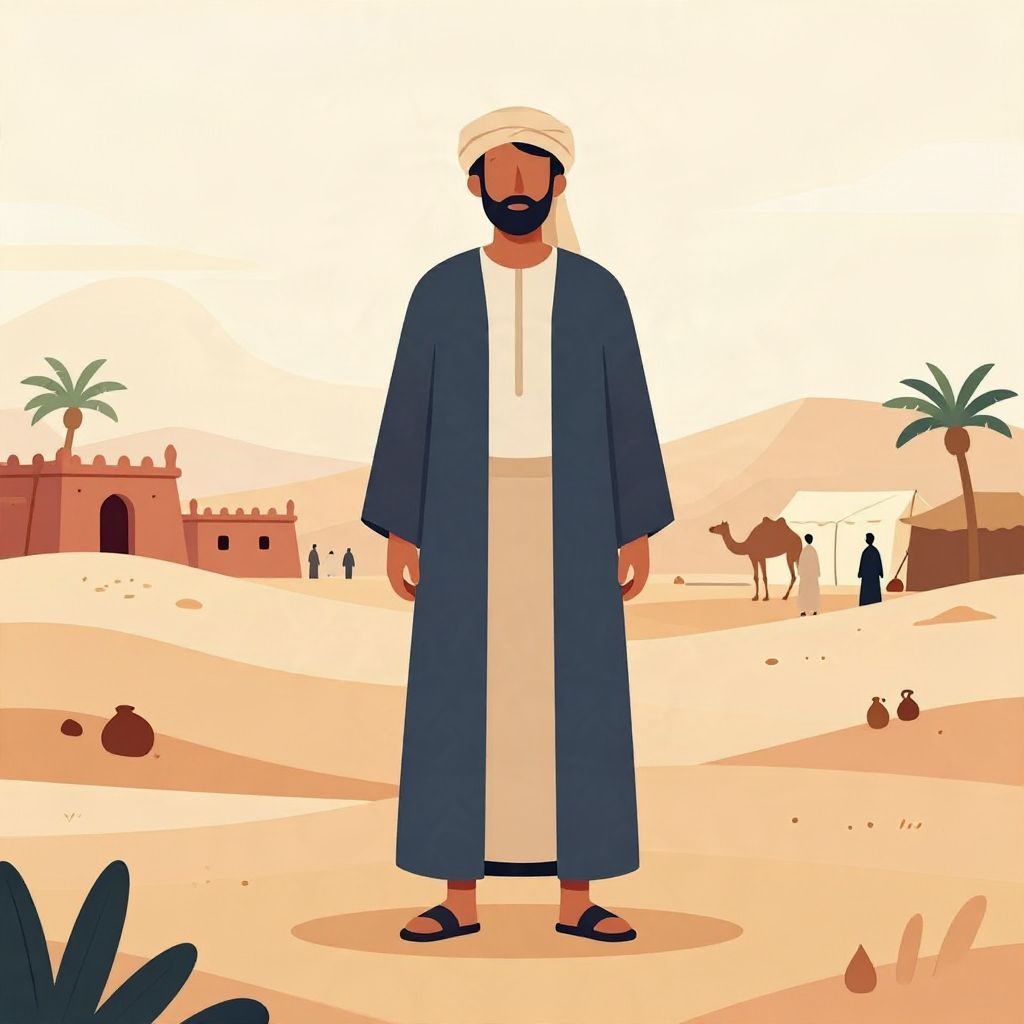
What did Muhammad look like? It is a question many readers ask, but the historical answer is necessarily careful. Muhammad, the founder of Islam, lived in the early seventh century in Arabia, and no confirmed portrait from his lifetime survives. What we know comes from later written descriptions, especially Muslim traditions that tried to preserve how he appeared, dressed, and carried himself.
Because these accounts were recorded after his death, they must be read as historical testimony rather than photographic certainty. They do, however, give a fairly consistent picture of a man of medium build, with a pleasant face, dark features, and a dignified presence.
What did Muhammad look like?
According to the earliest surviving Muslim descriptions, Muhammad was of medium height, neither very tall nor very short, with a broad chest, strong build, dark eyes, and a full beard. Traditions describe him as having a luminous or radiant face, thick hair, and a calm, memorable presence. Exact facial details remain uncertain because no contemporary visual likeness is known.
The historical evidence for Muhammad’s appearance
Our knowledge of Muhammad’s appearance comes mainly from hadith and later biographical literature, not from archaeology or surviving portraits. The most famous descriptive tradition is often associated with his companion Anas ibn Malik and with later collections that describe Muhammad’s face, hair, complexion, and manner. These texts are important, but they were written down after his lifetime and reflect both memory and devotion.
What the sources agree on
Across several descriptions, a few features recur with surprising consistency: Muhammad was not unusually tall, had a broad and well-proportioned body, and was generally described as handsome or striking. His hair is often said to have been black and somewhat wavy, sometimes reaching his earlobes or shoulders depending on the period described. He is also commonly said to have worn a beard.
What remains uncertain
Historians cannot verify precise skin tone, eye shape, nose shape, or exact facial proportions. The sources use language that is sometimes poetic rather than clinical, and later artists and communities often projected their own ideals onto his image. For that reason, any modern reconstruction is interpretive, not definitive.
How Muhammad was described in early Islamic tradition
Muslim tradition often emphasizes not only Muhammad’s physical appearance but also the impression he made. He is frequently portrayed as dignified, gentle, and composed. In these accounts, his appearance and character are linked: his face reflected moral authority, and his posture and speech conveyed confidence without arrogance. This blending of physical and ethical description is common in religious biography.
Common descriptive themes
- Build: medium height, sturdy, and proportionate
- Face: handsome, bright, and memorable
- Hair: dark, often wavy, sometimes shoulder-length in descriptions
- Beard: full beard in later depictions and textual accounts
- Eyes: dark, with a strong and attentive gaze
- Presence: calm, dignified, and respected
These repeated features suggest a stable tradition, even if the details cannot be checked with modern certainty. In historical terms, consistency across multiple accounts makes the broad outline more credible than any one exact detail.
Why there is no confirmed portrait of Muhammad
Unlike some rulers of antiquity, Muhammad left no universally accepted contemporary image. In the earliest Islamic community, religious caution about depicting prophets may have limited portrait production. Over time, many Muslim societies developed strong traditions of aniconism, or restraint in figural religious imagery, especially in sacred contexts. That did not mean all images were forbidden everywhere, but it did shape how Muhammad was remembered visually.
Text over image
Islamic culture often preserved sacred memory through recitation, calligraphy, architecture, and biography rather than portraiture. As a result, written descriptions became especially important. The emphasis on words over images helped create a detailed literary portrait of Muhammad even in the absence of a secure visual one.
Later artistic traditions
In some Persian, Ottoman, and other Islamic manuscript traditions, artists produced stylized images of Muhammad, sometimes veiling his face or replacing it with light or flame-like symbolism. These works are historically significant, but they are not eyewitness portraits. They reflect devotional art and later cultural practice, not a direct record of his appearance.
What the timeline tells us about the sources
Understanding when the descriptions were written helps explain why historians treat them carefully. Muhammad lived from about 570 to 632 CE. The earliest Muslim community preserved memories orally before they were compiled into written form in the decades and centuries after his death. That gap does not make the accounts useless, but it does require caution.
- 570 CE, approximate: Muhammad is traditionally said to have been born in Mecca.
- 610 CE, approximate: he begins receiving revelations, according to Islamic tradition.
- 622 CE: the Hijra, Muhammad’s migration from Mecca to Medina, marks the start of the Islamic calendar.
- 632 CE: Muhammad dies in Medina.
- 8th to 9th centuries CE: major hadith and biography collections are compiled, preserving many physical descriptions.
This chronology matters because it shows that the most detailed descriptions come from a later memory culture. Historians therefore distinguish between the probable outline of Muhammad’s appearance and the devotional language used to honor him.
How historians interpret these descriptions
Modern historians do not dismiss the traditional accounts, but they read them as products of early Muslim communities. Such sources tell us something about how Muhammad was remembered, revered, and visually imagined. They also reveal what his followers valued: balance, beauty, dignity, and moderation. In that sense, the descriptions are historically meaningful even when they cannot be verified in a modern forensic way.
Memory, reverence, and identity
Religious communities often preserve the appearance of founders in idealized language. For Muhammad, this idealization served several purposes. It reinforced his authority, distinguished him from ordinary political leaders, and helped unify believers around a shared image of prophetic excellence. The result is a portrait shaped by both memory and meaning.
Popular legends and modern reconstructions
Many modern images of Muhammad, including artistic reconstructions and internet illustrations, should be treated cautiously. They often borrow from later cultural conventions rather than historical evidence. Likewise, legends that assign exact measurements or highly specific facial traits usually go beyond what the sources can firmly support.
Why Muhammad’s appearance mattered historically
In the early Islamic world, Muhammad’s appearance mattered because he was not remembered only as a prophet but also as a leader, judge, and community builder. Descriptions of his body and face were part of a larger effort to preserve his sunna, or exemplary way of life. Physical description therefore became a form of historical and religious memory.
Appearance and authority
In many premodern societies, the body of a ruler or holy figure carried symbolic weight. A balanced, composed appearance could signal wisdom, legitimacy, and divine favor. For Muhammad, the traditions emphasize humanity without ordinariness: he was approachable, yet set apart by moral and spiritual authority.
Influence on Islamic culture
These descriptions influenced later Islamic literature, devotional practice, and art. Poets praised his beauty, scholars recorded descriptive traditions, and artists represented him indirectly through calligraphy, light, or veiling. The historical Muhammad remained central, but his image was mediated through reverence and interpretation.
So, what can we say with confidence?
The most responsible historical answer is that Muhammad was probably a medium-built, dark-haired Arab man with a beard, dark eyes, and a striking, dignified presence. He was remembered as handsome and radiant, but no exact visual likeness from his lifetime survives. The surviving descriptions are valuable historical sources, yet they are best understood as a blend of memory, devotion, and early Islamic biography.
In the end, the question of what Muhammad looked like leads to a larger historical insight: for many religious founders, image is preserved not by portraits alone but by the stories communities tell about them. If you are interested in how historians reconstruct the appearance of major figures from limited evidence, you may also enjoy what Alexander the Great looked like and what George Washington looked like.