
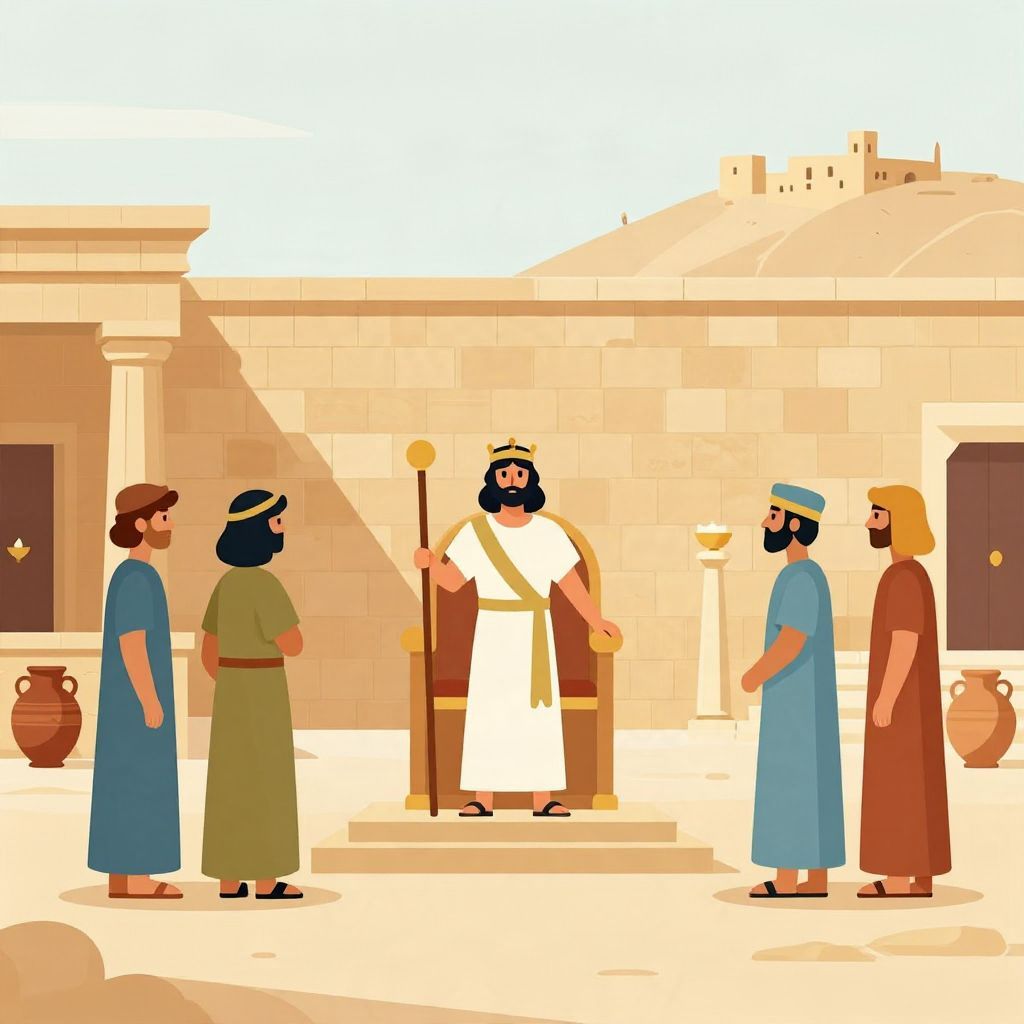
How old was Solomon when he became king? The short answer is that the Bible does not give Solomon’s exact age at his accession. Most historians and biblical scholars therefore treat his age as unknown, though he was likely a young adult rather than a child.
The question matters because Solomon’s rise to the throne shaped one of the most famous reigns in ancient Israelite history. His kingship followed a tense succession crisis at the end of David’s rule, and later tradition used Solomon’s wisdom and wealth to define an idealized image of monarchy.
How old was Solomon when he became king?
Solomon’s exact age is not stated in the biblical text, so there is no firm historical number. Based on the sequence of events in 1 Kings and 1 Chronicles, many readers infer that he was likely a young man—probably in his late teens or twenties—when he succeeded David, but this remains an educated estimate, not a documented fact.
What the biblical sources actually say
The main narrative sources for Solomon’s accession are found in 1 Kings 1–2 and 1 Chronicles 28–29. These chapters describe the transfer of power from David to Solomon, but they never state Solomon’s age. Instead, they focus on political legitimacy, court intrigue, and David’s instructions about the succession.
Why there is no exact age in the text
Ancient royal records often emphasized lineage, divine approval, and political continuity rather than biographical details such as age. In Solomon’s case, the biblical writers were more interested in showing that his kingship was legitimate and divinely favored than in recording a birth year.
That means any precise number you may see online is usually a later inference, not a direct statement from the ancient sources.
Why many people think Solomon was young
Several details in the biblical story suggest that Solomon was relatively young when he became king. He is portrayed as inexperienced enough to ask for wisdom rather than long life or riches, and David’s final instructions to him read like guidance given to a successor who still needed support and political training.
The succession context
David’s final years were marked by uncertainty. His son Adonijah attempted to claim the throne, while Bathsheba and the prophet Nathan intervened to secure Solomon’s succession. This was not a smooth hereditary transfer from an established adult monarch to a fully proven heir; it was a contested transition inside a royal household.
Because of that, some scholars and popular traditions imagine Solomon as a younger prince whose age made the succession more vulnerable to rivals. Still, the text itself does not say he was a teenager, nor does it require that conclusion.
What historians can and cannot conclude
From a historical standpoint, Solomon’s age at accession is unknown. The biblical narrative is the primary source, and it does not provide a birth date or age. Any estimate depends on reconstructing the chronology of David’s reign, Solomon’s reign, and the broader timeline of early Israelite monarchy—none of which can be fixed with complete certainty.
Why chronology is difficult
Ancient Near Eastern chronology often involves overlapping regnal years, different counting systems, and later editorial shaping of the text. Even when a reign length is given, converting that into an exact birth year is difficult. For Solomon, the problem is compounded because the sources are theological and literary as well as historical.
In other words, historians can discuss the likely age range, but they cannot responsibly give a precise birthday or age at coronation.
Likely age range: what is reasonable to say?
If one tries to infer an age range, the most cautious conclusion is that Solomon was probably a young adult when he became king. A common estimate places him somewhere around his late teens to early twenties, though some interpretations allow for an older age. The evidence does not support certainty beyond that broad range.
Why not assume he was very young?
Solomon quickly appears as a capable ruler in the biblical account. He organizes the kingdom, establishes alliances, and is associated with administrative development and large-scale building projects. That portrayal fits a monarch who was young but not necessarily a child. Ancient kings sometimes began ruling in adolescence, but the text does not indicate that Solomon was underage.
Why not assume he was older?
Some readers imagine Solomon as a mature adult because he is presented as wise and authoritative. But wisdom in the biblical narrative is a literary and theological theme, not a reliable indicator of age. The story of Solomon’s request for wisdom in 1 Kings 3 is meant to define his character, not to document his years.
The historical setting of Solomon’s rise
Solomon’s accession belongs to the early Iron Age history of the Israelite monarchy, usually placed in the 10th century BCE in traditional biblical chronology. This was a period when small kingdoms in the Levant were consolidating power, building court systems, and competing for regional influence.
David’s kingdom and succession politics
Solomon inherited a kingdom that biblical tradition describes as strengthened by David’s military successes and political unification. But succession in ancient monarchies was rarely automatic. Rival claimants, family factions, and court officials could all influence who became king. Solomon’s rise shows that royal succession was as much a political event as a family matter.
According to the biblical account, Solomon was anointed while David was still alive, which helped secure the transfer of power. This detail is important because it shows that Solomon’s kingship was presented as both dynastic and sanctioned by the existing ruler.
What Solomon’s age meant for his reign
Whether Solomon was in his late teens, twenties, or somewhat older, his age would have mattered in a world where kingship depended on experience, alliances, and public authority. A younger king might have relied more heavily on advisers, priests, scribes, and palace officials, especially early in his reign.
Wisdom as a political ideal
Solomon’s famous request for wisdom reflects the kind of ruler the biblical writers wanted to celebrate: one who governs by discernment rather than force alone. In that sense, the story of Solomon’s youth and wisdom works as a model of ideal kingship. It tells readers that legitimacy comes not just from bloodline, but from the ability to rule justly.
Later Jewish and Christian traditions expanded this image, making Solomon a symbol of wisdom, judgment, and prosperity. Those traditions often softened the uncertainty around his age by focusing instead on his reputation.
Solomon in later tradition versus historical evidence
It is important to distinguish between historical evidence and later tradition. The historical evidence tells us that Solomon became king after a contested succession and that his exact age is not recorded. Later tradition, by contrast, often treats him as the archetypal wise young king, sometimes implying a dramatic youthfulness that the sources do not explicitly confirm.
Popular assumptions
Because Solomon is associated with wisdom, many people assume he must have been very young when he began to rule. Others, seeing the scale of his alleged achievements, assume he must have been already mature. Both views go beyond what the text securely supports.
The most careful answer remains the same: Solomon’s age is not known with precision, but he was probably a young adult when he became king.
How Solomon’s accession fits into biblical chronology
Biblical chronology places Solomon’s reign after David’s and before the division of the united monarchy into the northern kingdom of Israel and the southern kingdom of Judah. Traditional calculations often place the beginning of Solomon’s reign around the 10th century BCE, though exact dating depends on the chronological system used.
- David’s reign: the background to Solomon’s succession
- Adonijah’s claim: the main rival challenge
- Solomon’s anointing: the formal confirmation of kingship
- Solomon’s early rule: associated with wisdom and state-building
This sequence matters because it shows that Solomon’s age question is part of a larger historical problem: how ancient Israel moved from charismatic leadership under David to a more institutional monarchy under Solomon.
Why the question still interests readers today
People continue to ask how old Solomon was because age helps make historical figures feel real. It also affects how we interpret his story. A very young Solomon suggests vulnerability, divine favor, and rapid maturation. An older Solomon suggests political experience and continuity. Since the evidence does not settle the matter, the question invites careful reading rather than certainty.
That uncertainty is not a weakness of history; it is part of honest historical method. Good history distinguishes what is known from what is inferred.
So, how old was Solomon when he became king? The best answer is that we do not know exactly. The biblical record does not give his age, but he was probably a young adult when he succeeded David. For more biblical background, you may also want to read about how old David was when he became king and the broader context of ancient court life, including figures such as eunuchs in the Bible.