
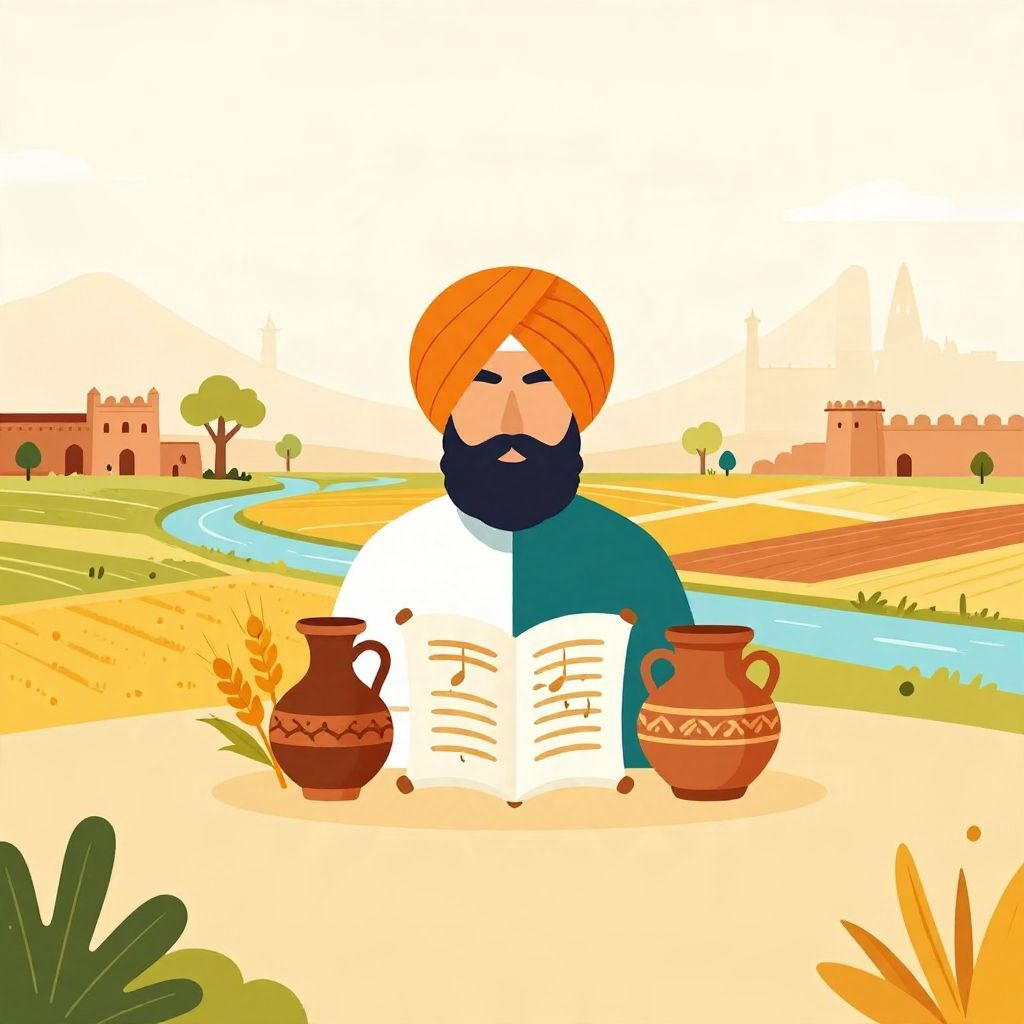
What is Punjabi? The word can refer to a language, an ethnic and regional identity, and a broad cultural world centered on the Punjab region of South Asia. Its meaning has changed over time, shaped by ancient geography, medieval empires, Sikh history, colonial rule, Partition, and modern migration.
To answer the question historically, it helps to separate language from identity. “Punjabi” is not one simple thing; it is a layered term that has developed over centuries and still carries different meanings in India, Pakistan, and the global diaspora.
What Is Punjabi?
Punjabi is the name of a major Indo-Aryan language and of the people and culture associated with the Punjab region. Historically, it has meant “from Punjab,” but over time it also came to describe a shared literary tradition, everyday speech, religious communities, music, foodways, and regional identity across a divided border.
The Meaning of “Punjabi” in History
The word Punjabi comes from Punjab, a Persian-derived term meaning “land of five rivers.” Those rivers are the Beas, Chenab, Jhelum, Ravi, and Sutlej, though the exact historical boundaries of Punjab have shifted many times. In its oldest sense, Punjabi simply meant a person or thing connected to that region.
From region to identity
Over centuries, regional belonging became more than geography. People in the Punjab spoke related dialects, shared agrarian life, traded across river systems, and participated in overlapping religious and political worlds. As a result, “Punjabi” gradually developed into a cultural and linguistic identity, not just a place-name.
Where Is Punjab?
Punjab is a historic region in the northwestern part of the Indian subcontinent. Today it is divided mainly between Punjab, India and Punjab, Pakistan, with cultural and linguistic communities extending into Haryana, Himachal Pradesh, Delhi, and the Pakistani provinces around Lahore, Faisalabad, Multan, and Rawalpindi. The region’s borders have never been fixed for all time.
A frontier region for empires
Because of its location between the Iranian plateau, Central Asia, and the Gangetic plain, Punjab was often a frontier zone. It was ruled or influenced by many powers, including the Mauryas, Kushans, Delhi Sultanate, Mughals, Afghans, Sikhs, and the British. This long history of movement and conquest helped make Punjabi identity flexible and layered.
The Punjabi Language: Origins and Development
Punjabi is one of the major languages of South Asia and belongs to the Indo-Aryan branch of the Indo-European language family. It developed from older regional Prakrits and Apabhramsha forms, alongside local speech traditions in northwestern India. Scholars generally place its recognizable early development in the medieval period, though the exact transition from older speech forms cannot be dated precisely.
Early literary evidence
Written Punjabi appears gradually in the medieval era, especially in devotional and poetic traditions. One important early literary figure is Baba Farid (12th–13th century), whose verses entered later Sikh scripture and are often cited as evidence of early Punjabi literary expression. However, medieval texts were not always written in a standardized “Punjabi” as modern speakers would define it.
Scripts used for Punjabi
- Gurmukhi — the main script for Punjabi in Sikh and many Indian contexts.
- Shahmukhi — a Perso-Arabic script used widely for Punjabi in Pakistan.
- Historically, Punjabi also appeared in other local and adapted scripts depending on region and community.
The use of different scripts reflects the region’s religious and political diversity. Script choice has often been tied to education, administration, and identity, rather than to language alone.
How Punjabi Became a Cultural Identity
Punjabi identity formed through everyday life as much as through political rule. Farming, village networks, riverine trade, military service, and shared forms of speech all helped create a recognizable regional culture. Yet Punjabi identity was never uniform. Religion, caste, class, and locality shaped how people understood themselves.
Religion and Punjabi history
The Punjab has been home to major religious traditions, including Hinduism, Islam, Sikhism, and earlier Buddhist and other traditions. Sikhism emerged in the late 15th century in the Punjab, and its growth gave the region particular historical importance. But it is important not to equate “Punjabi” with any single religion: many Punjabi speakers have been Muslim, Sikh, Hindu, Christian, and adherents of other faiths.
Sikhism and the Punjabi language
Punjabi became especially prominent through Sikh scripture and devotional culture. The Guru Granth Sahib, compiled in the early 17th century, preserves hymns in Punjabi and related languages, helping to elevate the prestige of the region’s speech forms. This religious-literary development was crucial in linking language, devotion, and identity.
Punjabi Under Mughal, Sikh, and Colonial Rule
The history of Punjabi identity cannot be separated from political change. Under the Mughals, the Punjab was a productive and strategically important region. In the 18th and early 19th centuries, Sikh misls and then the Sikh Empire under Maharaja Ranjit Singh built a powerful state centered in Lahore. This period strengthened regional prestige and political self-awareness.
British colonial classification
Under British rule, Punjab became a province administered through colonial bureaucracy, census-taking, and language categorization. The British often tried to classify people by religion, caste, tribe, and language in rigid ways. These categories influenced how Punjabi identity was recorded and sometimes hardened differences that had previously been more fluid.
At the same time, colonial education and print culture helped expand Punjabi prose, journalism, and political debate. Modern nationalist and reform movements also used Punjabi in new ways, linking language to social reform, religious revival, and political identity.
Partition and the Recasting of Punjabi Identity
The most dramatic turning point in modern Punjabi history was the Partition of 1947. When British India was divided into India and Pakistan, Punjab was split between the two states. The division triggered mass migration, violence, and the uprooting of millions of people. For many families, Punjabi identity became tied to memory, displacement, and loss as much as to homeland.
Different outcomes on each side of the border
In Pakistan, Punjabi remained widely spoken but often competed with Urdu in official and elite settings. In India, Punjabi gained stronger recognition in the state of Punjab, especially after the reorganization of states in 1966. Even so, the language and identity continued to be shaped by politics, migration, and the pressures of national integration.
Punjabi Today: Language, People, and Diaspora
Today, Punjabi is spoken by tens of millions of people worldwide, especially in Pakistan, India, the United Kingdom, Canada, the United States, and the Gulf. Migration in the 20th and 21st centuries spread Punjabi communities far beyond South Asia. In the diaspora, Punjabi often functions as a marker of family heritage, religion, music, and transnational belonging.
What does “Punjabi” mean now?
In modern usage, the term can mean several things at once:
- a language spoken in multiple scripts and dialects,
- a regional identity tied to Punjab,
- a cultural tradition expressed in music, dance, food, dress, and storytelling,
- and, for some people, a diasporic identity shaped by migration and memory.
This flexibility is part of what makes Punjabi historically significant. It has never been only one community, one religion, or one political project.
Punjabi Culture in Historical Perspective
Punjabi culture is often associated with vibrant music, bhangra, folk poetry, agricultural festivals, and rich culinary traditions. Historically, these cultural forms grew from a rural and river-based society, but they also evolved in cities, courts, religious institutions, and global migrant communities. Culture here is not static folklore; it is a living record of adaptation.
Language and literature
Punjabi literature includes devotional verse, Sufi poetry, Sikh scripture, modern novels, political writing, and popular song lyrics. Poets such as Bulleh Shah and Waris Shah are central to Punjabi literary memory, though they wrote in historical contexts very different from today’s nation-states. Their work shows how Punjabi became a vehicle for spiritual reflection, social criticism, and emotional expression.
Music, dance, and social life
Punjabi folk music and dance traditions developed in village society but later traveled into film, stage performance, and global pop culture. Their popularity today reflects both continuity and reinvention. What survives is not a frozen past, but a set of forms repeatedly reshaped by migration, media, and changing social life.
So, What Is Punjabi?
Historically, Punjabi is best understood as a regional language and identity rooted in the Punjab, a frontier region whose people have lived through empire, religious change, colonial rule, Partition, and migration. Its meaning has broadened over time from “from Punjab” to a complex cultural and linguistic world.
In short, Punjabi is not just a language or a label for an ethnicity. It is a historical tradition shaped by geography, politics, faith, and memory—and that is why its meaning remains so rich today. For related historical discussions, you may also want to read about what political ideology is and cultural preservation in architecture.