
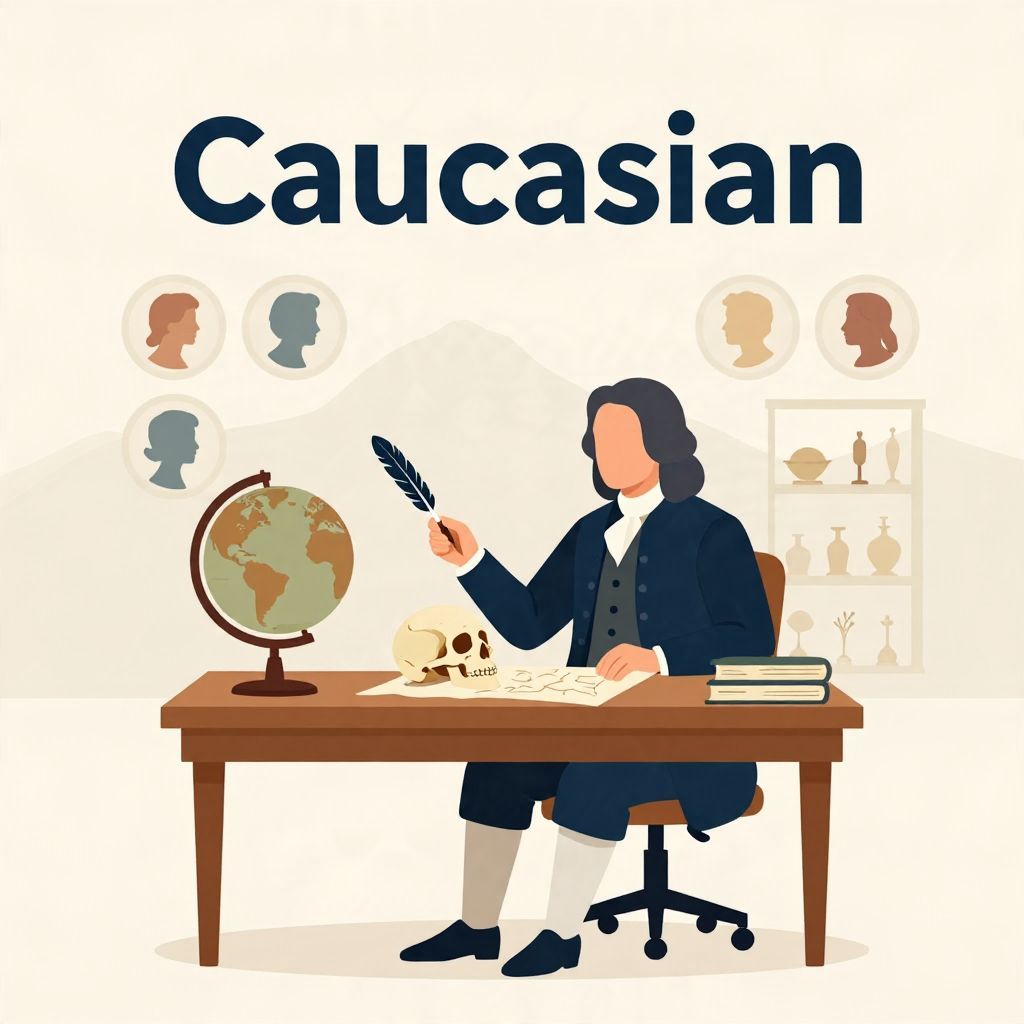
Why are white people called Caucasian? The short answer is that the term comes from an 18th-century European classification system, not from modern biology. A German scholar, Johann Friedrich Blumenbach, used “Caucasian” for one of several human “varieties,” and the word later became a common label for white people in some English-speaking contexts.
That usage spread through science, law, and everyday speech, even though modern anthropology and genetics no longer treat “Caucasian” as a precise racial category. Its history shows how ideas about race were created, circulated, and then challenged over time.
Why are white people called Caucasian?
White people are called Caucasian because 18th- and 19th-century European writers used the word “Caucasian” as a racial label for people they considered “white.” The term began with Johann Friedrich Blumenbach, who chose the name from the Caucasus region, but the connection was based on his theory of human classification, not on a proven origin of white Europeans there.
Where did the term “Caucasian” come from?
The word entered racial language through Johann Friedrich Blumenbach (1752–1840), a German naturalist and physician. In the late 1700s, he proposed a system that grouped humans into several “varieties.” He used “Caucasian” for one of these groups, alongside others such as “Mongolian,” “Ethiopian,” “American,” and “Malay.”
Why did Blumenbach choose the Caucasus?
Blumenbach believed the peoples of the Caucasus region were especially physically attractive and thought they represented an original or ideal human form. He admired a Georgian skull in his collection and used the region’s name to label the category. This was a scholarly guess shaped by the racial thinking of his era, not a modern scientific conclusion.
Was the Caucasus the true homeland of white Europeans?
No. There is no historical or genetic basis for the idea that all white people descend from the Caucasus region. The name “Caucasian” was chosen for a classification scheme, not because Europeans actually originated there. Over time, the label detached from Blumenbach’s original theory and became a broad racial term in the United States and elsewhere.
How did “Caucasian” become a word for white people?
The term spread because 19th-century writers, scientists, and legal systems liked neat racial categories. In that period, race was often treated as a fixed biological fact, and “Caucasian” became one of the formal labels used to describe Europeans and their descendants. It gradually entered dictionaries, census language, immigration debates, and popular speech.
Scientific racism and racial classification
In the 1800s, many European and American thinkers tried to rank human groups using skull measurements, skin color, and other physical traits. These ideas are now recognized as scientific racism, because they used the language of science to support social hierarchies. “Caucasian” fit neatly into that worldview, even though the category was arbitrary and oversimplified.
Law, census forms, and everyday language
In the United States, “Caucasian” appeared in legal and bureaucratic settings because officials wanted a formal-sounding term for white people. It was used in some court cases and government documents, especially in the 19th and early 20th centuries. The word sounded technical, which helped it survive longer than many other old racial labels.
What did “Caucasian” mean historically?
Historically, “Caucasian” did not mean exactly the same thing as “white” in every place or period. At first, it was part of a broader attempt to divide humanity into large racial groups. Later, especially in the United States, it became a near-synonym for white people, though its usage was inconsistent and often depended on law, local custom, and social status.
Not all “white” people were always treated the same
In the 19th and early 20th centuries, groups now widely considered white—such as Irish, Italians, Jews, and some Slavic peoples—were not always treated as fully “white” in social or political practice. This shows that race was not just about appearance; it was also shaped by immigration, religion, class prejudice, and national identity.
Why the term was appealing
“Caucasian” sounded learned and objective. Compared with everyday words like “white,” it gave racial categories a scientific appearance. That made it useful in an era when many people believed human differences could be measured and ranked. The term’s prestige helped it outlast the theory that created it.
What is wrong with the Caucasian racial label?
Modern scholarship rejects the idea that humanity can be divided into a few natural, biological races like “Caucasian.” Human genetic variation does not fit those old categories neatly. People from Europe, West Asia, North Africa, and many other regions share overlapping ancestry and traits, while the boundaries once drawn by race science are historically constructed rather than biologically fixed.
Race is a social category, not a simple biological fact
Today, historians and anthropologists generally treat race as a social and historical idea that has changed over time. That does not mean race has no real effects—racial labels have shaped law, housing, education, and violence—but it does mean the labels themselves are products of history. “Caucasian” is one such product.
Why the term is still used
The word survives in medicine, forms, and casual speech because old habits die hard. Some institutions keep it for tradition, while others avoid it because it is vague and outdated. In modern contexts, “white” is usually clearer, though even that category can vary by country and historical period.
How the term changed over time
The history of “Caucasian” can be understood as a chain of reinterpretations. A regional name became a racial label, and a racial label became a common synonym for white people. Each step reflected changing ideas about human difference rather than a stable scientific truth.
- Late 1700s: Blumenbach introduces “Caucasian” as one human variety.
- 1800s: The term spreads in European and American racial science.
- Late 1800s to early 1900s: It appears in law, census language, and popular usage.
- 20th century onward: Scholars increasingly criticize the category as imprecise and historically loaded.
Why this history matters
Understanding why white people are called Caucasian helps explain how race was invented, standardized, and repeated as if it were natural. The term’s history reveals the power of language in shaping identity and inequality. It also shows why older racial words can sound scientific while carrying assumptions that modern research no longer supports.
A reminder about historical labels
Terms like “Caucasian” are not neutral. They were created in specific intellectual and political settings, and they often reflected the prejudices of their time. Knowing that history helps us read old documents carefully and avoid treating outdated categories as timeless facts.
In the end, white people are called Caucasian because an 18th-century racial classification system gave that name to one human group, and later generations repeated it until it became familiar. The term is historically important, but it is not a precise scientific description. For related reading, see whether Caucasian means white and how ideas about identity connect with political ideology.