
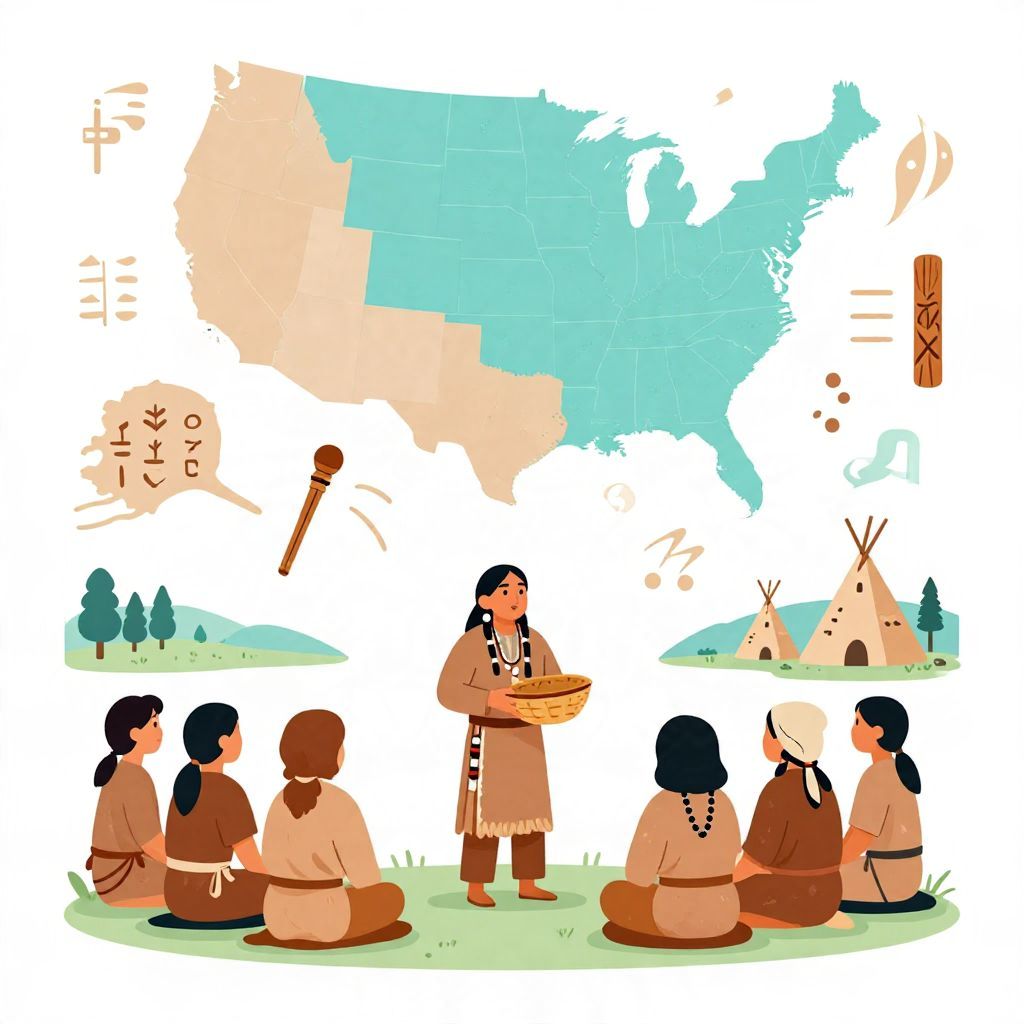
When people ask what language Native Americans spoke, the most accurate answer is: many languages. Indigenous peoples of the Americas did not share one common tongue. Instead, they spoke hundreds of distinct languages, grouped into language families that developed over thousands of years across North, Central, and South America.
The answer depends on where, when, and which Native nation you mean. Some languages survive today, while others disappeared after conquest, forced assimilation, and population loss. Understanding this linguistic diversity is essential to understanding Native American history itself.
What Language Did Native Americans Speak?
Native Americans spoke hundreds of different languages, not a single language. These included major language families such as Algonquian, Iroquoian, Siouan, Uto-Aztecan, Athabaskan, Mayan, Quechuan, and many others. The exact language varied by nation, region, and historical period, and many Indigenous languages are still spoken today.
A Continent of Many Languages, Not One
Before European colonization, the Americas were home to extraordinary linguistic diversity. Native communities were politically independent and geographically spread across forests, plains, deserts, mountains, and coasts. Because of that, language developed in many separate directions over long periods of time. A person in the Great Lakes region would not necessarily understand someone from the Southwest, just as speakers in the Andes would not understand speakers in the Amazon.
It is misleading to speak of “Native American language” as though there were one Native language. The better historical question is which Indigenous language a particular people spoke. For example, the Cherokee spoke Cherokee, the Navajo spoke Navajo, the Lakota spoke Lakota, the Hopi spoke Hopi, and the Maya spoke several related Mayan languages depending on community and era.
Examples of major Indigenous language families
- Algonquian — spoken by many peoples in eastern Canada, the Great Lakes, and parts of the Atlantic coast.
- Iroquoian — including Mohawk, Seneca, Oneida, and Cherokee.
- Siouan — including Lakota, Dakota, Nakota, and related languages.
- Athabaskan — including Navajo and Apache languages in the Southwest, and related languages in Alaska and western Canada.
- Uto-Aztecan — including Hopi, Shoshone, Comanche, and Nahuatl in central Mexico.
- Mayan — a large family in Mesoamerica, with many living languages today.
- Quechuan and Aymaran — important language families in the Andes.
Where Did These Languages Come From?
Most scholars agree that the ancestors of Indigenous peoples in the Americas migrated from northeast Asia thousands of years ago, likely beginning before or around the end of the last Ice Age. Over a long span of time, groups spread across the continents and their speech changed gradually into separate languages. This process is similar to how Latin eventually became French, Spanish, Italian, and other Romance languages, though the American timeline is much older and more complex.
Exactly how many migration waves occurred is still debated, and language evidence is only one part of the larger picture that includes archaeology, genetics, and oral history. But the broad historical pattern is clear: Indigenous languages in the Americas are ancient, diverse, and deeply rooted in long-term human settlement.
Why so many languages developed
- Communities lived far apart and often in difficult terrain.
- Trade existed, but many groups remained politically independent.
- Language changed over generations through daily use.
- Some groups split, migrated, or formed new alliances, creating new speech communities.
What Were the Main Native American Languages in Different Regions?
The languages of Native Americans varied by region, and some areas had especially dense linguistic diversity. In North America alone, dozens of language families and isolates existed before colonization. In Mesoamerica and South America, large civilizations and regional states also used multiple languages, sometimes alongside writing systems or imperial administration.
North America
In eastern North America, many peoples spoke Algonquian and Iroquoian languages. The Great Plains included Siouan, Caddoan, Algonquian, and other language groups. In the Southwest, Uto-Aztecan and Athabaskan languages were especially important. Alaska and the Arctic had their own Indigenous languages, including Inuit languages and Athabaskan varieties.
Mesoamerica
In what is now Mexico and Central America, Indigenous languages included Nahuatl, spoken by the Mexica (Aztecs) and others; the many Mayan languages; Mixtec; Zapotec; and several more. These languages were used in trade, diplomacy, tribute systems, and religious life. Some were written in hieroglyphic or pictorial scripts, especially among the Maya.
South America
In the Andes, Quechua became the language of the Inca Empire and remains widely spoken today. Aymara is also a major Andean language. Farther afield, South America contained hundreds of other Indigenous languages across the Amazon, the Gran Chaco, and coastal regions. Many were never written down before European contact, which makes their histories harder to reconstruct.
Did Native Americans Share a Common Language?
No single language united all Native Americans. However, some regions had lingua francas, or shared trade languages, that allowed communication across different groups. These were not universal languages for the entire hemisphere, but they were important in commerce, diplomacy, and empire. Nahuatl, Quechua, and various regional trade languages played this role in different places and periods.
In some cases, empires encouraged the spread of one language for administration. The Inca used Quechua widely across their realm, though many subject peoples kept their own languages. In central Mexico, Nahuatl became influential beyond the Mexica because of political power and trade. Still, local languages remained vital in everyday life.
Trade, empire, and multilingualism
Many Indigenous people were multilingual. A trader, diplomat, or interpreter might speak a local tongue at home, a regional language in commerce, and another language for political dealings. This multilingual world is one reason the history of Native American languages is so important: it shows that Indigenous societies were not isolated or simplistic, but highly adaptive and interconnected.
What Happened to Native American Languages After European Contact?
European colonization transformed Indigenous language history. Disease, warfare, displacement, slavery, and missionization devastated many communities. Colonial governments often tried to replace Native languages with European ones such as Spanish, English, French, and Portuguese. In the United States and Canada especially, boarding schools and assimilation policies punished children for speaking their ancestral languages.
This language loss was not accidental. It was tied to broader efforts to control land, labor, identity, and political sovereignty. In many places, speaking an Indigenous language became associated with shame or danger because colonial institutions treated Native culture as something to be erased.
Common pressures on Indigenous languages
- Forced removal from homelands
- Mission schools and boarding schools
- Legal restrictions or social punishment
- Intermarriage and urban relocation
- Disruption of intergenerational transmission
Which Native American Languages Survive Today?
Many Native American languages are still spoken, though some are endangered. In the United States and Canada, languages such as Navajo, Cherokee, Ojibwe, Lakota, Cree, and Inuktitut remain in use, alongside many others. In Mexico, Guatemala, Peru, Bolivia, and elsewhere, millions of people still speak Indigenous languages, especially Quechua, Aymara, Nahuatl, and numerous Mayan languages.
Language survival varies widely. Some communities have many fluent speakers and active language programs; others have only a handful of elderly speakers left. In recent decades, tribal governments, schools, families, and cultural institutions have worked to revive and teach Indigenous languages through immersion programs, dictionaries, recordings, and digital tools.
Why language revitalization matters
For many Native communities, language is not just a tool for communication. It carries oral history, ecological knowledge, kinship terms, ceremony, humor, and worldview. A language can encode relationships to land and ancestry that are difficult to translate fully into English, Spanish, or French. Revitalization efforts are therefore both cultural and political acts.
How Historians and Linguists Study Native Languages
Because many Indigenous languages were originally oral, historians rely on a mix of evidence: early missionary records, colonial dictionaries, oral traditions, comparative linguistics, and, where available, Indigenous writing systems. Scholars compare related languages to reconstruct older forms and trace how languages may have spread or changed over time.
At the same time, researchers must be careful not to treat written colonial records as neutral. Many were created by outsiders who misunderstood pronunciation, grammar, or meaning. Oral history and community knowledge remain essential sources, especially when studying languages that were suppressed or nearly lost.
Historical Significance of Native American Languages
The languages Native Americans spoke are historically significant because they reveal the depth, diversity, and continuity of Indigenous civilization in the Americas. They show that Native peoples were not one culture but many, each with its own history, territory, and identity. Language also helps historians understand migration, trade, diplomacy, and resistance across the continent.
Just as importantly, Indigenous languages are living evidence of survival. Despite centuries of colonization, many Native communities have preserved or revived their languages. That persistence is one of the clearest reminders that Native American history is not only a story of loss, but also of adaptation, endurance, and renewal.
So, what language did Native Americans speak? The historical answer is that they spoke hundreds of languages, shaped by region and nation, with many still alive today. To learn more through comparison, you might also explore what language the Romans spoke or what language the Vikings spoke.