
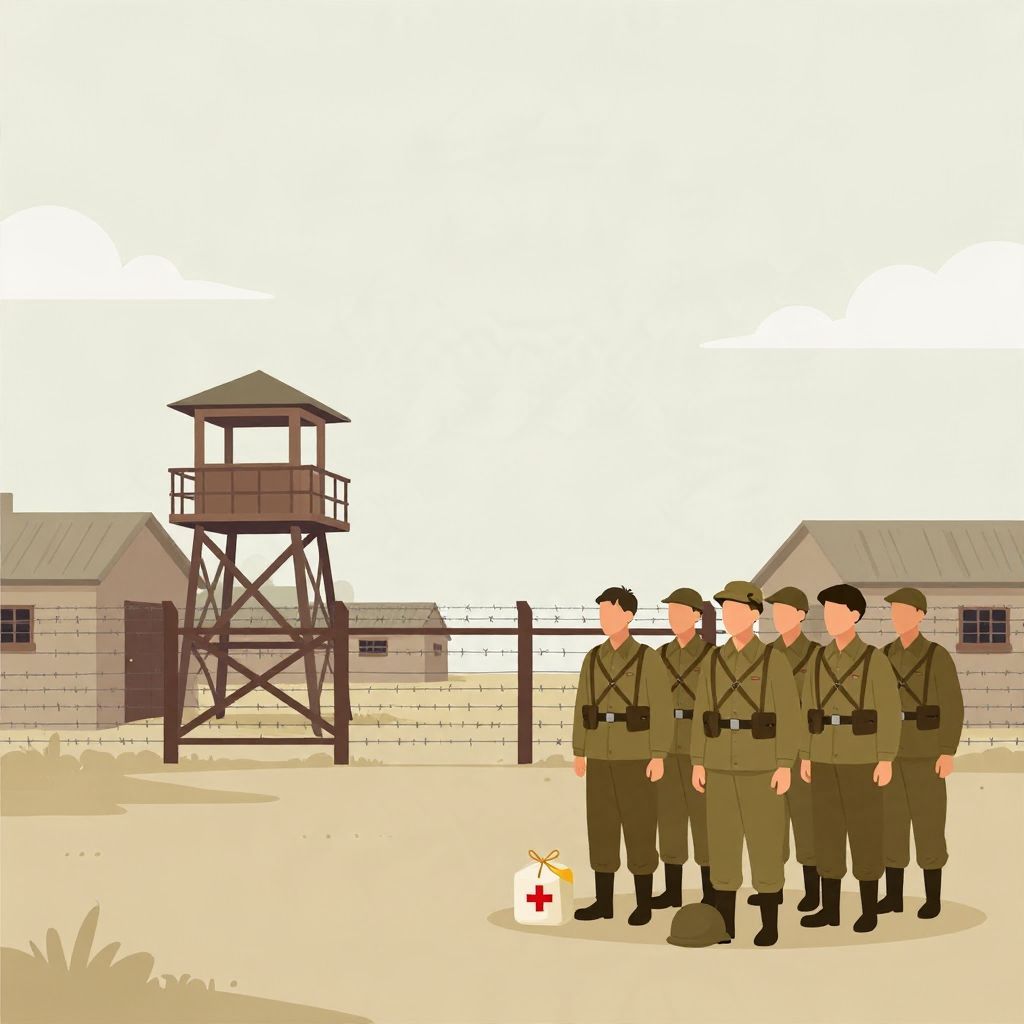
What is a POW? In history, the term means “prisoner of war”: a combatant who has been captured by an enemy force during an armed conflict. The phrase is modern, but the practice is ancient, and the treatment of captured fighters has changed dramatically over time.
From battlefield captivity in the ancient world to the detailed rules of the Geneva Conventions, the history of POWs reveals how societies have defined war, honor, and human rights. The term itself is simple; its historical meaning is not.
What Is a POW?
A POW, or prisoner of war, is a person detained by an enemy power because they are a member of an opposing armed force or an organized fighting group in wartime. The term applies to captured soldiers and, in some cases, certain other combatants protected by international law. It does not mean every captive in war is a POW.
The Origins of the Term “Prisoner of War”
The phrase “prisoner of war” is a relatively modern English expression, but the idea behind it is far older. In earlier centuries, captured enemies were often called captives, prisoners, hostages, or slaves depending on the culture and era. The abbreviation “POW” became especially common in the 20th century, during the world wars.
Ancient and medieval captivity
In the ancient world, a captured enemy might be ransomed, enslaved, executed, or absorbed into the victor’s society. The treatment depended less on universal law than on custom, status, and the needs of the conqueror. In medieval Europe, nobles were often held for ransom, while ordinary soldiers could face harsher outcomes.
From custom to legal category
The modern meaning of POW developed as states began to regulate warfare more systematically. By the 18th and 19th centuries, European powers increasingly treated captured soldiers as a separate legal category rather than simply as criminals or slaves. This shift reflected changing ideas about war between states and the status of uniformed soldiers.
How POW Status Developed in History
The history of POWs is the history of changing rules about who may be captured, how they may be held, and what rights they retain. Over time, war moved from a realm of largely discretionary treatment toward one governed by international agreements, especially in the 19th and 20th centuries.
Early modern warfare
In early modern Europe, large standing armies made battlefield capture more common. States began exchanging prisoners, organizing paroles, and negotiating releases. These practices were practical as much as humanitarian: keeping thousands of prisoners fed and guarded was expensive, and exchanges helped restore manpower.
The 19th century and international law
The 19th century marked a major turning point. As warfare became more bureaucratic and international diplomacy more formal, legal standards emerged. The Hague Conventions at the end of the century helped define the treatment of captured soldiers, laying groundwork for the more detailed protections that followed in the 20th century.
What Rights Do POWs Have?
Under modern international law, POWs are supposed to be treated humanely and protected from torture, execution, humiliation, and unsafe conditions. They are entitled to food, shelter, medical care, communication with families in many circumstances, and protection from violence. These rights are not perfect in practice, but they are central to modern war law.
The Geneva Conventions
The most important legal framework is the Third Geneva Convention of 1949, which sets out extensive rules for the treatment of prisoners of war. It defines who qualifies, how they must be housed, what labor they may be required to do, and how they should be repatriated after hostilities end. Earlier conventions and later protocols also shaped these standards.
Who qualifies as a POW?
Not everyone captured in war automatically receives POW status. Traditional armed forces, militia members who meet certain conditions, and some organized resistance fighters may qualify. Civilians are generally not POWs; if detained, they fall under different legal protections. This distinction is crucial in modern conflicts.
POWs in the World Wars
The First and Second World Wars made the POW issue globally visible on an unprecedented scale. Millions of soldiers were captured, and their treatment varied widely by country, theater, and phase of the war. These conflicts exposed both the strengths and the failures of international law.
World War I
During World War I, millions of soldiers became prisoners. Many were held for years in camps across Europe and beyond. Conditions varied, but the war also encouraged organized prisoner exchanges, inspections, and relief efforts. The scale of captivity helped normalize the idea that captured soldiers were not simply criminals.
World War II
World War II produced even larger numbers of POWs and far harsher abuses in some regions. German, Soviet, Japanese, Allied, and colonial forces all held prisoners, but treatment differed sharply. Some prisoners experienced relative compliance with legal standards; others suffered starvation, forced labor, executions, or death marches. The war’s brutality revealed how fragile legal protections could be when states ignored them.
Why the Second World War mattered
The experience of POWs during World War II strongly influenced postwar law. Many governments and humanitarian organizations concluded that clearer rules, stronger monitoring, and broader definitions of protected persons were necessary. The result was a more detailed international framework after 1945.
POWs in the Modern Era
In the 20th and 21st centuries, the term POW has remained important in conventional wars, but modern conflicts have complicated its use. Civil wars, insurgencies, anti-colonial wars, terrorism, and occupations have raised difficult questions about who counts as a lawful combatant and what protections apply.
Irregular warfare and legal disputes
When armed groups do not wear uniforms, answer to a state, or follow the rules of war, governments often dispute whether captured fighters are POWs or unlawful combatants. Historians and legal scholars note that these classifications have major consequences, because they determine detention rights, trial procedures, and access to international monitoring.
Humanitarian oversight
Organizations such as the International Committee of the Red Cross have played a major role in visiting prisoners, transmitting messages, and promoting compliance with the laws of war. Their work reflects a broader historical trend: the attempt to make wartime captivity less arbitrary and less brutal.
Why the POW Concept Matters Historically
The idea of a POW matters because it shows a major shift in how societies understand war. In older systems, captured enemies were often treated as spoils of victory. In modern systems, at least in principle, they are protected persons with legal status. That change reflects the growth of international law, state bureaucracy, and humanitarian norms.
War, honor, and state power
POW history also reveals changing ideas about military honor. In some eras, surrender was seen as shameful; in others, it became a regulated and accepted part of warfare. States had practical reasons to preserve prisoners’ lives, but they also had moral and political reasons to show restraint. The POW system emerged from both.
Limits of the law
It is important not to idealize the history of POW treatment. Legal protections have often been violated, especially in total war and ideological conflict. Still, the existence of POW law marks a real historical development: war was not only fought on battlefields, but also argued over in treaties, courts, and diplomatic negotiations.
Common Misunderstandings About POWs
Because the term appears often in films and news reports, it is easy to misunderstand. A POW is not just any captive, and not all detainees in wartime are prisoners of war. The label depends on legal status, the nature of the conflict, and the rules governing the combatants involved.
- POW does not mean civilian hostage. Civilians taken in war are protected under different legal rules.
- POW does not mean criminal prisoner. A prisoner of war is detained because of participation in hostilities, not ordinary crime.
- POW status is legal, not merely descriptive. It carries rights and obligations under international law.
- Not every armed group member qualifies automatically. Combatant status can be disputed in irregular wars.
Conclusion: What Is a POW in Historical Perspective?
A POW is a prisoner of war, but the term represents much more than a definition. It reflects centuries of changing attitudes toward enemies, surrender, and the limits of violence. From ancient captivity to modern humanitarian law, the history of POWs shows how war has been regulated, contested, and humanized over time. For related background, see what a black flag means and what an upside-down flag means.