
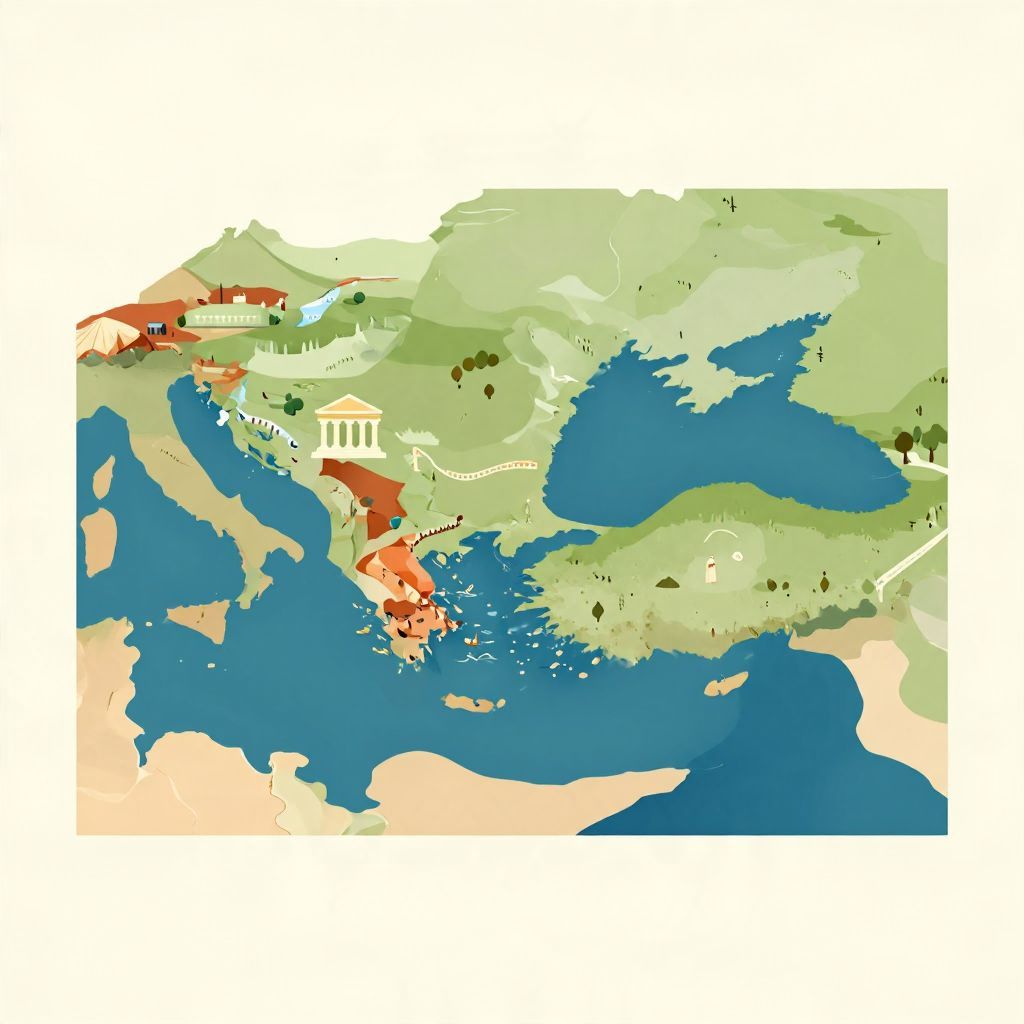
What is Asia Minor? In historical terms, it is the name long used for the large peninsula that makes up most of modern-day Turkey. Stretching between the Aegean, Black, and Mediterranean seas, it was one of the most important crossroads of the ancient world, linking Europe, Asia, and the Near East.
The term appears in Greek and Roman usage and became common in later European scholarship. It does not describe a single kingdom or empire, but a region whose borders, peoples, and political control changed repeatedly over thousands of years.
What is Asia Minor?
Asia Minor is the historical name for Anatolia, the westernmost part of Asia and the core landmass of modern Turkey. The phrase was used by Greeks and Romans to distinguish this peninsula from the larger Asian continent. Over time, it became a standard term in history, archaeology, and classical studies.
Where was Asia Minor located?
Asia Minor occupied a strategic peninsula between three seas and two continents. It formed a natural bridge between southeastern Europe and western Asia, which is why so many empires fought to control it. Its geography included coastal plains, mountain ranges, inland plateaus, and important river valleys.
Geographic boundaries
- West: the Aegean Sea
- North: the Black Sea
- South: the Mediterranean Sea
- East: the inland highlands that connect to the Armenian and Iranian plateaus
Because the region is a peninsula rather than an isolated landmass, it was never culturally uniform. Coastal cities often looked toward the Greek world and the Mediterranean, while inland communities were shaped by Anatolian, Persian, and later Turkish influences.
Why was it called Asia Minor?
The name “Asia Minor” means “Lesser Asia” in Latin, used to distinguish the peninsula from the much larger continent of Asia. Ancient Greek writers more often referred to the area as Anatolē, meaning “the east” or “sunrise,” a term that later developed into Anatolia. The Roman and Byzantine worlds helped spread the Latin form.
Asia Minor and Anatolia
Today, historians usually prefer Anatolia for the peninsula itself, while “Asia Minor” is often used in classical or older historical writing. The two terms overlap closely, but they are not always identical in emphasis. “Asia Minor” reflects a Greco-Roman naming tradition, while “Anatolia” is the more common modern geographic term.
The ancient history of Asia Minor
Asia Minor was inhabited for millennia before the rise of the classical Greek city-states. Archaeology shows complex societies there from the Neolithic period onward. By the Bronze Age, the region was home to powerful kingdoms and trade networks that connected Mesopotamia, the Aegean, and the Levant.
Early civilizations
Among the best-known early powers were the Hittites, who built a major kingdom in central Anatolia during the second millennium BCE. Their capital at Hattusa became one of the great political centers of the ancient Near East. Other peoples and states, including the Luwians, Phrygians, Lydians, and later the Carians and Lycians, helped shape the region’s diverse cultural landscape.
Greek settlement and the coastal cities
From roughly the late second millennium to the early first millennium BCE, Greek-speaking settlers established cities along the western and southern coasts. These communities became part of the wider Greek cultural world, though they remained in close contact with inland Anatolian peoples. Cities such as Miletus, Ephesus, and Smyrna became major centers of trade, philosophy, and art.
Asia Minor was also the setting for many famous episodes in Greek tradition, including the Trojan War legend associated with the site of Troy. While the epic story belongs to literature and myth, the archaeological site in northwestern Anatolia shows that the area was indeed important in the Bronze Age.
Asia Minor under Persia, Greece, and Rome
Control of Asia Minor shifted repeatedly as larger empires expanded. Its position made it valuable for taxation, military movement, and access to ports and inland routes. The region was never politically static; it was a prize for empires because it connected the eastern Mediterranean to the interior of Asia.
Persian rule
In the 6th century BCE, the Achaemenid Persian Empire conquered much of Asia Minor. Persian control brought the area into a vast imperial system, though local rulers and city-states often retained some autonomy. Greek cities on the coast sometimes resisted Persian authority, and their revolts helped trigger the wider Greco-Persian conflicts.
Alexander and the Hellenistic kingdoms
Alexander the Great invaded Asia Minor in 334 BCE, defeating Persian forces and opening the region to Macedonian rule. After his death, his successors divided the conquered territories. Asia Minor then became contested among Hellenistic dynasties such as the Seleucids, Pergamon’s Attalids, and others. Greek language and culture spread further, but local traditions remained strong.
Roman incorporation
Rome gradually absorbed Asia Minor between the 2nd and 1st centuries BCE. Some areas were annexed directly, while others first existed as client kingdoms. Under Roman rule, the region became one of the most prosperous parts of the empire. Its cities were wealthy, urbanized, and deeply connected to trade, administration, and early Christianity.
Asia Minor mattered to Rome not only for its resources but also for its roads and ports. It linked the eastern provinces to the Aegean and provided a base for imperial power in the eastern Mediterranean.
Asia Minor in the Byzantine and medieval periods
After the division of the Roman Empire, Asia Minor became a core territory of the Eastern Roman, or Byzantine, Empire. For centuries it served as the empire’s military heartland, supplying soldiers, grain, and administrative capacity. Major cities and fortified lines helped defend the empire against Persian, Arab, and later Turkish advances.
Christianity and Byzantine life
Asia Minor played a central role in early Christianity. Many of the New Testament’s communities were located there, and the region hosted important church councils and theological debates. Byzantine monasteries, bishoprics, and pilgrimage sites added to its religious importance.
Turkic migration and Seljuk expansion
After the 11th century, Turkic groups entered Asia Minor in greater numbers. The Battle of Manzikert in 1071 is often treated as a turning point because it weakened Byzantine control in the interior, though the process of change was gradual and uneven. Seljuk and other Turkish powers established themselves across much of the peninsula over time.
This transformation did not happen overnight. Greek-speaking, Armenian, Syriac, and other Christian communities remained present, and political control varied by region. But over the centuries, the demographic and linguistic balance changed, laying the groundwork for the later Turkish character of the area.
Asia Minor in the Ottoman period
By the late medieval and early modern periods, most of Asia Minor had come under Ottoman rule. The Ottomans built a state that connected Anatolia with the Balkans, the Middle East, and North Africa. Asia Minor became the empire’s central land base, not a peripheral possession.
Why the Ottoman era mattered
Ottoman administration, settlement, taxation, and military organization reshaped the region. Cities such as Bursa, Ankara, Konya, and later Istanbul became major centers of power and commerce. The region’s population remained diverse, including Muslims, Christians, and Jews, though that diversity changed over time through migration, conversion, war, and state policy.
In the 19th and early 20th centuries, nationalism, imperial decline, and war transformed Asia Minor again. The collapse of the Ottoman Empire after World War I led to conflict, population displacement, and the creation of the modern Republic of Turkey. The old historical label “Asia Minor” gradually gave way in common usage to “Anatolia.”
Why Asia Minor matters in history
Asia Minor matters because it was a meeting place of civilizations. It connected the ancient Aegean world with the Near East, and later linked Byzantine, Islamic, and Ottoman history. Few regions have seen such a long sequence of cultural overlap, conquest, adaptation, and continuity.
Its lasting historical significance
- It was home to major ancient states, including the Hittites and Lydians.
- It helped shape Greek colonization and classical urban culture.
- It became a key Roman and Byzantine heartland.
- It was central to the spread of Christianity and later Islam in the eastern Mediterranean.
- It formed the geographic core of modern Turkey.
In other words, Asia Minor is not just an old name on a map. It is a historical region whose changing identity reflects the broader story of the eastern Mediterranean and the Near East.
In summary
Asia Minor is the historical name for the Anatolian peninsula, the landmass that forms most of modern Turkey. Its importance comes from its geography: a crossroads of trade, migration, warfare, and empire. If you want to explore related ancient geography, see where Troy was located or, for a different kind of historical region, what Prussia was.