
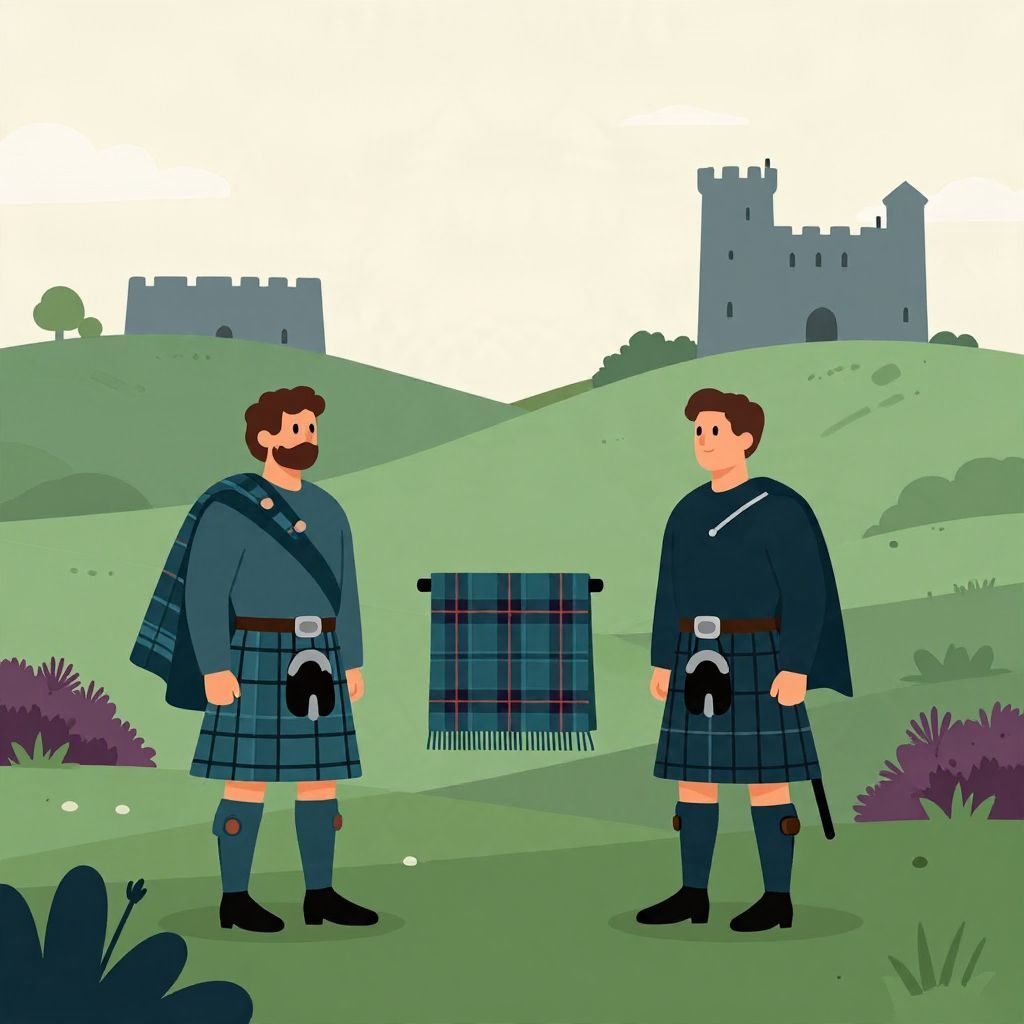
What is a kilt? At its simplest, a kilt is a knee-length garment with pleats at the back, most closely associated with Scotland. Today it is widely recognized as a symbol of Scottish identity, but its history is longer and more complex than a single national costume.
The kilt developed from earlier Highland dress, changed shape over centuries, and became a cultural emblem through politics, migration, and revival. Its story blends practical clothing, clan identity, military history, and later ideas of heritage.
What Is a Kilt?
A kilt is a pleated garment traditionally worn around the waist, covering the body from the waist to the knees. The familiar modern version is the tailored kilt, but the original Highland kilt was the great kilt or feileadh mòr, a long length of cloth wrapped and belted around the body. Both are linked to Scotland, especially the Highlands.
Where Did the Kilt Come From?
The kilt emerged in the Scottish Highlands during the late medieval and early modern periods, probably between the 16th and 17th centuries. It was not invented all at once. Instead, it developed from earlier forms of dress used in Gaelic-speaking communities, where a large woolen cloth could serve as clothing, blanket, and weather protection.
The Great Kilt: Practical Highland Clothing
The earliest widely recognized form was the great kilt, a large piece of tartan cloth gathered and belted at the waist, with the upper part draped over the shoulder or worn as a cloak. It was practical in a wet, rugged environment and suited a pastoral society where mobility mattered. Because it was made from a single broad cloth, it could be adjusted for work, travel, or sleeping outdoors.
From Utility to Tailored Garment
The smaller, modern-style kilt appeared later, likely in the 18th century. It was tailored with sewn-in pleats and did not require the same amount of cloth as the great kilt. This version became especially associated with Highland regiments and later with formal Scottish dress. The shift from wraparound cloth to tailored garment reflects broader changes in tailoring, trade, and military organization.
Why Is the Kilt Associated with Scotland?
The kilt became strongly associated with Scotland because it was worn in the Highlands, a region that retained distinct language, kinship, and dress traditions longer than much of the Lowlands. Over time, outsiders and later Scots themselves came to treat Highland dress as a marker of Scottish identity more broadly.
Highland Identity and Clan Culture
In the early modern period, Highland society was organized around kin groups and local power structures. Clothing could signal regional belonging, status, and practicality. Tartan patterns were used in woven cloth, though the idea that each clan had one ancient, fixed tartan is mostly a later development. In reality, patterns varied by region, availability of dyes, and fashion.
Lowland and Highland Differences
It is important not to imagine that all Scots always wore kilts. The garment was primarily Highland dress, while Lowland clothing followed broader British and European fashions. The kilt’s later national symbolism grew partly because Highland culture was romanticized after political and military upheavals in the 18th century.
The Kilt in Scottish History
The kilt’s history is tied to conflict, law, and cultural change. It was not simply a timeless tradition preserved unchanged. Its meaning shifted as Scotland changed politically, especially after the Jacobite risings and the integration of Scotland into the British state.
The Jacobite Era
During the 17th and 18th centuries, some Highland clans supported the Stuart claim to the throne in a series of uprisings known as the Jacobite risings. Highland dress, including the kilt, became linked in the public imagination with Highland martial culture. This association was strengthened by the role of Highland soldiers in both rebellion and government service.
The Dress Act of 1746
After the defeat of the Jacobites at Culloden in 1746, the British government passed the Dress Act as part of efforts to weaken Highland clan power. The law restricted Highland dress, including the wearing of tartan and kilt, except in military service. This was not a ban on Scottish identity as such, but it was a direct attempt to reshape Highland society.
The law was eventually repealed in 1782. By then, however, the political meaning of Highland dress had changed. What had once been local and regional clothing was increasingly becoming a symbol of a romanticized Scottish past.
How the Kilt Became a Symbol of Scotland
The modern image of the kilt owes much to the late 18th and 19th centuries. Writers, artists, and elites helped turn Highland dress into a national emblem. This process was not purely spontaneous; it was shaped by fashion, monarchy, tourism, and literature.
Romanticism and Reinvention
In the Romantic era, Europe developed a strong taste for medievalism, folklore, and “noble” regional traditions. Scotland became a favorite subject of this imagination. The kilt and tartan were presented as ancient, heroic, and distinctly Scottish, even when some of the most familiar customs were standardized or reinvented during this period.
Royal Patronage and Popular Fashion
Visits by King George IV to Scotland in 1822, carefully staged by Sir Walter Scott and others, helped elevate tartan and Highland dress in elite culture. Later, Queen Victoria and Prince Albert’s affection for Scotland reinforced the association. By the 19th century, kilts were worn not only for local tradition but also for ceremonial display, patriotism, and tourism.
What Does the Word “Kilt” Mean?
The word kilt is usually linked to the idea of “pleating” or “tucking,” though its exact linguistic origin is debated. The term appears in English usage relatively late compared with the garment itself. Earlier Gaelic terms such as feileadh are more directly connected to Highland dress traditions.
In modern English, “kilt” refers specifically to the tailored garment, but historically the word has been used more loosely. That is one reason discussions of kilt history can become confusing: the garment, the term, and the cultural meaning did not all develop at the same time.
What Is a Kilt Made Of?
Traditionally, kilts were made of wool, a durable and weather-resistant material well suited to the Scottish climate. Modern kilts are often made from wool tartan cloth, though lighter materials may be used for costume or informal wear. The cloth may be woven in a tartan pattern, a design of intersecting stripes that creates repeating checks.
Tartan and Its Later Importance
Tartan is now inseparable from the kilt in popular imagination, but tartan cloth existed before the modern national symbolism attached to it. The idea that specific tartans belong to specific clans became much more formalized in the 18th and 19th centuries. Today tartan can indicate family, district, regiment, or simply style.
When and Why Do People Wear Kilts Today?
Today, kilts are worn for weddings, graduations, formal events, Highland games, military ceremonies, and cultural celebrations. They may be worn by people with Scottish ancestry, but also by anyone participating in Scottish cultural traditions. In this sense, the kilt has moved from everyday regional dress to ceremonial and symbolic clothing.
Military and Ceremonial Use
Scottish regiments in the British Army helped preserve the kilt as a formal uniform. This military association gave the garment durability and prestige, especially in the 19th and early 20th centuries. For many people, the kilt came to represent courage, loyalty, and service as much as ancestry.
Modern Identity and Debate
Because the kilt is so strongly identified with Scotland, it can carry different meanings depending on context. For some wearers, it is a family tradition; for others, a national symbol; for others still, a fashion statement. Historians generally emphasize that the kilt is not a frozen relic of the past but a living cultural form whose meaning has changed over time.
Common Misconceptions About Kilts
- “Kilts are ancient and unchanged.” In fact, they evolved over centuries from the great kilt to the tailored kilt.
- “Every clan always had its own tartan.” Clan tartans were standardized much later than many people assume.
- “Kilts were always worn by all Scots.” They were mainly Highland dress, not universal Scottish clothing.
- “The kilt was only for men.” Historically it was male clothing in most contexts, but modern cultural practice is broader and more flexible.
Why the Kilt Still Matters
The kilt endures because it is more than clothing. It reflects the history of Highland life, the impact of political suppression, and the power of cultural revival. It also shows how a practical garment can become a national symbol through memory, fashion, and identity-making.
So, what is a kilt? It is a Scottish garment with roots in Highland dress, transformed over time from practical woolen wrap to tailored ceremonial wear. Its history reveals how clothing can carry the story of a people, a region, and a nation. For more on related topics, explore articles on Scottish history and the Jacobite risings.