
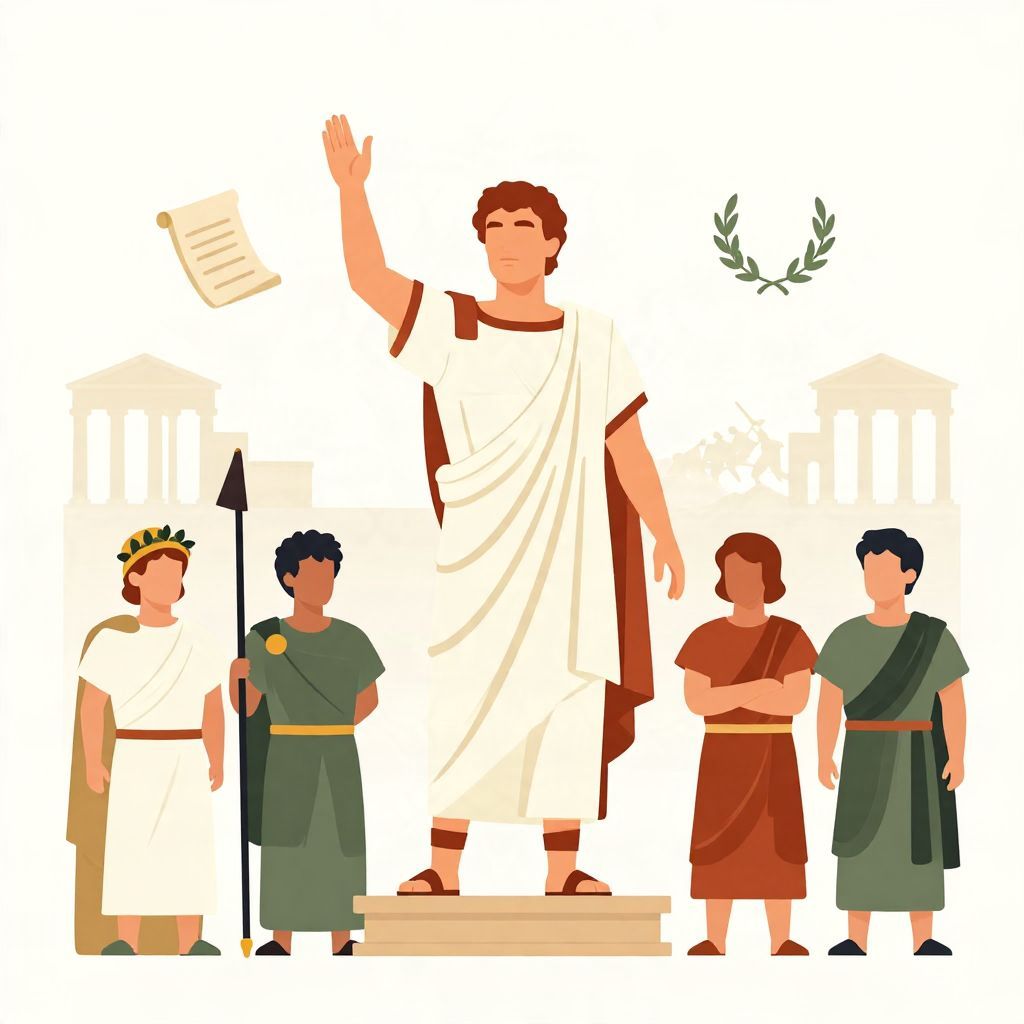
What did Julius Caesar do? In the broadest sense, he transformed the Roman Republic from a system of competitive aristocratic politics into a one-man regime that paved the way for the Roman Empire. He did this through military conquest, political alliances, civil war, and sweeping reforms.
He was also a writer, administrator, and public figure whose life ended in assassination in 44 BCE. His career mattered not only because of what he achieved, but because of the crisis it exposed in Roman politics.
What Did Julius Caesar Do?
Julius Caesar rose from Roman aristocrat to military commander, conquered Gaul, crossed the Rubicon to begin civil war, defeated his rivals, and became dictator of Rome. He reformed the calendar, expanded citizenship and administration, and concentrated power in ways that helped end the Roman Republic.
Caesar’s Early Life and Rise in Roman Politics
Gaius Julius Caesar was born in 100 BCE, or possibly 102 BCE according to some ancient traditions, into a patrician family that claimed ancient ancestry but little recent power. He entered politics during a period of intense rivalry among Roman elites, when personal ambition, military success, and public popularity often mattered as much as formal office.
Caesar aligned himself with powerful patrons, including figures associated with the popular political faction in Rome. He held the usual sequence of offices expected of an ambitious Roman noble, building support through speeches, legal work, and carefully managed public generosity. His early career showed a pattern that would define him later: he combined traditional Roman institutions with a willingness to challenge established limits.
Why his early career mattered
Rome’s Republic was not a democracy in the modern sense. Power rested with a narrow elite, but competition among that elite could become violent. Caesar entered politics at a time when the system was under strain, and his rise reflected the instability of the late Republic as much as his personal talent.
What Did Caesar Do in Gaul?
Caesar’s greatest military achievement was the conquest of Gaul, roughly modern France and Belgium, between 58 and 50 BCE. As governor, he led Roman armies against a wide range of Gallic peoples, expanded Roman control deep into western Europe, and gained the wealth, prestige, and loyal troops that made him one of the most powerful men in the Mediterranean world.
The campaign was not a single battle but a long series of wars. Caesar fought migrations, tribal alliances, and repeated uprisings. He also crossed into Britain in 55 and 54 BCE, partly for prestige and partly to demonstrate Roman reach, though these expeditions did not lead to lasting conquest at the time.
How the Gallic War changed Caesar
Gaul gave Caesar an army personally loyal to him, not just to the Roman state. It also brought enormous spoils and fame. He described these campaigns in Commentaries on the Gallic War, a work that served both as military record and political self-promotion. The writing helped shape his public image as disciplined, decisive, and victorious.
The Civil War and the Crossing of the Rubicon
Caesar’s rise alarmed many senators, especially those who feared he would dominate Roman politics permanently. In 49 BCE, after years of political tension, he crossed the Rubicon River with his army, a direct challenge to Roman law and authority. This act began a civil war against forces led by Pompey and the senatorial faction.
The phrase “crossing the Rubicon” later became a symbol of irreversible commitment, but historically it marked a legal and political rupture. Caesar’s army marched into Italy, and his opponents fled. The struggle then spread across the Mediterranean world, with major fighting in Greece, North Africa, and Spain.
Key stages of the civil war
- 49 BCE: Caesar crosses the Rubicon and advances into Italy.
- 48 BCE: He defeats Pompey’s forces at Pharsalus in Greece.
- 47–46 BCE: He secures power in Egypt and North Africa.
- 45 BCE: He defeats the last major opposition in Spain.
Pompey was eventually defeated and killed in Egypt. Caesar then became the dominant figure in Roman politics, though victory did not bring immediate stability. Instead, it concentrated power in his hands and deepened fears that the Republic was being replaced by autocracy.
What Did Julius Caesar Do as Dictator?
After the civil war, Caesar held extraordinary powers. He became dictator, a Roman office that was originally temporary and emergency-based, but under Caesar it became much more permanent. He was eventually named dictator perpetuo, or dictator for life, in 44 BCE.
As ruler, Caesar tried to reorganize Roman government and society. Some of his measures were practical administrative reforms; others were political acts meant to reward supporters, weaken rivals, and stabilize the state under his control. His rule was not simply tyranny in the modern sense, but it did break with the Republic’s old balance of power.
Major reforms associated with Caesar
- He reformed the calendar, creating the basis of the Julian calendar.
- He expanded citizenship and privileges in some provinces.
- He increased the Senate’s size, partly to include more supporters.
- He reorganized debt and settlement policies.
- He planned public works and administrative changes in Rome and beyond.
Not all reforms were revolutionary, and some were continuations of earlier trends. But together they show a ruler trying to manage a vast and troubled state by centralizing authority. The calendar reform was especially lasting: with later adjustments, it became the standard calendar in much of Europe for centuries.
Was Caesar a Good Ruler or a Tyrant?
Historians usually avoid a simple yes-or-no answer. Caesar was effective in some respects and deeply threatening in others. He ended a destructive civil war, introduced administrative reforms, and expanded Roman influence. At the same time, he concentrated power in a way that undermined republican government and alarmed many senators.
His supporters saw him as a strong leader who could restore order after decades of political violence. His enemies saw a man who was making himself king in all but name, a word Romans associated with the loss of liberty. The tension between those views helps explain why Caesar remains such a contested figure.
Why Roman elites feared him
Roman political culture valued competition among aristocrats, but it also feared any one man becoming too dominant. Caesar’s honors, portraits, titles, and lifetime powers looked to many senators like the end of shared rule. Whether he intended to abolish the Republic entirely is debated, but his actions made many Romans believe that he already had.
The Assassination of Julius Caesar
Caesar was assassinated on 15 March 44 BCE, the famous Ides of March. A group of senators, including Brutus and Cassius, stabbed him to death during a Senate meeting. They claimed they were saving the Republic from tyranny.
The assassination did not restore republican government. Instead, it triggered another round of civil wars, as Caesar’s supporters and heirs fought for control. In that sense, the conspirators removed one powerful man but did not solve the underlying crisis of Roman politics.
What the assassination shows
Caesar’s death reveals how deeply the Republic had fractured. Political violence had become a tool of elite competition long before 44 BCE, and his murder was both a dramatic climax and a symptom of that breakdown. The event became one of the most famous in world history because it symbolized the struggle between republican ideals and concentrated power.
What Was Caesar’s Historical Significance?
Caesar’s significance lies in the fact that he did not merely hold power; he helped change the structure of Roman rule. His career marked the collapse of the old republican order and the rise of personal monarchy under his adopted heir, Octavian, later Augustus. Caesar himself did not found the Roman Empire, but he made its creation possible.
His legacy also survived in language and institutions. The title “Caesar” became associated with imperial authority in later Roman and European history. His reforms, especially the calendar, shaped daily life long after his death. His writings remain valuable historical sources, though they must be read critically because they were also political propaganda.
Lasting effects of Caesar’s career
- He accelerated the end of the Roman Republic.
- He helped establish the model of one-man rule in Rome.
- He influenced later imperial titles and political symbolism.
- He left behind major written accounts of Roman warfare.
- He changed the calendar system used across the Roman world.
So, What Did Julius Caesar Do?
Julius Caesar conquered Gaul, won a civil war, seized control of Rome, and ruled as dictator while introducing reforms that outlasted him. He was one of the most consequential figures in ancient history because his actions helped end the Roman Republic and open the path to empire.
To understand Caesar is to understand how military success, political ambition, and institutional crisis combined to reshape Rome. If you want to explore the aftermath of his death, see what the Ides of March means and, for broader context on power and ideas in politics, what political ideology is.