
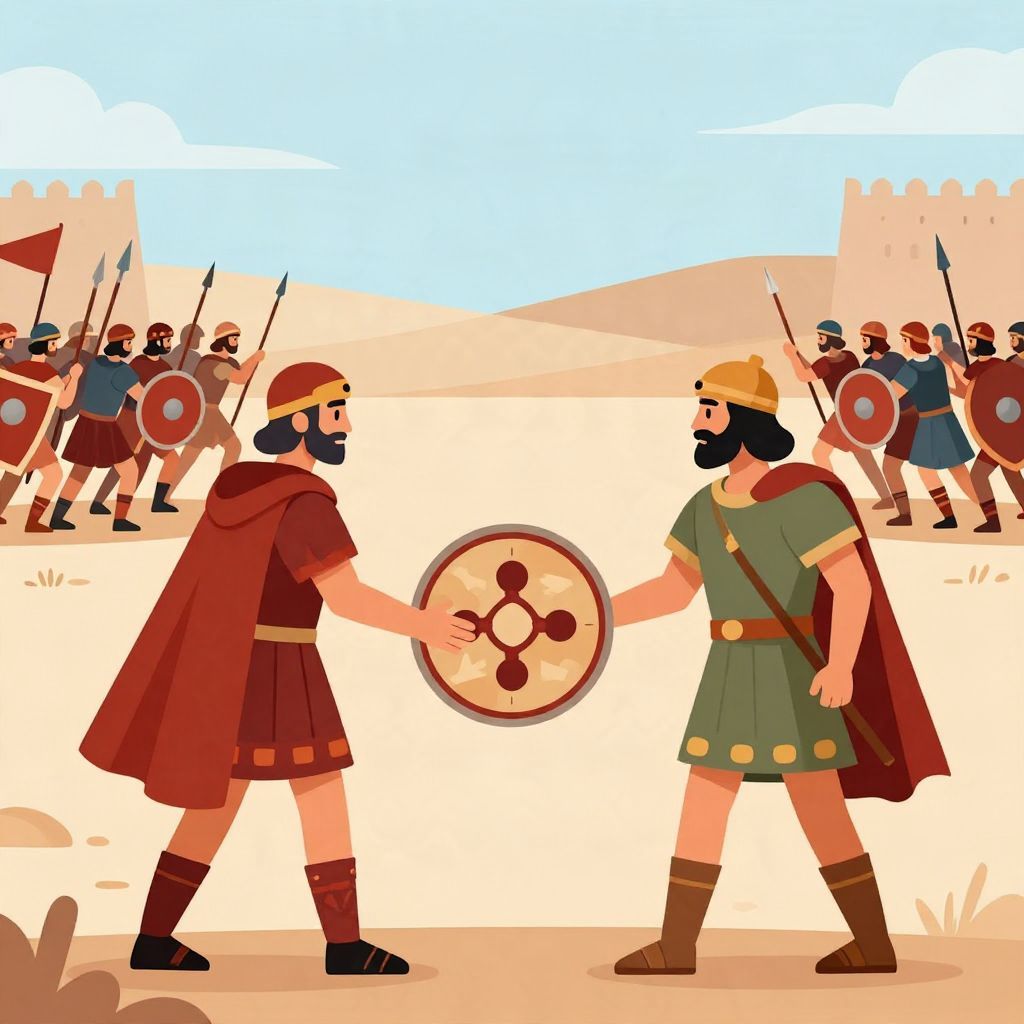
The phrase “the enemy of my enemy is my friend” sounds ancient, but its exact wording is modern. The idea behind it is much older: states, tribes, and rulers have long formed temporary alliances when a shared threat made cooperation useful. In history, this logic has often shaped wars, diplomacy, and revolutions.
Its meaning is simple, but its consequences have been profound. From ancient empires to the world wars, the saying helps explain why rivals sometimes cooperate—and why such partnerships are often fragile, strategic, and short-lived.
What does “the enemy of my enemy is my friend” mean in history?
The phrase describes a practical alliance between two parties who do not necessarily trust each other but share a common opponent. Historically, it has been used to explain diplomacy in which survival, not friendship, drives cooperation. The saying is ancient in spirit, but its modern English form became popular much later.
Origins of the idea and the phrase
Ancient political logic
The underlying idea appears in many premodern societies. Rulers in Mesopotamia, Greece, Rome, India, China, and the Islamic world all used temporary alliances against stronger enemies. This was not a moral principle so much as a survival strategy. If a neighboring power threatened both sides, cooperation could be the least bad option.
One of the clearest ancient examples is the diplomacy of rival states during the classical era. Greek city-states often allied against Persia, even while competing fiercely with one another. Later, Rome repeatedly made alliances with one enemy of another, then abandoned them when the balance of power changed. These patterns show that the logic behind the phrase is very old, even if the wording is not.
When did the saying itself appear?
The exact origin of the English phrase is difficult to pin down. It is often treated as a proverb of ancient wisdom, but the familiar wording is generally modern. Similar expressions exist in other languages and traditions, and the idea circulated long before the English phrase became common. Because proverbs evolve orally, there is no single documented “first use” that historians can confidently name.
What can be said with confidence is that the phrase became especially useful in modern politics, where shifting coalitions, imperial rivalries, and ideological conflicts made temporary alliances a recurring feature of international life.
How the logic worked in historical alliances
Temporary alliances usually formed when one power was strong enough to threaten several rivals at once. In those cases, former enemies could set aside smaller disputes to confront a larger danger. These alliances were rarely based on trust; they were based on calculation. Once the common enemy weakened, the alliance often unraveled.
Common features of these alliances
- Shared threat: both sides feared the same opponent.
- Limited trust: cooperation was usually cautious and conditional.
- Short time horizon: the alliance often lasted only as long as the danger remained.
- Unequal goals: each side expected different rewards after victory.
This pattern appears repeatedly across history. It helps explain why alliances can be both powerful and unstable. The same relationship that defeats one enemy may become a source of conflict once the shared threat disappears.
Major historical examples of “the enemy of my enemy” politics
Ancient and medieval worlds
In antiquity, empires often played rivals against one another. The Persian Empire, for example, faced shifting coalitions among Greek states and later among its own regional challengers. In the medieval period, rulers frequently allied across religious or cultural lines when political necessity demanded it. Crusaders, Muslim rulers, Byzantine emperors, and European kings all made pragmatic arrangements that do not fit simple “friend versus enemy” categories.
One famous medieval example is the complex diplomacy surrounding the Crusades. Christian and Muslim powers were not locked into a single, permanent pattern of hostility. Instead, they sometimes negotiated truces, exchanged prisoners, or allied against a third party. These arrangements were often controversial, but they were common in practice.
Early modern empire and balance-of-power politics
By the early modern period, European diplomacy increasingly revolved around balancing major powers. States allied not because they shared values, but because they feared domination by a stronger rival. France, for instance, sometimes supported Protestant powers against the Habsburgs despite deep religious differences. This was a classic case of strategic cooperation overriding ideological conflict.
Such alliances were part of a broader shift toward modern statecraft. As centralized states grew stronger, rulers became more willing to treat diplomacy as a tool of calculation. The phrase “the enemy of my enemy is my friend” captures that logic well, even though it oversimplifies the complexity of actual diplomacy.
Revolutionary and nationalist movements
The saying also fits the age of revolutions, when shifting political loyalties created unusual partnerships. Opponents of monarchy, empire, or foreign occupation often cooperated despite deep disagreements about religion, class, or future government. In these settings, the immediate goal of defeating a common enemy outweighed long-term differences.
During the nineteenth century, nationalist movements sometimes allied with liberal reformers, foreign powers, or even former imperial rivals. These alliances could be effective in the short term, but they often broke apart once independence or regime change was achieved.
World War I and World War II: the phrase in modern geopolitics
World War I
The First World War showed how alliance systems could turn a regional crisis into a global conflict. European powers had spent decades building treaties and understandings meant to deter enemies and preserve balance. But once war began in 1914, those same networks pulled states into opposing camps. The war was not caused by a single proverb-like alliance, but by a web of rivalries, imperial competition, militarism, and diplomatic commitments. For a deeper look at that background, see how imperialism led to World War I.
Even in that conflict, the logic of common enemies mattered. States with very different interests joined together because they feared a stronger rival more than they distrusted their partners. The Allied Powers, for example, included governments with different political systems and long-standing tensions among themselves. Their cooperation was shaped by necessity.
World War II
World War II produced some of the most striking examples of the principle. The United States, Britain, and the Soviet Union were ideological opposites, yet they formed a wartime alliance against Nazi Germany. Their partnership was effective in defeating the Axis, but it was never fully comfortable. Once the war ended, the alliance quickly gave way to the Cold War. This is one of history’s clearest demonstrations that a shared enemy can unite even deep rivals—temporarily.
At the same time, the war also showed the limits of the saying. Not every opponent of Nazi Germany was automatically a friend to every other opponent. Alliance politics remained shaped by strategy, timing, and mistrust. The phrase is useful, but only as a simplified summary of a much messier reality.
Why the saying has remained so popular
The phrase endures because it captures a recurring truth about human politics: fear can create cooperation. It is memorable because it reduces a complicated historical pattern to a single line. In diplomacy, business, and war, people often work with those they would otherwise avoid when a larger threat makes unity useful.
It has also become popular because it explains many situations that seem contradictory on the surface. Why would enemies cooperate? Why would ideologically opposed governments sign treaties? Why would former rivals share intelligence or military resources? The proverb offers a quick answer: because a greater danger changes the calculation.
Why historians treat it cautiously
Historians use the phrase carefully because it can hide as much as it reveals. Not every alliance between enemies is equal. Some are formal treaties; others are informal understandings. Some are based on mutual survival; others are coercive or opportunistic. And some so-called friendships are really temporary transactions with little trust involved.
In other words, the phrase is historically useful as a shorthand, but it should not be mistaken for a universal law. Shared enemies can create alliances, but they do not guarantee loyalty, harmony, or lasting peace.
Historical significance of the idea
The significance of “the enemy of my enemy is my friend” lies in how often it helps explain the structure of conflict. It reveals that history is not only a story of fixed camps, but also of shifting interests. Alliances are often built from necessity rather than affection, and those alliances can reshape wars, empires, and revolutions.
The phrase also highlights a central truth of international history: power is relational. A state’s choices depend not only on its own goals, but on the strength and behavior of others. When a common enemy emerges, old hostilities may be set aside. When that enemy disappears, the old tensions usually return.
Conclusion
The enemy of my enemy is my friend is not a single ancient quotation with one clear origin, but a long-standing political idea expressed in modern form. Across history, rulers and states have repeatedly formed temporary alliances against shared threats, from classical empires to the world wars. The saying remains useful because it captures a durable pattern: necessity can create friendship, but often only for as long as danger lasts. For related background, you may also be interested in why the Crusades happened and the broader causes of imperial rivalry in the modern era.