
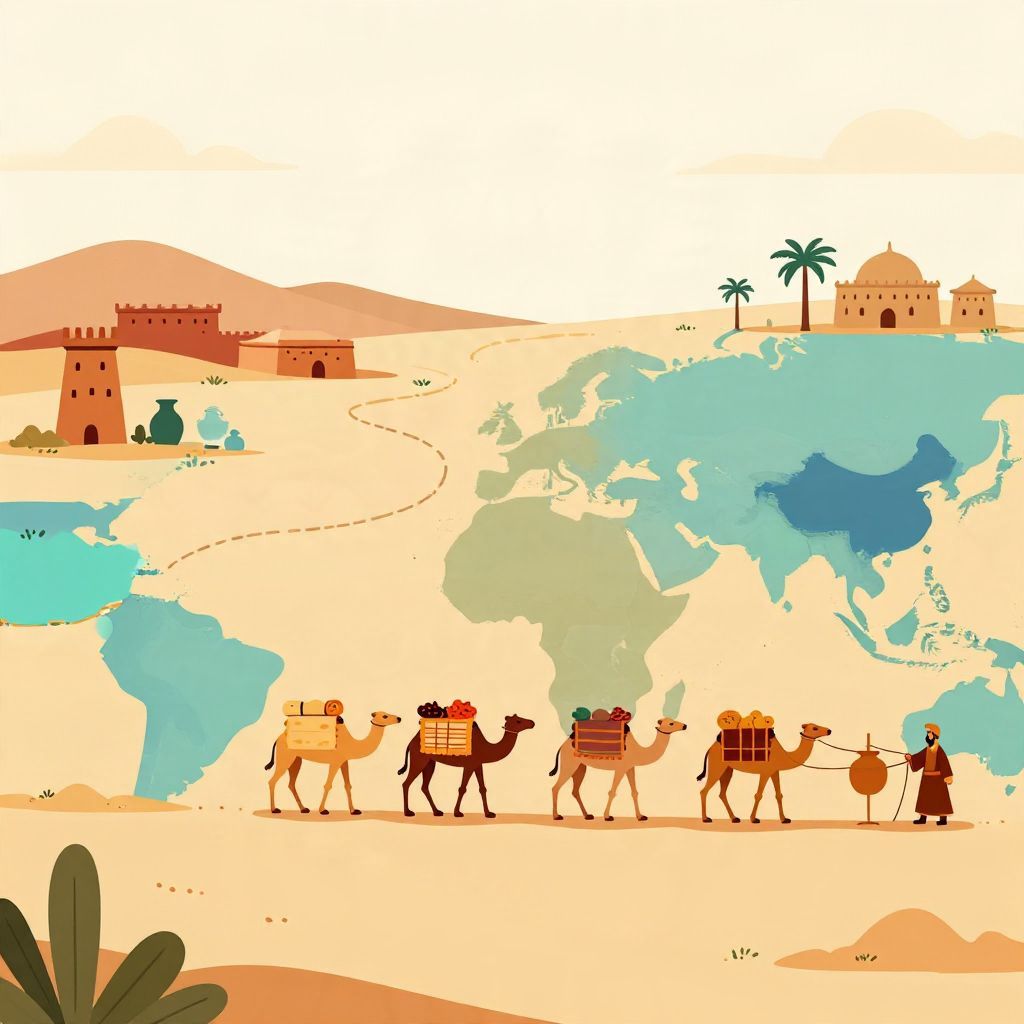
The Silk Road was important because it connected Asia, the Middle East, Africa, and Europe through trade, migration, diplomacy, and cultural exchange. It was not a single road but a vast network of routes that helped move goods, ideas, religions, technologies, and people across continents for more than a thousand years.
Its significance went far beyond luxury trade. The Silk Road shaped empires, enriched cities, spread belief systems, and linked distant societies in ways that changed world history.
Why Was The Silk Road Important?
The Silk Road was important because it made long-distance exchange possible on an unprecedented scale. From roughly the 2nd century BCE to the 15th century CE, it connected East Asia with Central Asia, the Indian subcontinent, the Middle East, and the Mediterranean, allowing goods, ideas, and technologies to travel far beyond their places of origin.
It connected distant civilizations
Before the Silk Road, many societies knew little about each other beyond their immediate neighbors. The route system linked Chinese dynasties, Central Asian kingdoms, Persian states, Indian polities, and Mediterranean powers into a wider world of contact. This did not create a modern global economy, but it did make Eurasia more interconnected than ever before.
Merchants, envoys, pilgrims, and migrants carried information as well as merchandise. As a result, the Silk Road became a channel for diplomacy, cultural borrowing, and the spread of practical knowledge.
It moved valuable trade goods
Silk is the most famous product associated with the route, especially because Chinese silk was highly prized in Rome, Persia, and beyond. But the trade network carried many other goods: spices, jade, horses, glassware, metals, textiles, paper, tea, precious stones, and perfumes. Some items were everyday necessities in one region and luxury goods in another.
Because overland transport was slow and expensive, the Silk Road was especially important for high-value, low-bulk goods. That made it profitable for merchants and valuable for states that taxed or protected trade.
It spread religions and ideas
The Silk Road was one of the major pathways through which religions traveled across Eurasia. Buddhism moved from India into Central Asia and China. Islam spread across parts of Central Asia and later into South and Southeast Asia through trade and political expansion. Christianity, especially in its eastern forms, also reached communities along the route. Zoroastrian, Manichaean, and other traditions likewise circulated in this connected world.
Ideas about art, medicine, astronomy, statecraft, and literature also moved along the same networks. The exchange was rarely one-way. Societies adapted foreign ideas to local traditions, creating new blends rather than simple imitation.
It helped technologies travel
One of the Silk Road’s most lasting effects was the movement of technologies. Paper-making techniques spread westward from China over time, helping transform record-keeping and learning in the Islamic world and later in Europe. Printing, gunpowder, and other innovations also moved through Eurasian contact, though not always quickly or directly.
Technological exchange mattered because it changed how states governed, how armies fought, and how knowledge was preserved. In that sense, the Silk Road was not only a trade route but also a transmission system for civilization-wide change.
How Did the Silk Road Begin?
The Silk Road developed gradually, rather than being founded at a single moment. Its early expansion is often linked to the Han dynasty in China, especially after the envoy Zhang Qian’s missions in the 2nd century BCE helped open contacts with Central Asian peoples and states. Trade routes already existed, but imperial interest and political stability helped them expand.
Geography made exchange both possible and difficult
The Silk Road crossed deserts, mountain passes, grasslands, and oasis towns. The Taklamakan Desert, the Pamirs, the Tian Shan, and other harsh landscapes made travel dangerous. Because of this, trade often depended on relay systems, caravan routes, and intermediary communities rather than direct journeys from one end of Eurasia to the other.
Central Asian oasis cities such as Samarkand, Bukhara, Dunhuang, and Kashgar became crucial stopping points. They supplied water, shelter, food, and markets, turning geography into an engine of commerce.
Empires helped protect the routes
The Silk Road flourished most when large states or empires maintained relative security along sections of the route. The Han dynasty, the Kushan Empire, the Parthian and Sasanian empires, the Tang dynasty, and later the Mongol Empire all contributed in different periods to safer or more predictable travel.
When political fragmentation increased, trade did not stop, but it became more expensive and risky. This helps explain why the Silk Road rose and declined in different eras rather than following a single continuous pattern.
Why Did Merchants and States Value It So Highly?
Merchants valued the Silk Road because it offered access to rare goods and profitable markets. States valued it because trade brought revenue, prestige, intelligence, and influence. Control of caravan routes could strengthen a ruler’s economy and diplomatic reach, while cities on the route benefited from customs duties, services, and commercial activity.
Trade created wealth for cities and intermediaries
The Silk Road did not enrich only the great imperial capitals. It also brought prosperity to intermediary communities who transported goods, provided lodging, translated languages, and negotiated across cultures. Sogdian merchants, for example, played a major role in Central Asian trade for centuries.
Urban centers along the route often became cosmopolitan. Different languages, religions, and artistic styles could coexist in the same market town. This diversity was one reason the Silk Road became so historically significant.
It encouraged diplomacy and intelligence gathering
Rulers used the Silk Road not only for commerce but also for diplomacy. Envoys traveled with gifts, messages, and proposals for alliances. Information about rival states, military conditions, and political changes could travel with merchants and travelers. In a premodern world, such knowledge was strategically valuable.
Trade routes also made it easier for empires to project soft power. A ruler who could protect merchants, attract foreign goods, and host travelers could enhance prestige at home and abroad.
What Cultural Changes Did the Silk Road Cause?
The Silk Road mattered because it transformed cultures through repeated contact. Art styles blended, languages borrowed terms from one another, and religious communities adapted to new environments. Rather than erasing local identities, the route often produced hybrid cultures that reflected multiple influences.
Art and material culture blended across regions
Archaeological evidence shows that motifs, techniques, and artistic forms moved along the route. Buddhist art in Central and East Asia absorbed influences from India, Persia, and Hellenistic traditions. Textiles, ceramics, and metalwork also reveal cross-cultural borrowing.
This blending is one reason historians see the Silk Road as a major example of cultural diffusion: the spread of ideas and customs from one society to another through contact, trade, and migration.
Language and learning crossed borders
Multilingualism was common in Silk Road regions. Merchants and diplomats often needed several languages to conduct business. Translation became essential for trade, religious texts, and administration. Over time, this encouraged the movement of scholarly traditions and helped preserve or transform knowledge across cultures.
Some manuscripts and records found in Silk Road sites show the practical realities of this exchange: contracts, letters, religious texts, and travel documents written in different scripts and languages.
How Did the Silk Road Affect Religion?
Religion was one of the most important forms of exchange along the Silk Road. Faiths spread because merchants, monks, missionaries, and migrants moved along the same routes as goods. Religious communities often established monasteries, temples, and congregations in trading hubs, where they could serve travelers and local populations alike.
Buddhism’s spread is a major example
Buddhism traveled from India through Central Asia into China, Korea, and eventually Japan. This was not a simple or automatic process. It took centuries, and the religion changed as it adapted to local languages, philosophies, and political conditions. Still, the Silk Road provided the physical and social pathways that made this spread possible.
Islam also expanded through connected trade networks
Islam spread across parts of Central Asia and beyond through a combination of trade, conquest, missionary activity, and political change. In many places, merchants played a key role in introducing Islamic practices and institutions. The Silk Road helped connect Muslim societies with other regions, making it part of a wider story of religious and commercial exchange.
For readers interested in this broader process, the Silk Road is closely tied to the history of religious transmission and exchange across Eurasia.
Why Did the Silk Road Decline?
The Silk Road did not end suddenly, but over time several developments reduced its central importance. The rise of maritime trade routes, especially from the 15th century onward, offered cheaper and often safer long-distance transport for bulk goods. Political instability in some overland regions also made caravan trade more difficult.
Sea routes became more efficient
Ships could carry larger loads than caravans and often at lower cost. As navigation, shipbuilding, and port networks improved, maritime links between Asia, the Middle East, and Europe became increasingly important. Over time, ocean trade overshadowed many overland routes.
But the Silk Road never disappeared entirely
Even after its peak, overland exchange continued in many forms. Regional trade, pilgrimage, diplomacy, and migration still used parts of the old network. The Silk Road is best understood not as a vanished road but as a long-lived system whose importance changed over time.
Why the Silk Road Still Matters to Historians
Historians study the Silk Road because it shows how interconnected the premodern world already was. It demonstrates that globalization did not begin in the modern era, even if modern systems are faster and more extensive. The Silk Road also helps explain how empires rose, how religions spread, and how cultures influenced one another across vast distances.
It is important, however, not to romanticize it. Travel was dangerous, exchange was uneven, and many people along the route lived under hardship, taxation, or political control. The Silk Road was significant precisely because it was both productive and unequal, both connective and contested.
In the end, the Silk Road was important because it linked civilizations and helped shape the development of Eurasia through trade, belief, technology, and culture. Its legacy can still be seen in the shared histories of the regions it connected, especially in the movement of ideas and faiths across borders. For related reading, see what cultural diffusion means in history and how Islam spread across regions.