
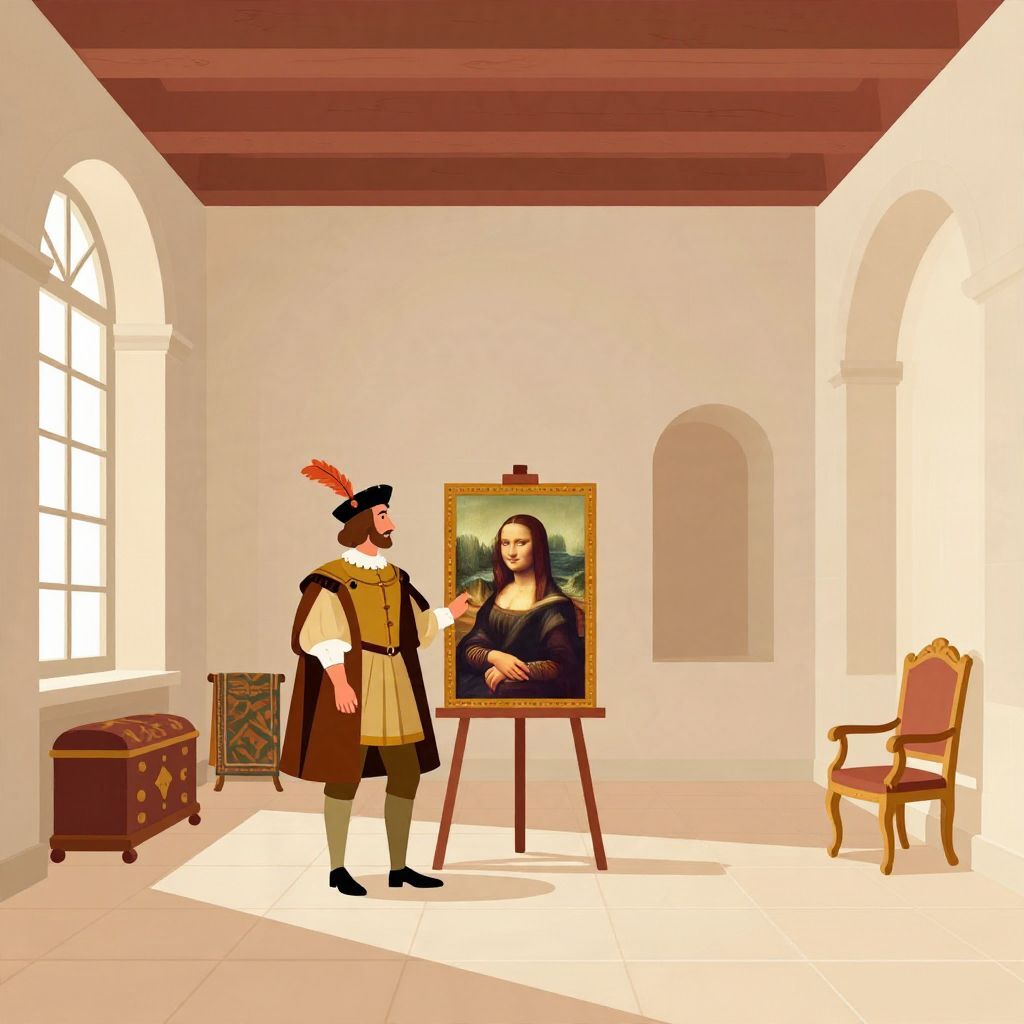
Where did King Francis keep the Mona Lisa? The short answer is that King Francis I of France most likely kept the painting in his royal residences, especially the Château de Fontainebleau, after acquiring it in the early 16th century. The exact room is not known, and the painting also appears to have traveled with the court among royal palaces.
What is clear is that Francis I valued Leonardo da Vinci’s work and brought the Mona Lisa into the French royal collection, where it remained after Leonardo’s death in 1519. From there, the painting’s location changed over time as French kings moved between palaces.
Where did King Francis keep the Mona Lisa?
King Francis I kept the Mona Lisa as part of the French royal collection, most likely at royal residences such as the Château de Fontainebleau and other palaces used by the court. Historians cannot point to one fixed “display room” for the painting in Francis’s reign, because 16th-century royal art was often moved with the monarch rather than stored in a single museum-like location.
The most likely royal setting: Fontainebleau
Fontainebleau is the royal residence most often associated with Francis I’s art patronage. He transformed it into a major Renaissance palace and gathered Italian artists and works there. The Mona Lisa may have been kept there at times, but the surviving evidence does not let historians prove that it stayed permanently in one chamber.
Why there is no exact room number
In the early 1500s, paintings were not usually displayed in the modern museum sense. Royal collections were private, mobile, and tied to the king’s household. Works could be hung in apartments, audience rooms, or galleries, then moved when the court relocated. That makes the question “where exactly was it kept?” difficult to answer with precision.
How Francis I acquired the Mona Lisa
The Mona Lisa entered the French royal collection after Leonardo da Vinci came to France in the final years of his life. Leonardo spent his last years under Francis I’s protection at Clos Lucé near Amboise, and after Leonardo died in 1519, several of his works, including the Mona Lisa, remained in French hands. The painting was not purchased from a public market; it became part of a royal collection through Leonardo’s final arrangements and the king’s patronage.
Leonardo’s move to France
Francis I admired Renaissance learning and art. He invited Leonardo to France, where the artist lived under royal favor. This relationship is central to the Mona Lisa’s French history: without Francis’s interest in Leonardo, the painting might not have entered the royal collection that later became the core of the Louvre’s holdings.
From Leonardo’s possession to royal property
Scholars generally agree that Leonardo kept the painting with him until his death. Afterward, the work passed into French royal ownership. The exact legal mechanism is not always described in simple terms in surviving summaries, but the historical outcome is well established: the Mona Lisa became a French crown painting.
What kind of place was Francis’s collection kept in?
Francis I did not keep the Mona Lisa in a museum, because no such public institution existed for royal art in his day. Instead, the painting would have been housed in one or more royal châteaux—large palaces and castles used by the French monarchy. These buildings combined residence, administration, ceremony, and display.
Royal châteaux as living spaces
A château was not just a fortress. By the 16th century, many French châteaux functioned as elegant court residences. They included state rooms, private chambers, chapels, and galleries. Artworks were part of the decoration and prestige of these spaces, especially in the circles of a king eager to present himself as a Renaissance ruler.
Fontainebleau’s importance
Fontainebleau became one of Francis I’s signature projects. He expanded and remodeled it, making it a center of court life and artistic innovation. Because of that, it is the strongest candidate when people ask where Francis “kept” the Mona Lisa. Still, the safest historical answer is that it was kept within the royal collection at French residences associated with the king, not in one permanently documented spot.
Why the Mona Lisa mattered to Francis I
Francis I’s interest in the Mona Lisa was part of a broader cultural program. He wanted to make France a leading Renaissance power, rivaling Italy in artistic sophistication. Collecting Leonardo’s work helped him project that image. The painting was valuable not only as an artwork but also as a symbol of royal taste, learning, and international prestige.
A king and the Renaissance
Francis I is often remembered as a Renaissance monarch because he promoted humanist culture, architecture, and the arts. He brought Italian styles into France and supported artists and architects who helped reshape royal spaces. The Mona Lisa fit that world perfectly: it was a celebrated Italian work now attached to French kingship.
More than a decoration
For Francis, owning the painting was a statement. Royal collections communicated power. They showed that the king could attract great artists, preserve their masterpieces, and surround himself with the finest objects of the age. In that sense, the Mona Lisa was both an artwork and a political trophy.
What happened to the Mona Lisa after Francis I?
After Francis I, the Mona Lisa remained in the French royal collection. Over the centuries it moved among royal residences as monarchs changed their preferred homes. Later French kings continued to value it, and after the Revolution it became state property. Eventually it entered the Louvre, where it is now displayed publicly.
A moving royal object
The Mona Lisa’s early history is a reminder that famous paintings did not always have fixed homes. Royal collections were portable and often reorganized. The painting’s journey from Leonardo’s studio to Francis’s court, and later to the Louvre, reflects the changing meaning of art in European history: from private possession to public heritage.
From court treasure to museum masterpiece
By the time the Mona Lisa reached the Louvre, it had already accumulated centuries of royal association. Its fame grew later, especially in the modern era, but its French identity began with Francis I’s patronage and the royal residences where the painting was kept.
What historians can say with confidence
The historical record supports a careful answer rather than a dramatic one. We can say that Francis I kept the Mona Lisa within the French royal collection, probably at Fontainebleau and other royal residences used by the court. We cannot say with certainty that it stayed in one exact room or palace throughout his reign.
Established facts
- Leonardo da Vinci came to France in his final years under Francis I’s patronage.
- The Mona Lisa remained in French royal hands after Leonardo’s death in 1519.
- The painting was kept in royal residences, not a public museum.
- Fontainebleau is the most likely and most important associated location.
What remains uncertain
- The exact room where the Mona Lisa hung.
- Whether it stayed continuously at one château or moved between several.
- The precise administrative details of its transfer into royal ownership.
So, if you are asking where King Francis kept the Mona Lisa, the best answer is: in his royal collection, most likely at Fontainebleau and other French châteaux used by the court. The painting’s early French life was shaped by Renaissance kingship, mobile court culture, and Francis I’s ambition to make France a center of art. For broader context, you may also want to read about what a château was and what a royal title meant in historical Europe.