
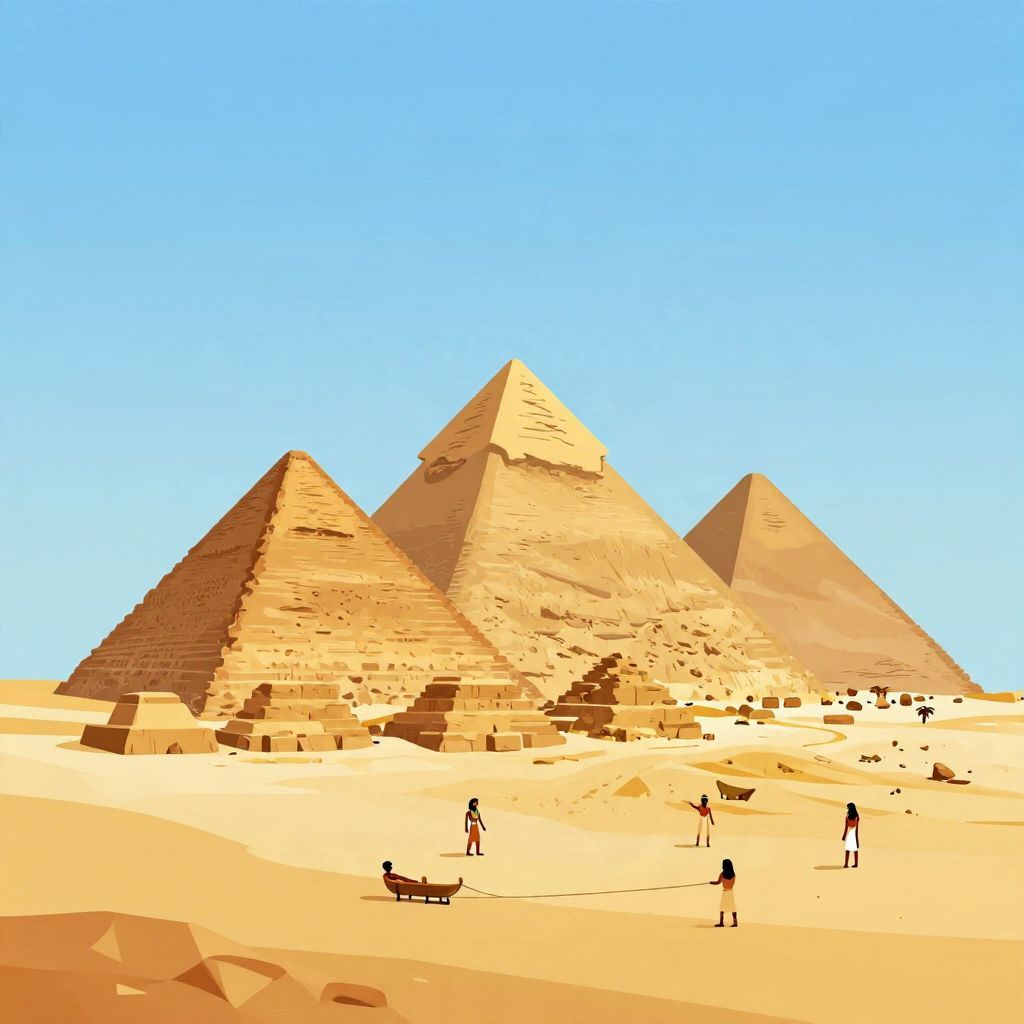
The Pyramids of Giza were built in ancient Egypt during the Old Kingdom, mainly in the 26th century BCE. The three great pyramids—those of Khufu, Khafre, and Menkaure—were constructed over roughly a century, with Khufu’s Great Pyramid usually dated to around 2600 BCE.
They were not built all at once, and their construction reflects the power, resources, and religious beliefs of Egypt’s Fourth Dynasty. Archaeology gives us a broad timeline, but the exact year each pyramid began or ended remains an estimate rather than a fixed date.
When were the Pyramids of Giza built?
The Pyramids of Giza were built between about 2600 BCE and 2500 BCE, during Egypt’s Old Kingdom, especially the Fourth Dynasty. The Great Pyramid of Khufu is generally the earliest and largest, followed by Khafre’s pyramid and then Menkaure’s. Most scholars place the main building phase in the 26th century BCE.
Which pyramid was built first?
The Great Pyramid of Khufu was built first, probably around 2600 BCE. Khafre’s pyramid came next, likely a few decades later, and Menkaure’s pyramid was completed after that. The order is supported by archaeology, inscriptions, surrounding tombs, and the historical sequence of the kings themselves.
Approximate construction order
- Khufu’s Great Pyramid — c. 2600 BCE
- Khafre’s Pyramid — c. 2550 BCE
- Menkaure’s Pyramid — c. 2490 BCE
These dates are approximate because ancient Egyptian chronology is reconstructed from king lists, inscriptions, and archaeological context. The sequence is well established, but the exact start and finish dates cannot be known with modern precision.
Why were the pyramids built at Giza?
The pyramids were royal tombs built to serve the afterlife of the pharaohs. In ancient Egyptian religion, the king was not just a ruler but a divine or semi-divine figure whose burial had cosmic importance. The pyramids at Giza helped secure the king’s transition into the afterlife and reinforced the state’s religious and political order.
Religious purpose
Egyptians believed that proper burial rituals, offerings, and monumental tombs helped preserve the king’s identity after death. The pyramid shape may have symbolized the rays of the sun or the primeval mound from which creation emerged, linking the dead king to divine renewal.
Political purpose
Building a pyramid also demonstrated the pharaoh’s authority. It required centralized planning, labor organization, quarrying, transport, and food supply on a huge scale. In that sense, the pyramids were not only tombs but also public statements of state power.
How long did it take to build the pyramids?
Each pyramid likely took many years to complete, though the exact duration is debated. The Great Pyramid of Khufu may have taken about 20 to 30 years to build, based on the reign length of Khufu and the scale of the project. Smaller pyramids probably took less time, but still required sustained labor over many seasons.
Ancient Egyptian workers were not slaves in the popular Hollywood sense. Evidence suggests that many were skilled laborers, seasonal workers, and support staff organized by the state. Villages, bakeries, granaries, and work crews near Giza show that pyramid building was a managed national project rather than a random mass effort.
What historical evidence tells us the date?
Historians and archaeologists date the pyramids through a combination of king lists, inscriptions, construction evidence, and radiocarbon analysis. No single source gives a perfect answer, so the timeline is built from several kinds of evidence that generally agree.
Main kinds of evidence
- Dynastic chronology from ancient Egyptian king lists and historical reconstruction
- Archaeological context from tombs, settlements, tools, and building phases at Giza
- Inscriptions naming work crews, officials, and royal associations
- Scientific dating, including radiocarbon tests on organic remains
There is still some uncertainty. For example, scholars may differ by a few decades on the exact reign dates of Khufu, Khafre, and Menkaure. But the broad conclusion is secure: the Giza pyramids belong to the middle of the third millennium BCE.
Who built the Pyramids of Giza?
The pyramids were commissioned by the pharaohs of the Fourth Dynasty: Khufu, Khafre, and Menkaure. They were built by teams of Egyptian workers, supervisors, architects, masons, quarrymen, boat crews, and support staff. The most famous architect associated with the Great Pyramid is Hemiunu, though the evidence for his exact role is indirect.
The royal builders
Khufu was the king most closely associated with the Great Pyramid, the largest of the three. Khafre’s complex includes the second pyramid and the Great Sphinx, while Menkaure’s pyramid is smaller but still monumental. Together, they formed a royal necropolis that marked Giza as one of the most important sacred landscapes in ancient Egypt.
What was happening in Egypt at the time?
The pyramids were built during a period of strong central government and economic organization. The Old Kingdom is often called the “Age of the Pyramids” because pharaohs had the power and resources to mobilize large labor forces and direct massive construction projects. Agriculture along the Nile supported this system by producing surplus food.
This was also a period of artistic and administrative development. Egypt had a sophisticated bureaucracy, stone-working traditions, and long-distance transport networks. The Giza pyramids were therefore the product of a mature state, not an isolated burst of genius.
Why are the Giza pyramids so important?
The Pyramids of Giza are important because they are among the most enduring symbols of ancient civilization. They show the scale of Egyptian engineering, the religious beliefs of the Old Kingdom, and the ability of an early state to organize enormous labor and material resources. They also remain the only surviving wonder of the ancient world.
Lasting significance
- They reveal how ancient Egypt linked kingship, religion, and architecture.
- They provide evidence for advanced engineering and planning in the third millennium BCE.
- They shaped later ideas about monumentality, power, and the ancient world.
- They continue to influence archaeology, tourism, and historical imagination today.
Common myths about the pyramids
Because the pyramids are so famous, they attract many myths. Some people claim they were built by aliens, lost supercivilizations, or enslaved outsiders. These ideas are not supported by historical evidence. The pyramids were built by ancient Egyptians using the tools, labor systems, and knowledge of their own time.
Another misconception is that the pyramids were built instantly or by a single ruler alone. In reality, they were the result of decades of planning, multiple reigns, and a large workforce. Their construction reflects continuity, not mystery in the supernatural sense.
So, when were the Pyramids of Giza built?
In short, the Pyramids of Giza were built during Egypt’s Old Kingdom, mainly between about 2600 BCE and 2500 BCE. Khufu’s Great Pyramid was built first, followed by Khafre’s and Menkaure’s. Their exact dates are approximate, but their place in history is clear: they were products of the Fourth Dynasty and of one of the most powerful early states in the world.
If you want to explore more ancient monument history, you may also be interested in what country has the most pyramids and what is the oldest building in the world.