
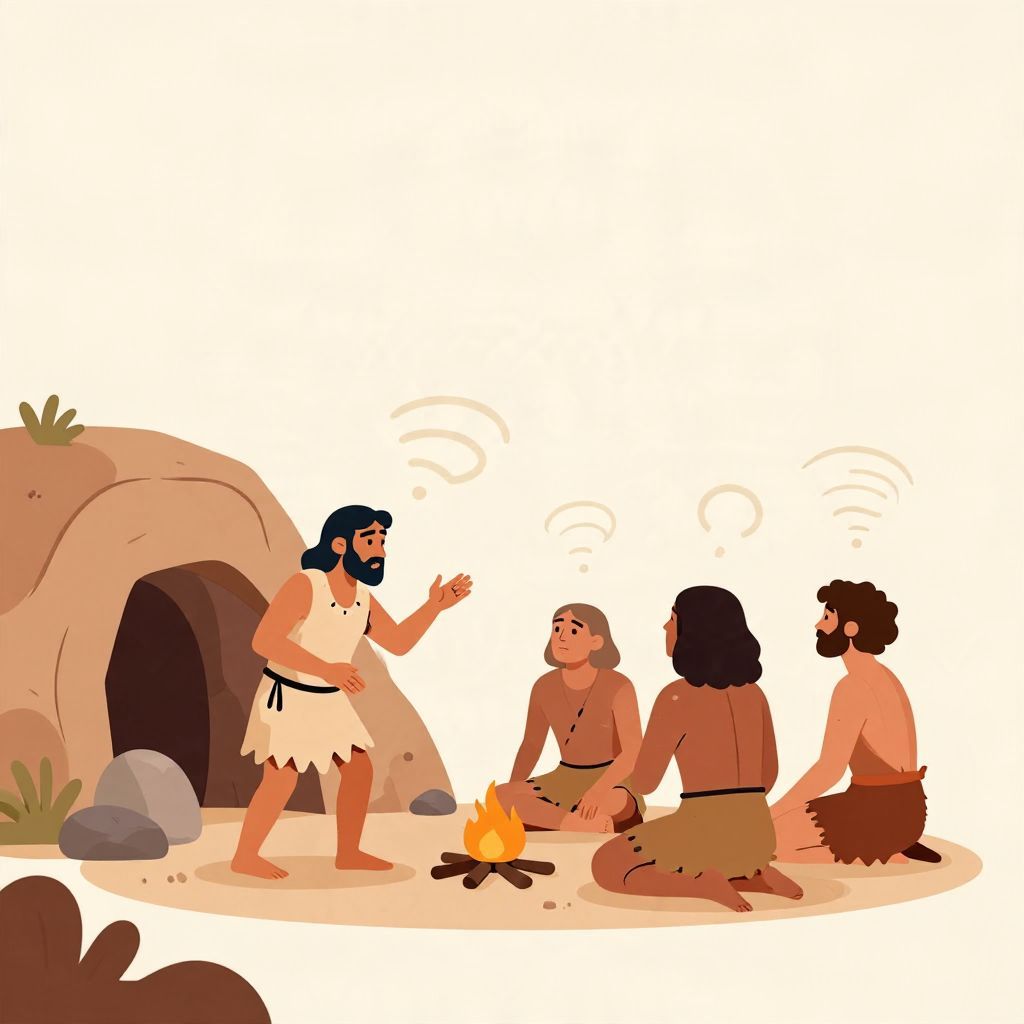
What was the first word ever said? It is one of history’s most intriguing questions, but there is no single provable answer. Speech did not appear in one moment; it evolved gradually over hundreds of thousands of years as human ancestors developed the anatomy, brain capacity, and social needs for language.
So the honest historical answer is this: we do not know the first word ever spoken, and it may not have been a “word” in the modern sense at all. Scholars can only infer how early language emerged from archaeology, anthropology, genetics, and comparisons with living languages and primates.
What Was the First Word Ever Said?
No one knows the first word ever said, and there is no evidence for a single original word used by all humans. Language likely began as a slow transition from sounds, gestures, and shared signals into more complex speech. The earliest “words” were probably simple, practical sounds tied to food, danger, people, or actions.
Why There Is No Known First Word
Speech leaves no direct fossil record. Bones can show whether a species had the vocal tract and hearing needed for language, but they cannot preserve actual conversations. Because of that, historians and scientists cannot identify a first spoken word the way they can identify a first written text.
Language predates writing by a vast margin
Writing is only about 5,000 years old, beginning in places such as Mesopotamia and Egypt. Human language is far older. Most researchers think spoken language existed long before writing, perhaps tens or even hundreds of thousands of years earlier. That means the earliest words disappeared long before any record could capture them.
“Word” is a modern way of thinking
When people ask about the first word ever said, they usually imagine a single sound like “mama” or “hello.” But early language may have worked differently. A sound could have meant “food,” “come here,” or “danger” depending on tone, gesture, and context. The boundary between sound, signal, and word was probably blurry.
How Human Speech Likely Began
Most scholars believe language developed gradually rather than suddenly. Early humans probably used a mix of facial expressions, hand gestures, vocal calls, and shared routines. Over time, these signals became more standardized and flexible, allowing people to name objects, describe events, and communicate abstract ideas.
The biological foundations of speech
Human beings have several traits that support language: a highly developed brain, fine control of breathing, a lowered larynx, and the ability to produce many distinct sounds. Genetic evidence, including changes associated with speech and language ability, suggests that our species was biologically prepared for complex communication, though this does not reveal the first word.
Social pressure probably mattered most
Language is useful because humans live in groups. Early communities needed ways to coordinate hunting, share warnings, care for children, and maintain relationships. In that sense, the first words were likely born from practical social needs rather than from storytelling or poetry.
Common Theories About the Earliest Words
Because the first word cannot be proven, scholars have proposed several possibilities. These are educated guesses, not established facts. The most plausible candidates are short, useful sounds connected to daily life, especially family relationships, objects, actions, and threats.
“Mama” and “Papa” are famous guesses
Many languages around the world use similar sounds for parents, such as “mama” and “papa.” This has led some people to think one of these may have been among the first words. However, that similarity may come from the ease of making those sounds with an infant’s mouth, not from a single ancient origin.
Words for danger or food may have come first
Another theory is that early speech centered on survival. A warning sound for predators, a call for help, or a word for food would have been immediately useful. These kinds of expressions fit the needs of small groups living in dangerous environments, but no one can identify the exact sound.
Imitation and action words are also possible
Some researchers think early words may have imitated natural sounds or actions, such as a crack, a splash, or a movement. Others suggest verbs came early because action is central to human life. Still, these ideas describe how language may have grown, not a verified first utterance.
What Archaeology and Science Can Tell Us
Although archaeology cannot recover the first word, it can help reconstruct the conditions under which language emerged. Evidence from tools, symbolic behavior, burial practices, and long-distance cooperation shows that humans were capable of complex thought and communication long before written history.
Symbolic behavior suggests advanced communication
By at least 100,000 years ago, and perhaps earlier, humans were making ornaments, using pigments, and creating symbolic marks. Such behavior implies the ability to share meanings beyond immediate survival. That does not prove full language in the modern sense, but it strongly suggests sophisticated communication systems were in place.
Neanderthals and other human relatives may have spoken too
There is growing evidence that Neanderthals and possibly other archaic humans had some capacity for speech. Their anatomy and tools suggest communication skills more advanced than simple animal calls. If so, the story of language is not limited to Homo sapiens alone, and the “first word” question becomes even more complicated.
Why Myths About the First Word Persist
People have always wanted a clear origin story. A single first word feels tidy and memorable, which is why legends about the beginnings of language remain popular. But history rarely begins with a dramatic first line. More often, it develops through long, uneven change.
Religious and philosophical traditions offered answers
Many ancient cultures believed language was given by the gods or tied to creation itself. Philosophers also debated whether words were natural or invented by humans. These traditions are important because they show how deeply people cared about the origin of speech, even when they lacked evidence.
Modern science replaced certainty with probability
Today, scholars approach the question through evolutionary biology, linguistics, and anthropology. Instead of asking for a single magical word, they ask how communication systems became language. That shift has produced better evidence, but it also means accepting uncertainty where the record is silent.
What the First Word Was Probably Like
If there was a first recognizable word, it was likely short, practical, and tied to immediate experience. It may have referred to a person, a need, a nearby object, or a warning. It was probably repeated often, understood within a small group, and supported by gesture and tone.
It was not likely a full sentence
Early speech almost certainly did not begin with complex grammar. Grammar, vocabulary, and pronunciation would have developed over time. The first word, if we could identify it, would probably have been a simple label or signal rather than a complete thought in the modern sense.
Different groups may have had different “first words”
There may never have been one universal first word. Language likely emerged independently in many communities through shared human capacities. That means one group’s earliest word could have been entirely different from another’s, even if both were part of the same broad evolutionary process.
The Historical Significance of the Question
Asking what the first word ever said was is really asking how humans became human. Language transformed cooperation, memory, teaching, trade, religion, and politics. Once people could share ideas across generations, culture accelerated in ways no other species achieved.
Language changed history before history was written
Spoken language made it possible to pass down hunting knowledge, social rules, myths, and technical skills. It also allowed larger communities to form. Long before kings, empires, and written laws, speech gave humans the ability to organize collective life.
It laid the groundwork for civilization
Without language, there would have been no literature, no diplomacy, no legal codes, and no formal education. Writing preserved language later, but speech came first and made civilization possible. In that sense, the first word—whatever it was—belongs to the deepest prehistory of human society.
So, What Is the Best Answer?
The best historical answer is that the first word ever said is unknown and probably unknowable. It was likely a simple, useful sound from an early human ancestor, but it was not preserved, and it may not have been a single universal word at all. What we can say with confidence is that language emerged gradually from human social life.
For readers interested in origin stories and historical firsts, you may also enjoy What Was the First Word Ever Said? and What Was the First? The larger lesson is that history often begins not with a clear first moment, but with a long process of change.