
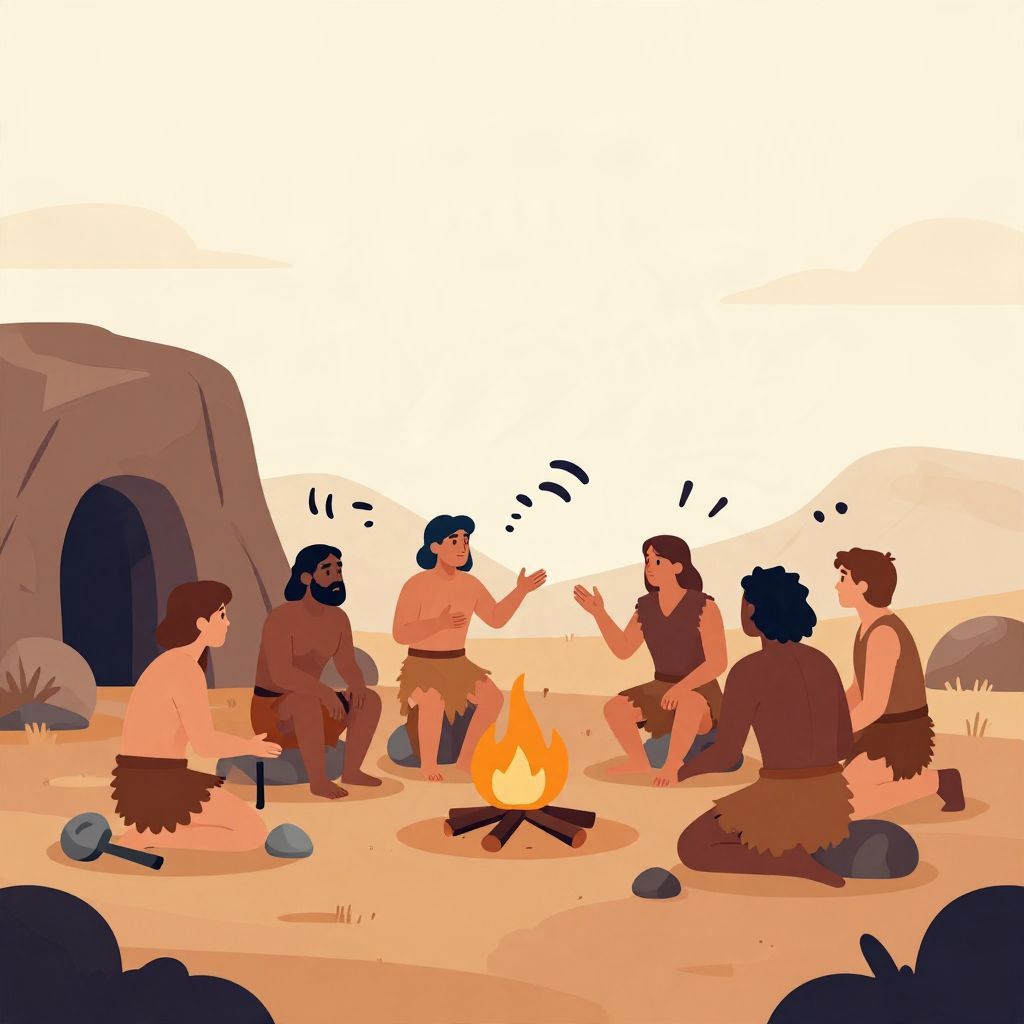
What was the first word ever? It is a fascinating question, but history cannot give a single verified answer. Language emerged long before writing, so no ancient record preserves the very first spoken word. What scholars can say is that early human speech likely began as simple sounds, calls, and shared meanings that gradually became words.
The answer depends on what counts as a “word,” which language you mean, and whether you are asking about spoken language or written language. The history of language is a story of evolution, not a single invention, and that makes the search for the first word both intriguing and uncertain.
What was the first word ever?
There is no known first word ever spoken. Human language developed gradually over tens of thousands of years, probably from vocal sounds, gestures, and social communication. Because speech existed long before writing, historians and linguists cannot identify one original word with evidence. Any specific “first word” is speculation, not established fact.
Why historians cannot name a single first word
Unlike a king’s coronation or a battle, the origin of language left no direct record. Speech predates writing by a vast stretch of time, and the earliest writing systems appeared only around 3200 BCE in Mesopotamia and Egypt. By then, language was already fully developed in many forms.
Language leaves few traces
Archaeology can reveal tools, burials, art, and settlements, but not the exact sounds people made in conversation. Fossils do not preserve vocabulary. Even if early humans had a recognizable “first word,” there would be no inscription or audio evidence to identify it.
Words also change over time
Languages do not stay fixed. A word that sounds ancient today may have changed shape many times. That means even if we could somehow trace language back to its beginnings, the “first word” would not survive unchanged in modern speech.
How language likely began
Most scholars think language developed gradually rather than appearing all at once. Early humans probably used a mix of gestures, facial expressions, and vocal signals before combining sounds into meaningful speech. Over time, these sounds became more structured, allowing people to name objects, actions, and relationships.
From sounds to shared meaning
The key step was not simply making noise, but agreeing on meaning within a group. A sound could come to stand for food, danger, a person, or an action. Once a community recognized that a sound carried a shared message, it functioned like a word.
Speech and social life
Language likely grew because it helped humans cooperate. Shared speech would have made hunting, parenting, planning, teaching, and bonding easier. In that sense, the first words were probably practical rather than poetic: signals for attention, warning, request, or recognition.
What might the first word have sounded like?
No one knows the exact sound, but linguists have suggested that early words may have been short, easy-to-pronounce syllables. Human speech tends to favor simple combinations of sounds, especially in early or basic vocabulary. Common examples in many languages include repeated syllables such as “ma,” “pa,” or “ba.”
Why simple sounds are plausible
These sounds are easy for infants to produce and easy for adults to hear. That has led some researchers and popular writers to imagine that the earliest words may have resembled parent names or basic labels. But this is only a hypothesis, not proof.
Popular guesses are not evidence
People often suggest that the first word was something like “mama,” “hello,” or a word for water or food. These guesses are understandable, but they reflect modern intuition more than historical certainty. There is no way to verify one universal first word for all humans.
Did the first word belong to one language?
Probably not in the way people imagine. Human language did not begin in a single documented nation-state with a dictionary. It emerged among prehistoric populations long before the first civilizations. Different groups may have developed speech independently or shared ancestral forms that later diverged into many language families.
Proto-languages and deep history
Linguists sometimes reconstruct older language stages, such as Proto-Indo-European, by comparing related languages. But even these reconstructions are far too recent to reveal the first human word. They show language change over thousands of years, not the birth of speech itself.
One origin or many?
Scholars debate whether language arose once in one population or developed in stages across multiple groups. Either way, the result was not a single global word but the gradual emergence of many languages, each shaped by culture, environment, and migration.
What is the earliest word ever written?
If you mean the earliest word we can actually see in a historical record, the answer is different. The first written words appear in the earliest cuneiform tablets from Mesopotamia, around the late fourth millennium BCE. These were often administrative marks, lists, and labels rather than literature or conversation.
Writing came much later than speech
Writing was invented to record goods, labor, taxes, and transactions. It did not create language; it preserved selected parts of it. The oldest texts are therefore not “the first words ever spoken,” but the first words ever recorded.
Administrative records, not first conversations
Many of the earliest inscriptions are brief and practical. They may list grain, animals, or deliveries. That makes them historically important, but they do not tell us what the first human word was. They only show that by then, language was already complex enough to be written down.
Why the question still matters
Asking about the first word ever is really asking how humans became human in a cultural sense. Language allowed people to share knowledge across generations, build communities, and develop memory beyond the individual mind. It was one of the major turning points in human history.
Language changed civilization
Once language became stable and shared, it made law, religion, trade, storytelling, and government possible on a larger scale. Civilizations depended on speech long before writing, and writing later amplified language’s power by preserving it across time and distance.
From speech to history
Without language, there would be no oral tradition, no myths, no treaties, no records, and no history in the usual sense. The first word, wherever and whenever it emerged, helped open the path to everything that followed.
Common myths about the first word
Because the question is so appealing, it attracts myths and oversimplifications. It is worth separating historical evidence from popular storytelling.
- Myth: There was one single first word for all humanity.
- Reality: Language likely developed gradually and in multiple stages.
- Myth: Scholars know the exact sound of the first word.
- Reality: There is no direct evidence for that claim.
- Myth: The first word must have been a name for a parent, object, or command.
- Reality: That is possible, but unproven.
The best historical answer
If the question is asked strictly and historically, the best answer is simple: we do not know the first word ever. Human speech is ancient, gradual, and undocumented in its earliest phase. What historians and linguists can say is that the first words were probably short, practical sounds that evolved into shared meaning within early human communities.
So the history of the “first word” is really the history of language itself: uncertain in its beginnings, transformative in its effects, and impossible to reduce to one neat answer. If you want to explore another origin question, you may also enjoy what was the first and what was the first song ever made.