
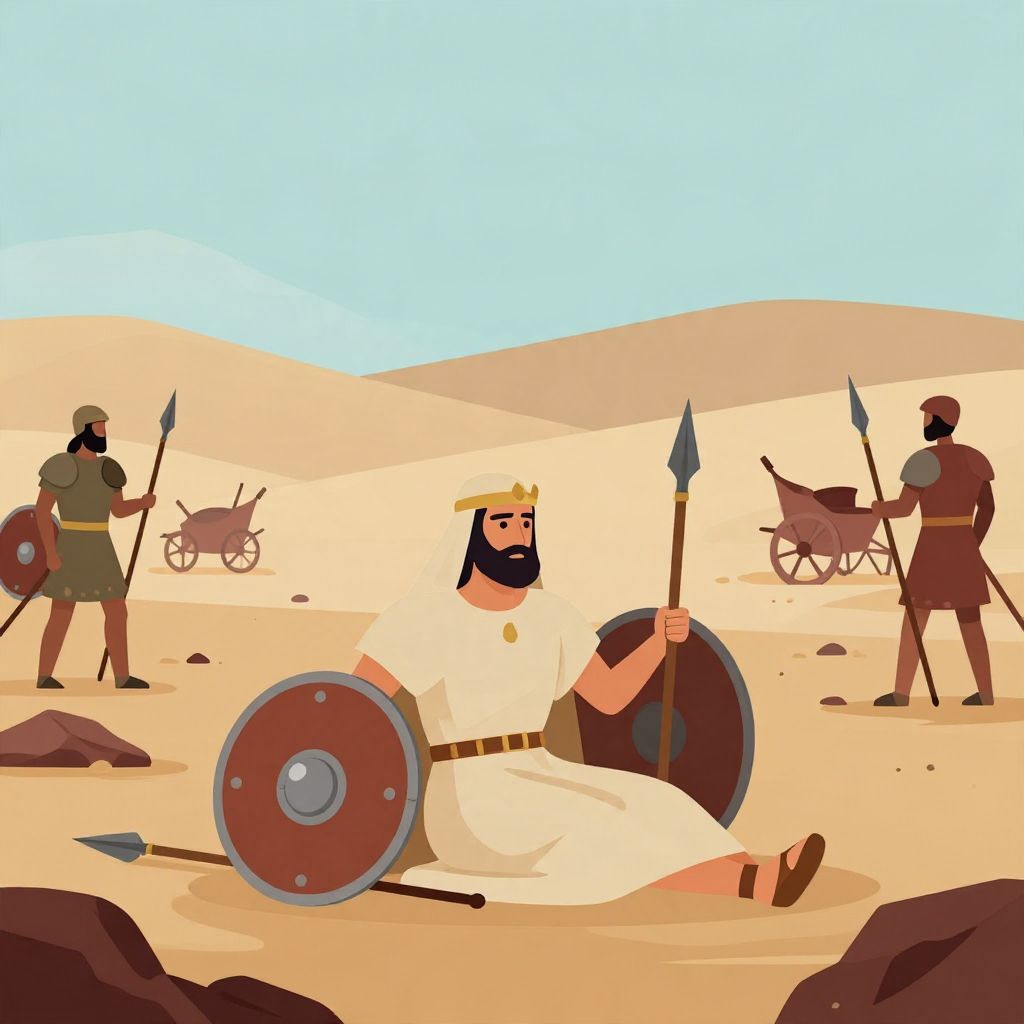
Saul, the first king of ancient Israel, died in battle on Mount Gilboa, most likely around the early 10th century BCE. According to the biblical account, he was wounded by Philistine archers, feared capture and humiliation, and then took his own life. His death marked a dramatic turning point in Israel’s early monarchy and opened the way for David’s rise.
The story is preserved in the books of 1 Samuel and 1 Chronicles, but the details differ slightly, so historians read the account with care. What is clear is that Saul died during a disastrous military defeat against the Philistines, and his death became one of the defining moments in the political history of ancient Israel.
How did Saul die?
Saul died during the Battle of Mount Gilboa after being badly wounded by Philistine archers. The biblical narrative says he asked his armor-bearer to kill him so he would not be captured and abused, but when the armor-bearer refused, Saul fell on his own sword. His death was part of a larger defeat in which his sons also died.
What happened at Mount Gilboa?
Mount Gilboa was the site of a major clash between the Israelites and the Philistines, likely near the end of Saul’s reign. The Philistines were a powerful coastal people and long-standing rivals of early Israel. In this battle, Saul’s forces were overwhelmed, and the king was left exposed after his sons and many soldiers were killed.
The battle’s collapse
The biblical text presents the battle as a rout rather than a close contest. Saul’s army broke under pressure, and the king was left vulnerable on the battlefield. This matters because ancient kings were expected to lead from the front, and a king’s death in combat could signal not only military defeat but also political collapse.
Why capture mattered
In the ancient Near East, being captured alive by enemies could mean humiliation, torture, or public display. The text emphasizes Saul’s fear of that fate. Whether every detail is exact or shaped by later storytelling, the broader point is historically plausible: a defeated ruler would have had strong reason to avoid capture at all costs.
Did Saul kill himself?
According to 1 Samuel 31, yes: Saul fell on his sword after his armor-bearer refused to kill him. The same chapter says the armor-bearer then also died. However, 1 Chronicles 10 gives a slightly different emphasis, saying Saul died because he was unfaithful and that he “took his own life.” The two accounts agree on the basic outcome but frame it differently.
Why the sources differ
These differences are important for historical reading. 1 Samuel gives a battlefield narrative focused on the immediate events, while 1 Chronicles offers a theological interpretation, stressing Saul’s failure and divine judgment. Historians usually treat the battle death as the core historical tradition, while recognizing that the biblical writers shaped the story for religious and moral meaning.
Who was Saul, and why was his death important?
Saul is remembered as the first king of Israel, an important figure in the transition from tribal leadership to monarchy. His reign belongs to a formative period in Israelite history, when smaller highland communities were organizing politically amid pressure from neighboring powers, especially the Philistines. His death ended the first royal experiment and created a power vacuum.
Saul’s place in early Israel
Saul’s kingship represents a shift from charismatic judges and local leaders toward centralized rule. The biblical tradition portrays him as a capable but troubled ruler whose relationship with the prophet Samuel and later with David became increasingly strained. Whether one reads this as straightforward history or as a literary-theological narrative, Saul’s reign marks a major stage in Israel’s state formation.
The impact on succession
Saul’s death did not simply end a life; it altered the political future of the kingdom. His son Ish-bosheth briefly ruled in parts of Israel, while David gained strength in Judah and eventually unified the kingdom. In that sense, Saul’s death was both a military endpoint and the beginning of a new dynastic era.
What do the biblical texts say exactly?
The main account comes from 1 Samuel 31, which says Saul was struck by archers, asked his armor-bearer to kill him, and then died by falling on his sword. 2 Samuel 1 adds another layer: an Amalekite claims he found Saul dying and finished him off at Saul’s request. Later, 1 Chronicles 10 returns to the self-inflicted death version.
How historians interpret the discrepancy
Most scholars do not read the Amalekite’s story as a simple eyewitness report. It may reflect a later literary attempt to explain Saul’s death or to set up David’s reaction to the news. David has the Amalekite executed in the narrative, which reinforces David’s refusal to benefit from Saul’s death by murder or opportunism.
Which version is most likely?
The most widely accepted historical reconstruction is that Saul was mortally wounded in battle and died either by suicide or through a final act connected to his armor-bearer or another soldier. The exact mechanics cannot be proven with certainty. What can be said with confidence is that Saul died in the chaos of defeat, not in old age or after a peaceful reign.
Why did Saul’s death matter to later Israelite history?
Saul’s death mattered because it changed the balance of power in ancient Israel. The Philistines briefly celebrated their victory, but the deeper consequence was internal: the monarchy survived and transformed under David. Saul’s fall made room for a new political center, new alliances, and eventually the consolidation of a larger kingdom.
David’s rise after Saul
David’s ascent is closely tied to Saul’s death, though the transition was not immediate. David first ruled in Hebron over Judah before extending authority more broadly. The biblical narrative presents David as Saul’s successor, but historically the process likely involved negotiation, conflict, and regional loyalties rather than a smooth handover.
The memory of Saul
Saul’s death also shaped how later generations remembered him. He is often portrayed as tragic: chosen, successful in some respects, yet undone by fear, disobedience, and political instability. That memory is part history and part interpretation. It shows how ancient texts preserved not only events but also judgments about leadership and legitimacy.
What is historically certain, and what remains uncertain?
Several points are well supported by the biblical tradition and by the broader historical setting: Saul was an early Israelite king, he fought the Philistines, he suffered defeat at Mount Gilboa, and he died in that battle. Beyond that, the exact sequence of his final moments remains uncertain because the sources are not identical and were written with different purposes.
Established points
- Saul was the first king of Israel in the biblical tradition.
- He died in battle against the Philistines at Mount Gilboa.
- His sons, including Jonathan, also died in the same conflict.
- His death led to a major political transition in Israel.
Uncertain or debated points
- Whether Saul died strictly by suicide or from a combination of wounds and self-inflicted injury.
- Whether the Amalekite’s account in 2 Samuel 1 reflects fact or literary purpose.
- The exact date of the battle, which is usually placed in the early 10th century BCE but cannot be fixed with precision.
The larger historical setting of Saul’s death
Saul’s final battle should be understood in the context of a contested landscape. Early Israel was not yet a large, stable state. It was a developing society under pressure from neighboring groups, with power fragmented among tribes and local leaders. The Philistines, with their military organization and strategic control of the coastal plain, posed a serious challenge to inland highland communities.
War, kingship, and legitimacy
In this world, a king’s authority depended heavily on military success. Saul’s defeat therefore had consequences beyond the battlefield. It weakened confidence in his house, exposed the fragility of the new monarchy, and helped define the idea that kingship in Israel was accountable not only to military strength but also to divine favor and covenant loyalty.
A tragic end in ancient memory
Saul’s death has endured because it combines several themes common in ancient historical memory: heroic defeat, royal humiliation, family loss, and political transition. Whether read as sacred history, national memory, or early state history, it remains one of the most consequential deaths in the biblical narrative.
So, how did Saul die? He died after being wounded in battle on Mount Gilboa, with the biblical tradition describing him as taking his own life to avoid capture. His death ended Israel’s first monarchy and set the stage for David’s rise, making it a turning point in ancient Near Eastern history. For related reading, see how King Saul died and how King David died.