
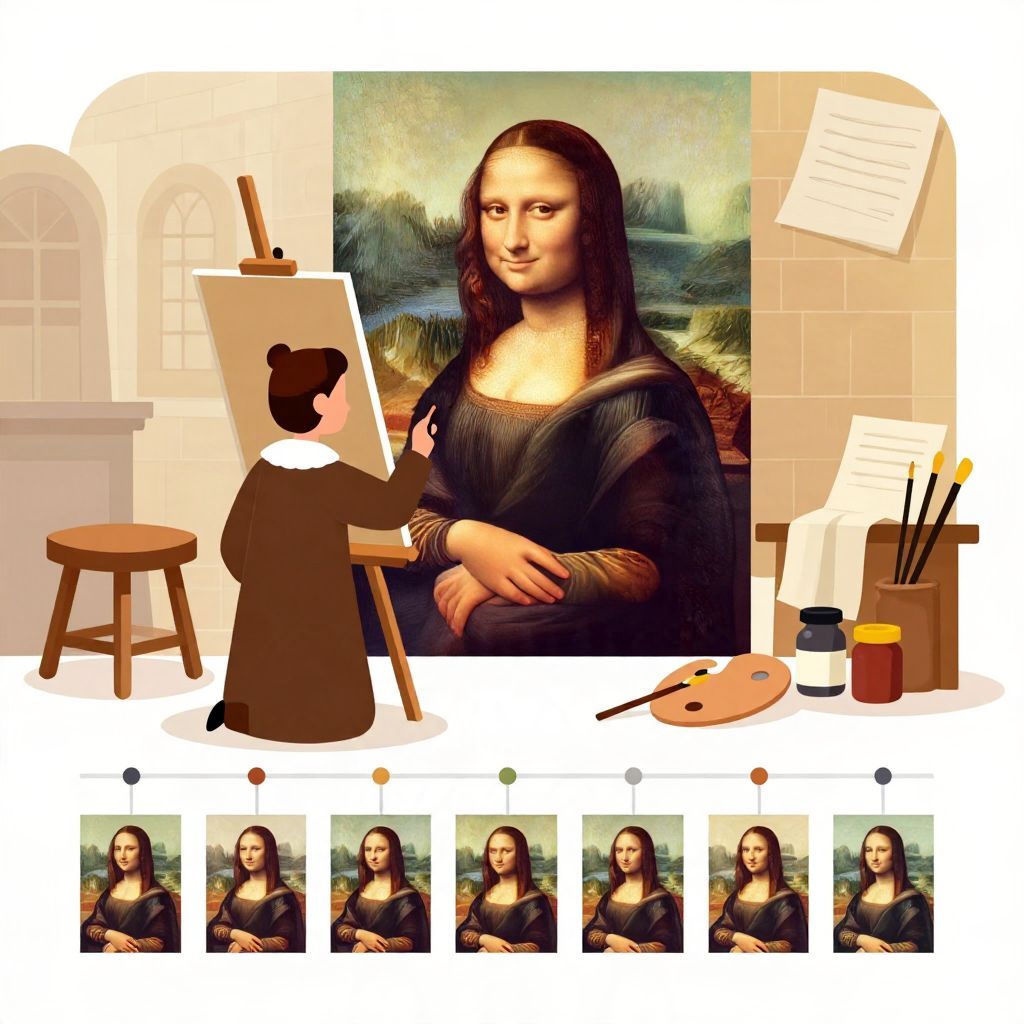
How long did it take to paint the Mona Lisa? The short answer is that Leonardo da Vinci likely worked on it for several years, probably beginning around 1503 or 1504 and continuing in stages into the 1510s. Because Leonardo rarely dated his paintings and often revisited works for long periods, historians cannot give an exact start-and-finish date.
What is clear is that the Mona Lisa was not a quick commission completed in a single burst. Its long, careful development reflects Leonardo’s habit of refining composition, atmosphere, and technique over time.
How long did it take to paint the Mona Lisa?
Most scholars believe Leonardo da Vinci worked on the Mona Lisa for roughly four to seven years in active phases, beginning around 1503 or 1504, with possible retouching or continued work into the 1510s. The exact timeline is uncertain, but the painting was clearly not finished in one continuous session.
What historians know about the painting’s timeline
The best-known early clue comes from Giorgio Vasari, who wrote in the 16th century that Leonardo began a portrait of Lisa Gherardini, wife of Francesco del Giocondo, and worked on it for a long time. Later evidence suggests Leonardo may still have had the painting with him years afterward, which helps explain why it was never delivered in the way a normal commissioned portrait might have been.
Likely chronology
- c. 1503–1504: Leonardo likely begins the portrait in Florence.
- 1504–1506: He continues refining the work, possibly alongside other projects.
- By 1516: The painting is in Leonardo’s possession in France, suggesting it remained unfinished or at least still under his control.
- 1519: Leonardo dies with the painting still associated with him.
This timeline is an approximation rather than a certainty. Renaissance artists often reused panels, altered details, and returned to portraits after long interruptions, so a painting’s “completion” could be much less clear than modern viewers expect.
Why did Leonardo take so long?
Leonardo da Vinci was famous for perfectionism, experimentation, and unfinished projects. He was not simply painting a likeness; he was studying how to represent flesh, light, air, and expression with unprecedented subtlety. The Mona Lisa shows the results of that slow method: delicate transitions, soft modeling, and a mysterious atmosphere achieved through painstaking layers.
Leonardo’s working habits
Leonardo often moved between painting, scientific observation, engineering, and anatomical study. He did not always work like a workshop painter producing large numbers of portraits for quick payment. Instead, he could labor over details, revise compositions, and postpone completion when a work no longer satisfied him.
That habit helps explain why the Mona Lisa remained with him for so long. It may also explain why the portrait looks so carefully controlled: the face, hands, and background are unified by a technique that depends on gradual blending rather than fast brushwork.
The sfumato technique
One reason the painting appears so refined is Leonardo’s use of sfumato, a technique that creates soft, smoky transitions between tones and edges. This effect is difficult to achieve quickly. It requires thin glazes and repeated adjustments, which would naturally extend the time needed to finish the portrait.
Was the Mona Lisa ever truly finished?
That question remains open. Some scholars think Leonardo may have considered the portrait complete enough for his own purposes, even if he kept refining it. Others argue he never fully finished it in the conventional sense. The evidence suggests a work that was both highly developed and still open to revision.
Why the “unfinished” idea matters
In Renaissance Italy, a portrait usually had a practical purpose: to commemorate a person, celebrate a marriage, or serve a patron’s household. The Mona Lisa does not fit neatly into that pattern. Leonardo seems to have retained it, which may mean he valued it as an artistic experiment or a personal project rather than as a standard commissioned delivery.
That is one reason the painting became historically unusual. It was not just a portrait; it was a long-term exploration of artistic possibility.
Who was Mona Lisa?
The woman in the painting is widely identified as Lisa Gherardini, the wife of Florentine merchant Francesco del Giocondo. The title “Mona Lisa” comes from “Monna,” a polite form of “madam,” combined with her first name. The alternative title “La Gioconda” refers to her married name.
Although the identification is broadly accepted, the painting’s later fame has sometimes encouraged myths and speculation. The historical consensus is that it is a portrait of Lisa Gherardini, but the exact circumstances of the commission are still debated.
How the painting’s long creation shaped its fame
The long creation period matters because it helps explain both the painting’s style and its later reputation. Leonardo’s slow, experimental approach produced a work that felt different from ordinary portraits of the time. The subtle expression, atmospheric background, and layered finish gave the image a sense of psychological depth that later viewers found compelling.
From portrait to masterpiece
At the time of its creation, the Mona Lisa was not yet the global icon it would become. Its fame grew later, especially after it entered French royal collections and was eventually displayed in public museums. The painting’s history of long authorship and uncertain completion added to the aura surrounding it.
In other words, the time Leonardo spent on the work was not just a biographical detail. It helped shape the very qualities that made the painting famous: mystery, refinement, and a sense that it exceeds the normal limits of portraiture.
What happened after Leonardo stopped working on it?
By the time Leonardo left Italy for France in the later years of his life, the Mona Lisa appears to have remained in his possession. He likely brought it with him, along with other works and notebooks. After his death in 1519, the painting passed into the French royal sphere, which helped preserve it and eventually elevate it into a national treasure.
This later history matters because it shows that the painting’s significance was not fixed at the moment of creation. Its long life after Leonardo’s death transformed it from a Renaissance portrait into one of the most studied artworks in the world.
Why there is no exact answer
Historians cannot provide a precise number of days, months, or even a single uninterrupted span because the surviving evidence is incomplete. Leonardo left no clear completion note, and early accounts are not detailed enough to reconstruct his schedule exactly. What can be said confidently is that the painting took years, not weeks or months.
Best historical estimate
- Minimum likely span: several years of intermittent work
- Common scholarly estimate: about four to seven years of active development
- Possible broader span: continued attention or revision into the 1510s
That uncertainty is not a weakness in the historical record so much as a reflection of Renaissance artistic practice. Leonardo’s career was marked by experimentation, revision, and unfinished ambition, and the Mona Lisa is one of the clearest examples of that pattern.
Historical significance of the painting’s long creation
The time Leonardo spent on the Mona Lisa is historically significant because it reveals a shift in what painting could be. Instead of serving only as a formal likeness, the portrait became a site for exploring mood, perception, and the relationship between viewer and subject. Its long gestation is part of why it feels so layered and enigmatic.
The painting also illustrates a broader Renaissance truth: great works were often shaped by long processes, patronage changes, travel, and artistic revision. The Mona Lisa survived because it was valued not just as a commission, but as an object of exceptional artistic interest.
So, how long did it take to paint the Mona Lisa? Probably several years, with Leonardo returning to it repeatedly rather than finishing it in one stretch. That slow creation is central to its meaning, and it helps explain why the portrait remains one of the most famous works in art history. For more on the painting’s physical presence and later royal history, see how big the Mona Lisa is and where King Francis kept the Mona Lisa.