
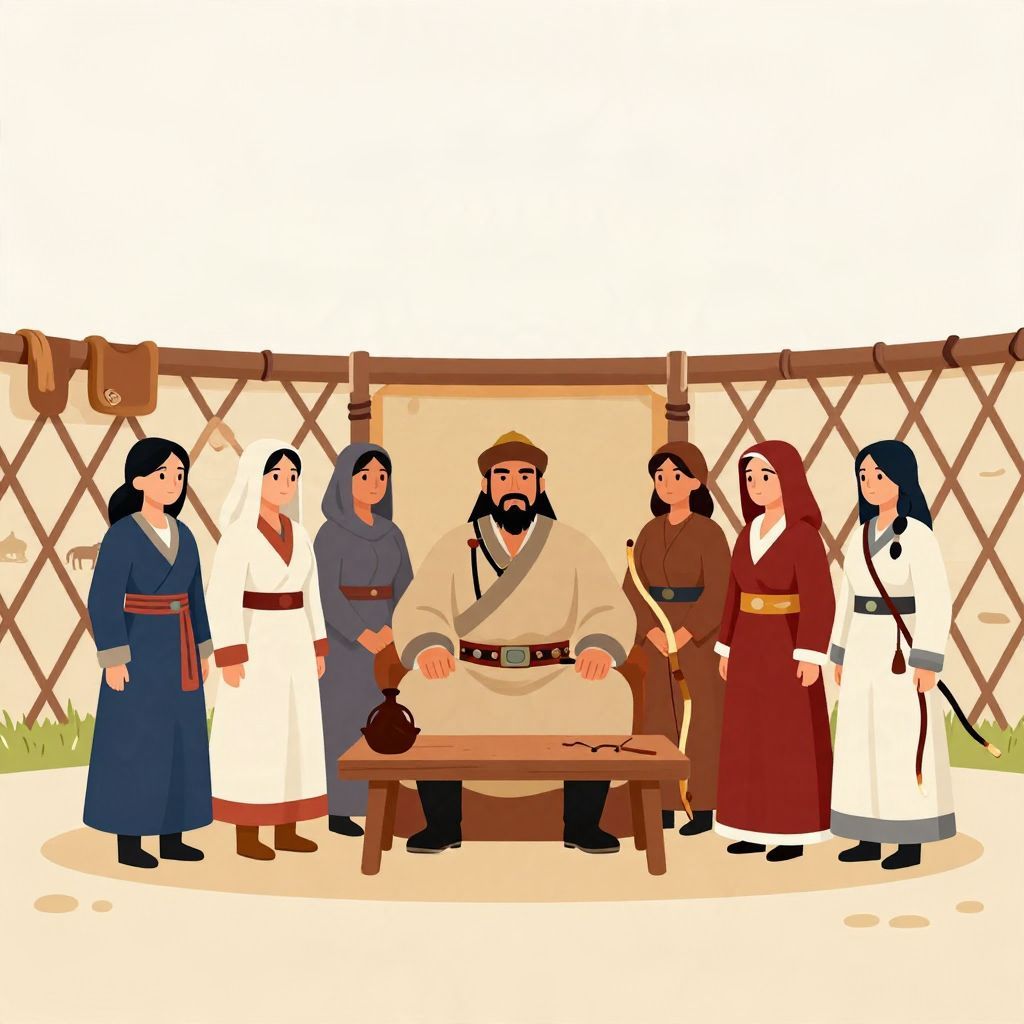
How many wives did Genghis Khan have? The short answer is that historians can identify at least one principal wife and several additional wives or consorts, but the exact total is uncertain. The best-known wife was Börte, his chief empress. Medieval sources and later tradition suggest he also had other wives, likely as part of Mongol elite marriage customs.
Because the surviving evidence is incomplete and sometimes shaped by later storytelling, the safest historical answer is not a single exact number but a range: one major wife and multiple secondary wives or consorts.
How many wives did Genghis Khan have?
Genghis Khan almost certainly had more than one wife, but historians cannot give a fully certain count. Börte was his primary and most politically important wife, while other women entered his household through alliance-building, conquest, and steppe elite practice. Depending on how “wife” is defined, the total is usually described as several women, not just one.
The most secure answer: Börte was his chief wife
Börte Ujin is the only wife of Genghis Khan who is consistently central in the historical record. She was his first major wife and the mother of his most important sons, including Jochi, Chagatai, Ögedei, and Tolui. Her status was exceptional: in Mongol politics, the chief wife often played a crucial role in succession and household authority.
Börte’s abduction by the Merkits early in Temüjin’s life, and his later effort to rescue her, became one of the defining episodes in his rise to power. Her return strengthened his legitimacy and helped shape the family line that would inherit his empire.
Did he have other wives?
Yes, most historians accept that Genghis Khan had additional wives or consorts beyond Börte. Mongol rulers commonly formed multiple marriages for political, diplomatic, and practical reasons. These unions could bind tribes, reward allies, absorb defeated groups, or secure loyalty among the steppe elite.
However, the sources do not preserve a neat, universally agreed list of every woman in his household. Some were likely full wives in the Mongol sense, while others may be better described as secondary wives, concubines, or politically attached women. That distinction matters because medieval Mongol society did not always map cleanly onto later European ideas of monogamy and marriage.
Why the exact number is uncertain
The uncertainty comes from the nature of the sources. The main surviving accounts were written after Genghis Khan’s lifetime, often by authors with political or literary agendas. They emphasize lineage, conquest, and legitimacy more than domestic detail. As a result, historians can identify the broad pattern of multiple wives but not always the exact count.
In other words, the question “How many wives did Genghis Khan have?” has a historically responsible answer only if we accept some ambiguity. The evidence supports one clearly primary wife and several other women associated with his household, but not a single universally verified number.
Who was Börte, and why was she so important?
Börte was more than a spouse. She was the political center of Genghis Khan’s family and the mother of the line that would dominate the Mongol Empire. Her sons became the main heirs to imperial power, and the question of their legitimacy would later matter enormously in succession disputes.
Because of this, historians often focus on Börte when discussing Genghis Khan’s wives. She was the wife whose position is clearest in the sources and whose influence was most consequential for the empire’s future.
Börte and the succession problem
One of the most famous complications in Mongol history concerns the paternity of Börte’s eldest son, Jochi. After her abduction by the Merkits, questions arose about whether Jochi was Temüjin’s biological son. Genghis Khan publicly recognized him, but the issue later affected succession politics among his descendants.
This shows why marriage in the Mongol world was not only personal but deeply political. A wife’s status could shape the future of an empire.
How Mongol marriage customs worked
To understand Genghis Khan’s household, it helps to understand Mongol elite marriage practices. Steppe rulers often had multiple wives because marriage was a tool of statecraft. These unions linked clans, created alliances, and helped manage conquered peoples.
Women in elite Mongol households could have real influence, especially the chief wife, who often oversaw domestic administration, camps, and family interests. While the society was patriarchal, it also gave elite women more visibility and authority than in many contemporary settled societies.
Marriage as alliance
For Genghis Khan, wives could serve several purposes:
- strengthening alliances with powerful tribes
- integrating defeated groups into his expanding polity
- securing heirs from different branches of the ruling family
- displaying status and imperial power
These marriages were part of how the Mongol Empire was built. They were not merely private relationships; they were instruments of rule.
What do the historical sources actually say?
The most important surviving narratives about Genghis Khan come from later Mongol, Persian, and Chinese traditions. They agree on Börte’s prominence, but they are less precise about the total number of wives. Some sources mention additional wives connected to conquered peoples or alliances, yet they do not always present a complete roster.
That is why modern historians tend to speak cautiously. Rather than repeating a fixed number without support, they describe the evidence as showing a ruler with multiple wives or consorts, headed by Börte.
Why later legends can be misleading
Genghis Khan’s life became surrounded by legend, and later retellings often exaggerate his personal life in ways that are hard to verify. Some popular accounts make him sound like a figure from folklore rather than a historical ruler. Others oversimplify by reducing his household to a single wife because Börte is so prominent.
Both extremes miss the historical reality. He was neither a monogamous husband in the modern sense nor a ruler whose private life can be reconstructed in full detail. The evidence points to a complex elite household typical of the Mongol world.
How many children did his wives have?
The best-known children of Genghis Khan came from Börte. Her sons were central to the imperial succession and the later division of the Mongol Empire into major khanates. He also had daughters, who were important in diplomacy and family politics, though they are less well known in popular history.
Other wives or consorts may have borne children as well, but the historical record is uneven. The names and roles of many women in the household were not preserved in the same detail as Börte’s.
Why descendants mattered so much
In Mongol politics, descent determined legitimacy, inheritance, and military command. That meant the identity of a wife could influence the fate of entire regions. Genghis Khan’s marriages were therefore not only domestic arrangements but foundations of dynastic power.
So what is the best historical answer?
The most accurate answer is that Genghis Khan had at least one major wife, Börte, and several other wives or consorts whose exact number is not securely known. If you want a simple summary, it is fair to say he had more than one wife, but historians cannot confidently give a precise total.
That uncertainty is itself historically meaningful. It reflects both the limits of the sources and the different marriage customs of the Mongol elite, where political households were often larger and more complex than later readers expect.
Why this question still matters
People often ask how many wives Genghis Khan had because the answer reveals something larger than a personal biography. It opens a window onto Mongol society, succession politics, and the way empires were built through family alliances as much as through battlefield victories.
Genghis Khan was not only a conqueror; he was also the head of a dynastic household whose marriages helped shape the future of Eurasia. If you want to explore more about this ruler’s life and legacy, you may also be interested in where Genghis Khan is buried and what Genghis Khan looked like.