
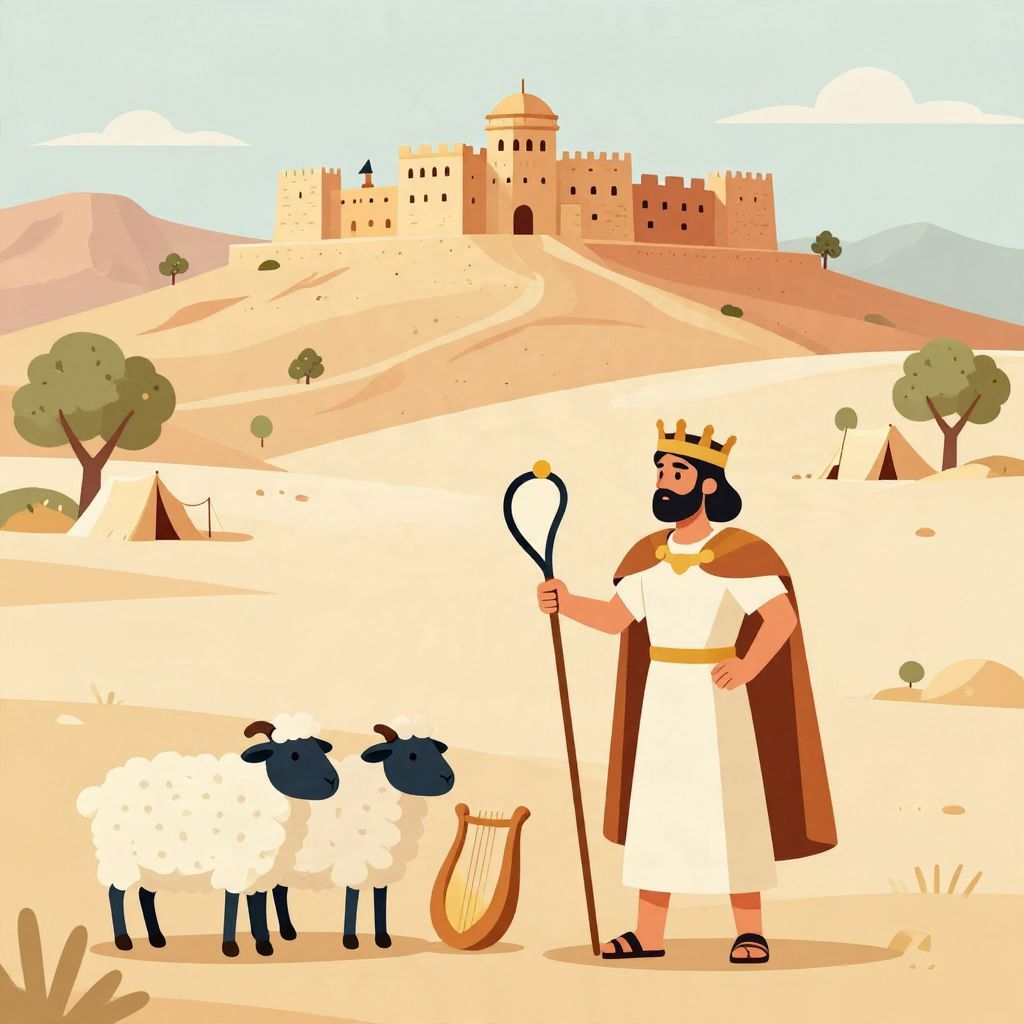
How old is David? The answer depends on which David you mean, because the name appears in both modern life and ancient history. In history writing, this question most often refers to King David of Israel, one of the best-known figures in the Hebrew Bible and Jewish, Christian, and Islamic tradition.
For King David, the exact age is not firmly known from independent historical records. The biblical narrative gives clues that scholars use to estimate his age at different moments in his life, but the precise numbers remain approximate rather than certain.
How old is David?
King David’s exact age is not known with certainty. Based on biblical chronology, he is often understood to have been a young shepherd when first introduced, a young adult when he fought Goliath, and likely around 30 years old when he became king in Hebron. His age at death is usually estimated at about 70 years, though this is not independently verified.
Who was David in history?
David is presented in the Hebrew Bible as the second king of Israel, succeeding Saul and establishing a dynasty that later tradition connected to Jerusalem and the line of future kings. He is a central figure in the books of Samuel, Kings, and Chronicles, where his life is told as a story of rise, conflict, rule, failure, and legacy.
Historically, David sits at the intersection of memory, religion, and early Israelite state formation. Many scholars think there was likely a historical ruler behind the biblical tradition, but the scale of his kingdom, the details of his reign, and even the exact chronology are debated. The biblical account is therefore essential for understanding David’s age, but it is not the same thing as a modern documentary record.
How old was David when he became king?
The Bible says David was 30 years old when he began to reign, first over Judah in Hebron and later over all Israel. This figure appears in 2 Samuel 5:4 and is the main reason many summaries give David’s age at accession as 30. It is the clearest age statement in the tradition, though historians still treat it as a biblical chronology rather than an independently confirmed fact.
Why historians use this number
Unlike many ancient rulers, David’s story includes a direct age statement. That makes 30 the standard figure in historical and religious discussion. Still, scholars note that biblical writers often shaped chronology for theological and literary purposes, so the number may reflect an idealized or structured presentation rather than exact modern-style recordkeeping.
How old was David when he fought Goliath?
David’s age when he fought Goliath is not stated directly. In the biblical story, he is still a youth or young man, often imagined as a teenager or someone in his late teens or early twenties. The text calls him young, but it does not give a precise number, so any exact age here is an informed estimate rather than a fact.
Why the story matters
This episode became one of the most famous in biblical history because it marks David’s public emergence. He moves from shepherding to national attention, and the story helps explain why later tradition saw him as chosen, courageous, and fit for kingship. His youth in the narrative is part of the message: the unlikely underdog defeats a powerful enemy.
How old was David when he died?
David’s age at death is also not directly stated in a universally secure historical record. A common traditional estimate places him at about 70 years old, based on the biblical chronology that gives him 30 years at the start of his reign and 40 years of rule. If that sequence is accepted, he would have died around age 70.
Why this remains approximate
The “70 years” total comes from adding the years of his reign described in the Bible. That makes it a reasonable traditional calculation, but not a proven biographical fact. Ancient texts often preserve regnal numbers more reliably than birth dates, and David’s early life is especially difficult to date with precision.
David’s timeline in historical order
Because the question “How old is David?” is really a timeline question, it helps to place the major events in sequence. The dates below are approximate and based on biblical chronology and later historical reconstruction.
- Youth: David is introduced as a shepherd in Bethlehem, before his public rise.
- Young adulthood: He defeats Goliath and enters Saul’s service.
- Before kingship: He spends years in conflict, hiding, and political struggle.
- Around age 30: He becomes king, first in Hebron.
- Later reign: He rules from Jerusalem after uniting the kingdoms.
- After roughly 40 years of rule: He dies, traditionally at about age 70.
Was David a real historical person?
This is one of the most important historical questions surrounding David. Many scholars think the biblical David reflects a real early monarch or chieftain from the Iron Age, but the evidence is limited. The main written source is the biblical text itself, while archaeology provides indirect context rather than a full biography.
Some scholars argue that David’s kingdom may have been smaller and less centralized than later tradition suggests. Others believe the biblical memory preserves a genuine dynastic founder whose importance grew over time. What is clear is that David became far more than a historical ruler: he became a foundational symbol of kingship, covenant, and national identity.
What evidence exists?
Archaeological and epigraphic evidence from the region helps establish the broader world in which David may have lived, but it does not give us a birth certificate or exact age. That means historians must distinguish between:
- biblical chronology, which gives ages and reign lengths;
- historical reconstruction, which estimates dates from context;
- religious tradition, which preserves David as a sacred figure.
Why David’s age matters in history
David’s age is not just a biographical detail. It helps explain how the biblical story presents him as a ruler who grows from obscurity to kingship in a carefully shaped narrative. His youth emphasizes divine selection, while his mature age at accession suggests readiness, legitimacy, and experience.
The traditional age of 70 at death also fits a long-standing symbolic pattern in ancient literature, where a full life often represents completion and blessing. Whether or not the number is exact, it reflects how the biblical writers wanted David’s life to be understood: as long, eventful, and consequential.
David in later tradition
David’s image changed over time. In Jewish tradition, he became the ideal king, poet, and ancestor of the Messiah. In Christian tradition, he became part of the genealogy of Jesus and a model of repentance and kingship. In Islamic tradition, Dawud is remembered as a prophet and righteous ruler.
These later traditions did not preserve David merely as a historical person. They expanded his meaning. As a result, questions like “How old is David?” can refer to different layers of tradition: the biblical narrative, later interpretation, and modern historical analysis.
So, how old is David really?
If you mean King David of ancient Israel, the best historical answer is that his exact age is unknown. The Bible suggests he was about 30 when he became king and about 70 when he died, but these figures are traditional and approximate. His age at earlier moments, such as the Goliath story, is not given precisely.
In other words, David’s “age” is best understood as part of a historical and literary tradition rather than as a fixed modern-style fact. If you want to go deeper, it also helps to explore how old David was when he became king and how old David was when he died.