
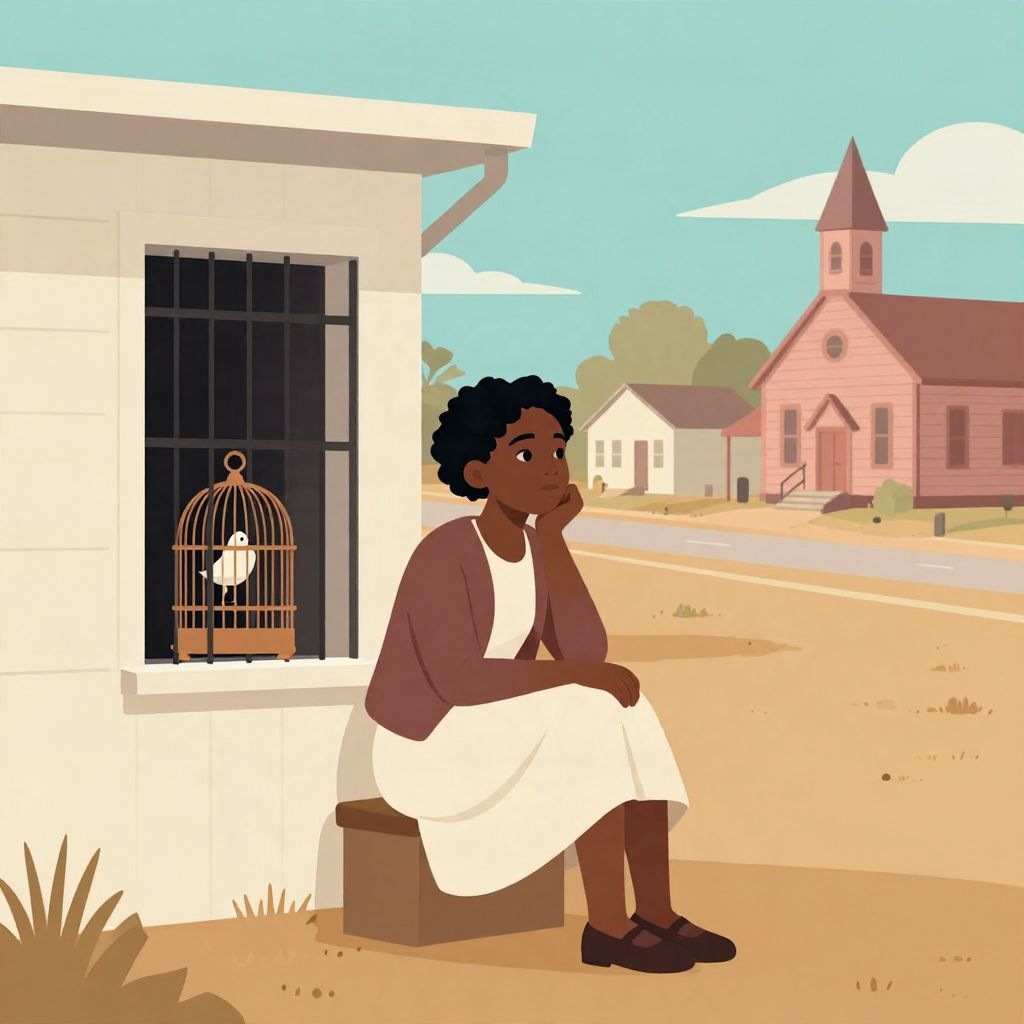
I Know Why the Caged Bird Sings is Maya Angelou’s first autobiography, published in 1969. It tells the story of her childhood and early adolescence, especially the trauma of racism, sexual violence, and displacement, and the way literature, memory, and community helped her survive. The book is both a personal coming-of-age narrative and a historical record of Black life in the United States during the Jim Crow era.
For readers searching for an I Know Why The Caged Bird Sings Summary, the central point is simple: Angelou recounts how a Black girl in the segregated South and later in California learns to endure humiliation, reclaim her voice, and begin shaping the identity of the writer she would become.
What is I Know Why the Caged Bird Sings about?
I Know Why the Caged Bird Sings is a memoir of Maya Angelou’s early life, from her childhood in Stamps, Arkansas, through her teenage years. It follows her experiences with racism, family separation, assault, and self-discovery, while showing how reading, language, and resilience helped her move toward adulthood.
Although the book is rooted in Angelou’s life, it is not a simple diary. It is a crafted autobiography that uses memory, scene, and reflection to show how personal pain was shaped by the wider history of segregation and racial inequality in the United States.
I Know Why The Caged Bird Sings Summary: the main story in order
Angelou begins with her early childhood in the segregated Black community of Stamps, Arkansas, where she and her brother Bailey are sent to live with their grandmother, Annie Henderson, whom they call Momma. Their parents are absent, and the children grow up under the protection of a strong, practical Black family structure. In Stamps, Angelou learns both the limits imposed by Jim Crow and the dignity with which Black people created community under oppression.
One of the book’s most important early experiences is her growing awareness of racism. She sees how white people control public life, how Black people are expected to accept humiliation, and how fear shapes everyday behavior. Yet she also sees acts of endurance and quiet resistance, especially in her grandmother’s steadiness and moral authority.
Angelou is later sent to live with her mother in St. Louis, where she is sexually abused by her mother’s boyfriend, Mr. Freeman. After she testifies against him, he is imprisoned and later killed, and Angelou believes that her words caused his death. Overwhelmed by guilt, she stops speaking for years. This silence becomes one of the book’s most famous and painful episodes.
She eventually returns to Stamps, where the support of family and the influence of books and teachers slowly help her recover. Later, she moves again, this time to California, where she lives with her father for a period and experiences a different social world. As a teenager, she works, explores independence, and begins to understand her own body, intelligence, and ambitions. By the end of the memoir, she is pregnant as a teenager and preparing to become a mother, marking a difficult but transformative transition into adulthood.
Key events in the memoir
- Childhood in Stamps, Arkansas, with her grandmother and brother
- Exposure to the realities of segregation and racial humiliation
- Move to her mother in St. Louis
- Sexual abuse by Mr. Freeman and Angelou’s long period of silence
- Return to Stamps and gradual healing through family and education
- Move to California and new experiences of adolescence
- Pregnancy as a teenager and the close of childhood
Why does the title matter?
The title comes from Paul Laurence Dunbar’s poem “Sympathy,” which includes the line about the caged bird singing. The image of the bird represents confinement, suffering, and the desire for freedom. In Angelou’s memoir, the “caged bird” is not only the Black child trapped by racism, but also the wounded self trying to survive through speech, memory, and art.
The title is historically significant because it links Angelou’s personal story to a larger tradition of Black literature. Dunbar wrote in the late 19th and early 20th centuries, and Angelou’s use of his imagery shows how Black writers often drew strength from earlier voices while describing the realities of segregation and exclusion in their own eras.
Historical context: the Jim Crow world behind the memoir
To understand the book, it helps to place it in the United States between the 1930s and 1940s, when Angelou was growing up. In the South, Jim Crow segregation enforced racial separation in schools, transportation, housing, and public life. Black citizens were denied equal rights through law, custom, intimidation, and violence. Even outside the South, Black Americans often faced discrimination, though the forms could differ by region.
Angelou’s memoir shows how segregation worked not only through laws but through daily habits: who could enter a store, who had to step aside, who was expected to show deference, and who could speak freely. Her grandmother’s store in Stamps becomes a small center of Black economic and social life, but it exists within a larger system that limits Black freedom.
The book also reflects broader historical patterns of the Great Migration era, when many Black families moved between Southern and Western cities in search of work, safety, and opportunity. Angelou’s own movement from Arkansas to St. Louis and later California mirrors that wider mobility, though her life remains shaped by instability and family separation.
How the memoir develops Angelou’s voice
One of the most important themes in I Know Why the Caged Bird Sings is the making of a voice. Angelou begins as a child who is observant, frightened, and often powerless. After the trauma with Mr. Freeman, silence becomes both a shield and a prison. The memoir shows that speech is not simply natural or easy; it can be stolen, feared, and slowly recovered.
Books, teachers, and family members help restore that voice. Angelou admires literature and learns that language can be a source of dignity and imagination. Her intelligence is not presented as abstract brilliance, but as something formed under pressure. She learns to read the world as carefully as she reads books.
This is one reason the memoir has remained so influential. It is not only a story of suffering. It is also a record of how a Black girl, denied safety and equality, begins to claim authorship over her own life.
Major themes in the book
Racism and segregation
The memoir shows racism as a structure, not just a series of personal insults. It shapes where people live, how they are treated, and what futures seem possible. Angelou’s childhood world is full of rules that mark Black inferiority, even when Black people themselves build strong communities in response.
Trauma and silence
Angelou’s years of silence after the assault are central to the book. The memoir treats silence as a consequence of trauma, shame, and fear, but also as a condition that can be survived. Her eventual return to speech suggests recovery, though not a simple or complete healing.
Family and community
Family in the memoir is complicated, but it is also a source of survival. Grandmother Annie Henderson, Bailey, and other relatives provide structure, discipline, and love. The book suggests that community can help children endure what they should never have to face alone.
Literature and self-making
Angelou repeatedly shows that reading matters. Literature gives her language for pain and possibility. It also links her private life to a longer cultural history, especially the tradition of Black writing that insists on humanity in the face of oppression.
Is the memoir the same as a strict historical document?
Not exactly. I Know Why the Caged Bird Sings is an autobiography, but like many memoirs it shapes memory into narrative. That means it is valuable as a historical source for lived experience, emotional truth, and social atmosphere, even if every detail cannot be treated as a legal record. Scholars generally read it as both literature and testimony.
This matters because memoirs often compress events, emphasize certain scenes, and interpret the past through later understanding. Angelou’s book should therefore be read as a carefully composed life story that reveals the realities of race, gender, and class in mid-20th-century America, rather than as a neutral chronicle.
Why the book became historically significant
Published in 1969, I Know Why the Caged Bird Sings appeared during a period of major social change in the United States, after the civil rights movement had challenged legal segregation. The memoir resonated because it connected the public struggle for racial justice to the intimate life of a Black girl growing up under oppression.
Its significance is also literary. Angelou helped expand the reach of autobiography by writing openly about trauma, sexuality, race, and survival in a voice that was accessible yet artistically controlled. The book became one of the best-known memoirs of the 20th century and helped establish Angelou as a major public intellectual and writer.
Over time, the memoir has also become part of debates about censorship and education. Some readers and institutions have challenged its content because of its treatment of rape, racism, and sexuality, while others defend it as essential reading for understanding American history and the experiences of marginalized people.
Concise takeaway
I Know Why the Caged Bird Sings is the story of Maya Angelou’s early life under segregation, trauma, and instability, and of her gradual emergence into selfhood through family, reading, and resilience. It is both a personal coming-of-age memoir and an important historical witness to Black life in Jim Crow America. For related context, see Separate Is Never Equal and what political change means in history.