
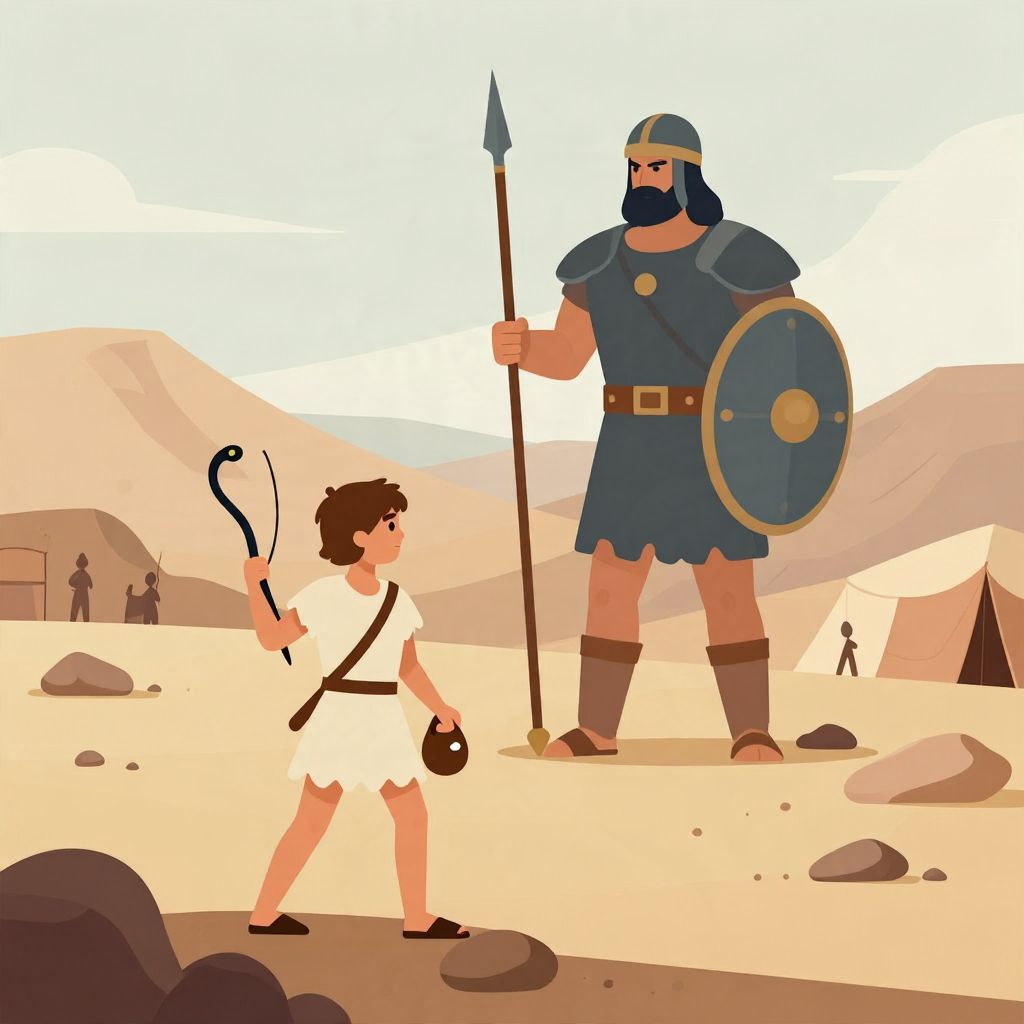
How old was David when he fought Goliath? The Bible does not give a precise age, but the most common historical and scholarly estimate is that David was a teenager or young adult, often placed somewhere around 15 to 20 years old. That estimate comes from reading the biblical narrative carefully, not from a surviving birth record.
Because the story is both historical tradition and sacred literature, the exact number cannot be proven. What can be said with confidence is that David was still young, inexperienced in battle, and not yet the seasoned warrior he would later become.
How old was David when he fought Goliath?
David was probably a teenager or very young adult, likely in his late teens. The text in 1 Samuel presents him as the youngest son of Jesse, still tending sheep while his older brothers served in Saul’s army, which strongly suggests he was not a mature military veteran at the time.
Why historians and readers estimate David’s age
The Bible never states David’s age at the battle with Goliath. Instead, the estimate comes from clues in the narrative: David is described as a shepherd boy, his brothers are already old enough for military service, and Saul treats him as too young to wear armor comfortably. These details point to youth rather than childhood.
Clues from the biblical account
- David is the youngest son of Jesse.
- He is still watching sheep when Samuel anoints him.
- His brothers are serving in the army, suggesting a gap in age and status.
- Saul initially doubts David’s ability to fight because of his youth and lack of experience.
- David himself says he has fought lions and bears while protecting sheep, showing courage but not professional military training.
These details do not prove a specific birthday, but they do make a childhood reading unlikely. In the world of the ancient Near East, a young man could be considered ready for adult responsibilities before the modern age of 18 or 21.
Why “teenager” is the safest answer
Some popular retellings imagine David as a small child, but that is not the strongest reading of the text. A more careful interpretation places him in adolescence or early adulthood. That fits the story’s tension: he is young enough to seem unqualified, yet old enough to act independently, speak boldly, and later enter military and royal life.
The timeline of David and Goliath in the biblical story
The David and Goliath episode belongs to the early part of David’s rise in the books of Samuel. It is set during the conflict between Israel and the Philistines, probably in the late 11th century BCE, though exact dating remains uncertain. The story marks the moment when David moves from obscure shepherd to national figure.
Key events in sequence
- Samuel anoints David while he is still a youth in Bethlehem.
- David continues tending sheep for his family.
- His brothers are sent to the battlefield against the Philistines.
- David brings food to his brothers and hears Goliath’s challenge.
- He volunteers to fight, despite Saul’s doubts.
- David defeats Goliath with a sling and a stone.
- His victory leads to public recognition and the beginning of his rise in Saul’s court.
This sequence matters because it shows David’s age as part of the story’s meaning. The contrast between a young shepherd and a giant warrior is not only dramatic; it is central to the narrative’s message about divine favor, courage, and unexpected leadership.
What the story says about David’s youth
David’s youth is not just background detail. It shapes the entire episode. The story emphasizes that he lacks armor, rank, and battlefield prestige. His confidence comes from experience protecting sheep and from faith that God will deliver him, not from military training or social status.
Shepherding and youth in ancient Israel
In the ancient world, shepherding was often the work of younger sons or family members with fewer inheritance prospects. David’s role as a shepherd fits that pattern. It also helps explain why he is absent from the front line until his father sends him to check on his brothers.
That does not mean shepherds were powerless or childish. On the contrary, they were expected to be alert, brave, and responsible. David’s claim that he had fought off predators suggests a young man already tested by hardship, even if he had not yet become a soldier.
Why Saul’s reaction matters
Saul’s hesitation is one of the strongest hints about David’s age. He sees David as too young and unarmored for combat with an experienced champion. David’s refusal to wear Saul’s armor also reinforces the image of a youth not yet shaped by conventional warfare.
The armor scene is symbolic as well as practical. David cannot fight as Saul does. He must confront Goliath in a way that reflects his own experience and identity. That makes the age question important, because the story depends on the contrast between the expected warrior and the unexpected one.
How old was David in relation to the rest of his life?
If David was around 15 to 20 when he fought Goliath, then the battle happened early in his public life. He would later spend years in Saul’s service, flee as an outlaw, rule first in Hebron, and eventually become king over all Israel. In that sense, Goliath is the beginning of David’s rise, not the middle or end of it.
David’s later life in brief
- He becomes known at Saul’s court after the battle.
- He gains military fame and political loyalty.
- He endures conflict with Saul before becoming king.
- He rules as one of Israel’s most important monarchs in biblical tradition.
Readers sometimes ask David’s age at Goliath because they compare it with other milestones in his life, especially his death. But the biblical text gives no exact age for either event, so all such calculations remain approximations based on narrative clues and chronology.
Was David a child, a teenager, or an adult?
The best answer is that David was probably a young man, not a small child. The “boy David” image comes partly from translation choices and later artistic tradition. In many contexts, biblical language for a “youth” can describe someone who is still young but not necessarily a child in the modern sense.
Why the child image became popular
Art, sermons, and children’s literature often portray David as very young because it heightens the miracle of the victory. A small boy defeating a giant is memorable and emotionally powerful. But historical caution requires separating that dramatic image from what the text most likely intends.
That said, the story still works if David was in his teens. A young person defeating a seasoned champion remains extraordinary, especially in a culture where battlefield age, status, and experience mattered greatly.
Historical context: David, Goliath, and the Philistines
The Goliath story is set in a period of tension between the Israelites and the Philistines, a powerful coastal people in the southern Levant. The narrative reflects a world of local warfare, shifting alliances, and heroic combat. Whether every detail is read as strict history or as stylized tradition, the setting is deeply rooted in the politics of Iron Age Israel.
Why the setting matters
The Philistines were among Israel’s major rivals in the biblical period. Goliath represents more than one enemy soldier; he symbolizes the military threat facing Israel. David’s victory therefore has political and religious meaning. It suggests that leadership does not depend only on size, weapons, or rank.
In that setting, a young fighter could be seen as both vulnerable and promising. David’s age underscores the reversal at the heart of the story: the least expected person becomes the instrument of victory.
What can we say with confidence?
We cannot know David’s exact age when he fought Goliath. But the strongest historically responsible conclusion is that he was a teenager or young adult, probably in his late teens. He was clearly young enough to be underestimated, but old enough to act independently and to enter the next stage of his life.
So if you are looking for a direct answer, the best one is this: David was likely around 15 to 20 years old when he fought Goliath, though the Bible does not provide a precise number. That estimate fits the text, the setting, and the way the story presents him as a young shepherd on the edge of adulthood.
For readers interested in David’s broader life story, it is also worth exploring how old David was in the wider biblical timeline and how old David was when he died. Taken together, those questions show how David’s age is less about exact numbers than about the arc of a life that moved from shepherding to kingship.