
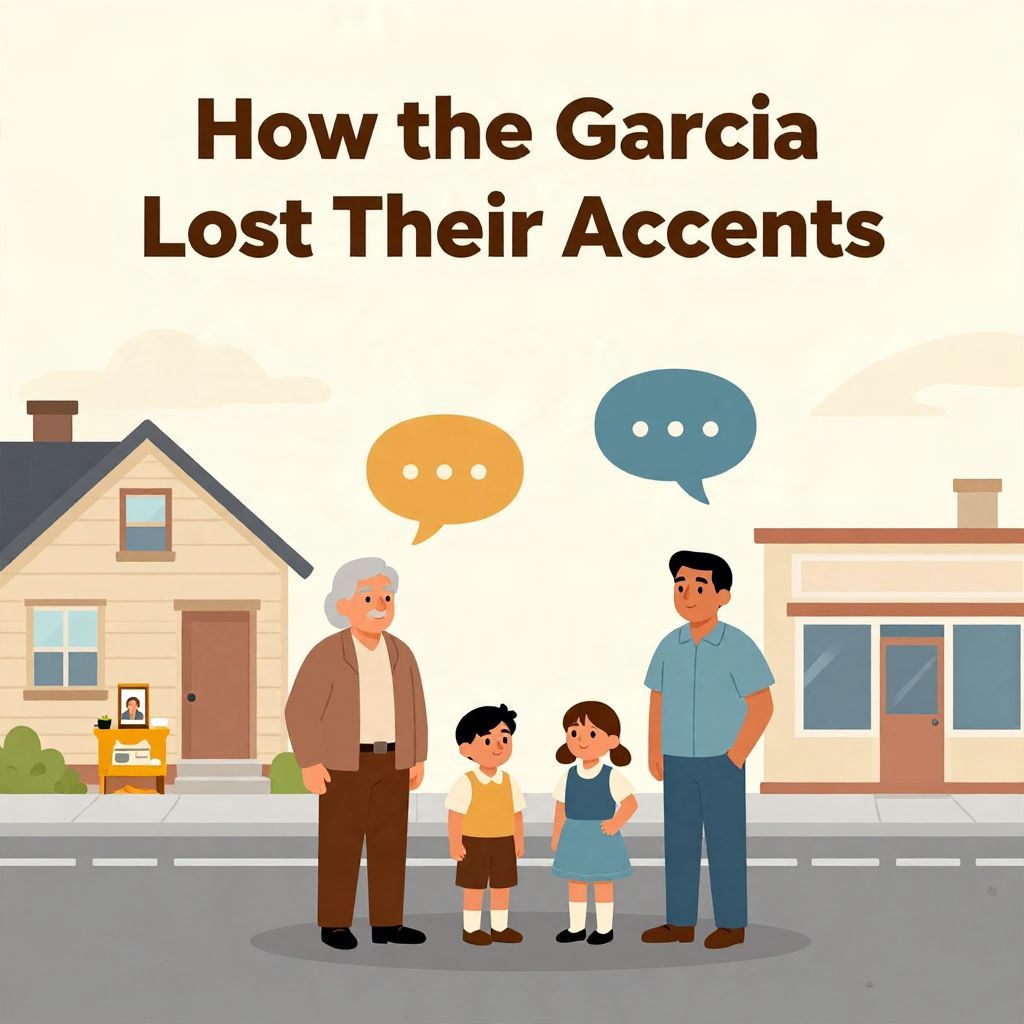
How did the Garcias lose their accents? The short answer is that they did not lose them all at once, and not for one single reason. The phrase points to a broader history of language shift among Spanish-speaking families in the United States, especially in Puerto Rican, Mexican American, and other Latino communities, where English-language schooling, migration, discrimination, and intergenerational change gradually reshaped speech.
In historical terms, “losing an accent” usually means developing a new dominant language pattern, not erasing identity. The process often unfolded over years or generations, and it could be uneven: some family members kept Spanish-influenced speech, others became bilingual, and some shifted almost completely to English.
How did the Garcias lose their accents?
The Garcias “lost their accents” through language assimilation, especially in the United States, where Spanish-speaking children were often educated in English and encouraged to sound “American.” This happened gradually across the 20th century as schools, workplaces, military service, and media rewarded English fluency while stigmatizing Spanish accents. The result was not a simple loss, but a change in how later generations spoke.
The historical background: Spanish, migration, and Americanization
To understand the story, it helps to place it in the history of Latino migration and U.S. language policy. Spanish has been spoken in what is now the United States since the colonial era, long before English became dominant. But in the 19th and 20th centuries, new waves of migration from Puerto Rico, Mexico, Cuba, and elsewhere brought millions of Spanish speakers into an English-dominant society.
Why accents became a social issue
In many communities, an accent was heard not just as a way of speaking but as a marker of class, race, and belonging. English-speaking institutions often treated Spanish accents as signs of foreignness or lower status. That pressure encouraged some families to reduce or hide their accents, especially when seeking jobs, housing, or acceptance in schools.
Schooling and the pressure to sound “American”
Public schools were one of the strongest forces behind language change. Children were frequently taught in English, sometimes punished for speaking Spanish, and often steered toward English-only habits at home. Even when formal punishment was less explicit, the message was clear: English brought opportunity, while Spanish accents could bring ridicule or exclusion.
What actually changed from one generation to the next?
Most often, the change was generational. Immigrant parents might speak Spanish at home and English at work, while their children became bilingual, and grandchildren grew up using mostly English. Over time, the family’s speech patterns shifted, and the accent associated with Spanish became weaker or disappeared in everyday English. That did not mean the family stopped being culturally or ethnically connected to its roots.
Bilingualism and language shift
Many families did not simply replace one language with another overnight. Instead, they moved through bilingual stages. A child might understand Spanish but answer in English; a grandparent might speak Spanish at home but use English in public; later generations might know only a few Spanish words or phrases. This is a classic pattern of language shift, common in immigrant history around the world.
Accent reduction versus accent loss
Strictly speaking, people rarely “lose” an accent entirely. They may reduce features associated with Spanish phonology, such as certain vowel patterns or consonant sounds, and adopt the pronunciation of the surrounding English-speaking community. In historical and sociolinguistic terms, this is better understood as accent change or accent accommodation, not total disappearance.
The Puerto Rican and Latino context in the 20th century
The phrase “The Garcias” often evokes a broad Latino family experience, especially in the United States. Puerto Ricans, for example, became U.S. citizens in 1917 through the Jones-Shafroth Act, and large-scale migration to the mainland accelerated after World War II. New York City, Chicago, and other urban centers became major sites of Spanish-English contact, where accent and identity were constantly negotiated.
Postwar migration and urban life
After the 1940s, many Puerto Rican families moved to mainland cities for factory work, service jobs, and better economic prospects. Their children entered schools where English was the language of advancement. In crowded neighborhoods, many families maintained Spanish at home, but the second generation often became more fluent in English than in Spanish. This shift could happen quickly under strong social pressure.
Discrimination and the desire to blend in
Accent change was also a survival strategy. In workplaces and schools, speaking English with a Spanish accent could invite mockery or discrimination. Some people consciously adjusted their speech to avoid being singled out. Others internalized the idea that sounding less “foreign” would make life easier. This historical reality is central to understanding why accents changed so visibly in some families.
How the process worked in everyday life
The loss or reduction of a Spanish accent usually happened through repeated exposure and practice. Children learned English from teachers, peers, radio, television, and later film and television. They also learned which sounds were rewarded and which were corrected. Over time, pronunciation patterns shifted in subtle but lasting ways.
Common factors that influenced accent change
- English-only schooling that made English the default language of literacy and status.
- Intermarriage with English-speaking or non-Spanish-speaking partners.
- Urban residence in neighborhoods where English dominated public life.
- Workplace pressure to sound “professional” or “neutral.”
- Media influence from English-language radio, television, and later digital media.
- Family decisions to prioritize English for children’s future success.
Why some family members kept the accent
Accent change was never uniform. Older immigrants often kept stronger accents because they had learned English later in life. People who lived in dense Spanish-speaking communities could preserve more of their original speech. Some individuals also deliberately maintained their accent as a sign of pride, resistance, or connection to heritage.
Historical significance: what “losing an accent” reveals
The story matters because it shows how language can be shaped by power. Accents are not just personal habits; they are tied to institutions, migration, and identity. When families like the Garcias changed the way they spoke, they were responding to a social world that often rewarded conformity and punished difference.
Identity, assimilation, and resistance
For many Latino families, accent change was part of assimilation, but assimilation was never complete or simple. A person could speak English with little accent and still remain deeply connected to Spanish-language traditions, family networks, foodways, religion, and community memory. At the same time, some people resisted pressure to erase their accent because they saw it as part of who they were.
What historians and linguists emphasize
Historians and sociolinguists generally treat accent change as a social process rather than a personal failure. It reflects the relationship between minority communities and the larger society. In the U.S. context, it also highlights the long history of English dominance and the marginalization of Spanish speakers, especially in schools and public institutions.
Why the phrase still resonates today
“How the Garcia lost their accents” remains a powerful phrase because it captures a common immigrant experience: the tension between preserving heritage and adapting to a new environment. It speaks to the emotional cost of fitting in, the practical benefits of bilingualism, and the way language can change within just a few generations.
Historically, then, the answer is not that the Garcias simply forgot how to speak. They adapted under pressure from schools, workplaces, neighborhoods, and broader ideas about belonging. Their accents changed because their world changed. For a deeper look at related Latino history and the unequal treatment that shaped language and identity, see When I Was Puerto Rican and Separate Is Never Equal.