
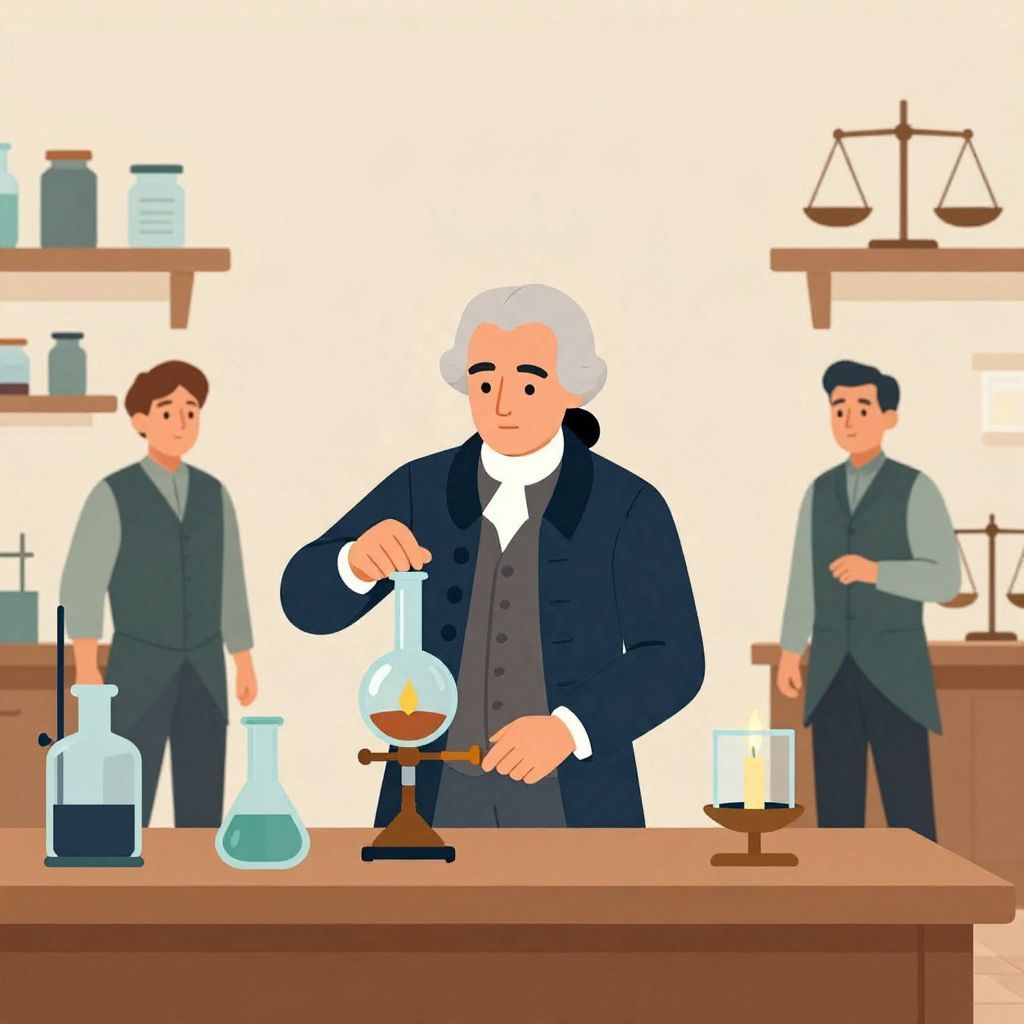
How was oxygen discovered? The short answer is that oxygen was not “found” all at once by a single person. In the 18th century, several chemists isolated the gas independently while trying to understand combustion, respiration, and the composition of air.
The discovery became clear only when scientists moved beyond the old theory of phlogiston and began treating air as a mixture of different gases. That shift transformed chemistry and helped explain why things burn, animals breathe, and metals rust.
How Was Oxygen Discovered?
Oxygen was discovered in the 1770s through experiments by Joseph Priestley, Carl Wilhelm Scheele, and later Antoine Lavoisier. Priestley and Scheele produced the gas independently, but Lavoisier correctly interpreted it as a distinct chemical element and showed its role in combustion and respiration. The discovery was therefore both experimental and conceptual.
The Scientific World Before Oxygen Was Understood
Before the 18th century, European natural philosophers explained burning and breathing with older ideas, especially the phlogiston theory. According to this theory, combustible materials contained a fire-like substance that escaped during burning. Air was not yet understood as a mixture of gases with different properties.
This framework shaped how scientists interpreted their observations. If a candle went out in a sealed jar, or a mouse died in enclosed air, the explanation was usually that the air had absorbed too much phlogiston. The theory was influential because it seemed to fit many experiments, even though it was ultimately wrong.
The Key Discovery: Oxygen in the 1770s
The discovery of oxygen emerged from laboratory work on heated substances. Chemists noticed that certain materials released a gas that made flames burn more brightly and supported life longer than ordinary air. What they were observing was oxygen, though they did not all interpret it the same way at first.
Joseph Priestley and “Dephlogisticated Air”
In 1774, the English chemist Joseph Priestley heated mercuric oxide with a burning lens and collected the gas that came off. He found that candles burned strongly in it and that mice survived longer than in normal air. Priestley called it dephlogisticated air, because he still worked within the phlogiston theory.
Priestley’s importance lies in both the experiment and the publication. He described the gas clearly and shared his results, allowing other chemists to repeat them. His work made oxygen visible as a distinct substance, even if he did not fully understand what it was.
Carl Wilhelm Scheele’s Earlier Work
The Swedish chemist Carl Wilhelm Scheele probably produced oxygen before Priestley, likely around 1772, by heating several compounds such as mercuric oxide and potassium nitrate. Scheele called the gas fire air. However, his findings were published later, so Priestley long received more credit in the historical record.
Scheele’s case shows how discovery in science is not always a single moment. A person may first isolate a substance, but if the results are not published promptly, shared, or recognized, another scientist may become better known. Historians therefore often describe oxygen as a discovery made independently by more than one chemist.
Antoine Lavoisier and the New Chemistry
The French chemist Antoine Lavoisier gave oxygen its modern scientific meaning. By the late 1770s and early 1780s, he argued that burning involved combination with a component of air rather than release of phlogiston. He also helped name the gas “oxygen,” from Greek roots meaning roughly “acid-former,” because he believed it was essential to making acids.
That naming idea was not fully correct, since not all acids contain oxygen. Still, Lavoisier’s broader theory was revolutionary. He replaced the old explanation of combustion with a new chemistry based on measurement, conservation of mass, and the composition of gases. In historical terms, this was the moment oxygen became more than an isolated gas: it became a foundation for modern chemistry.
Why Oxygen Was Hard to Identify
Oxygen was difficult to recognize because it is invisible, odorless, and mixed with other gases in air. Scientists could observe its effects, but not directly “see” it. They had to infer its existence through careful experiments involving burning, heating, and animal respiration.
The Role of Combustion Experiments
Combustion provided the clearest clue. A flame in oxygen burns more intensely than in ordinary air, while a candle in a sealed container goes out once the oxygen is used up. These observations suggested that air was not a single uniform substance. Instead, part of it was necessary for fire and life.
The Role of Respiration
Animals also helped reveal oxygen’s importance. Priestley and others noticed that enclosed air became “stale” after use by animals. Later science showed that breathing consumes oxygen and produces carbon dioxide. This connection between air, fire, and life made oxygen one of the most significant discoveries in the history of science.
The Timeline of Oxygen’s Discovery
The discovery unfolded over several years rather than in one instant. A simplified chronology helps show how the evidence accumulated:
- c. 1772 — Carl Wilhelm Scheele likely isolates oxygen in Sweden.
- 1774 — Joseph Priestley isolates the gas and describes its unusual properties.
- Late 1770s — Antoine Lavoisier reinterprets the gas and rejects phlogiston theory.
- 1780s — The new chemistry spreads across Europe and reshapes scientific understanding.
This sequence matters because it shows the difference between discovering a substance and understanding it. Priestley and Scheele isolated oxygen; Lavoisier explained it in a way that changed science.
How Oxygen Changed Chemistry
Oxygen’s discovery helped overturn older ideas and establish modern chemical science. Lavoisier’s experiments showed that when substances burn, they combine with oxygen from the air. This insight explained why metals gain weight when they rust or are heated, a result that had puzzled supporters of phlogiston theory.
It also encouraged more precise laboratory methods. Chemists began weighing substances before and after reactions, measuring gases, and treating matter as something that could be analyzed quantitatively. In this sense, oxygen’s discovery was not just about one gas; it helped create modern experimental chemistry.
From Phlogiston to Oxygen Theory
The shift away from phlogiston was gradual and contested. Many scientists did not abandon the older theory immediately, because it had been deeply embedded in chemical thought. But as more experiments accumulated, oxygen-based explanations proved more accurate and more useful.
Lavoisier’s new framework also changed language. Terms such as “oxidation” and “oxide” entered chemistry, and air came to be understood as a mixture containing oxygen and other gases. The discovery thus reshaped both scientific concepts and scientific vocabulary.
Why Oxygen Discovery Matters in History
Oxygen’s discovery matters because it changed how people understood life, fire, and matter itself. It helped launch modern chemistry, improved medicine and physiology, and supported later work on respiration, metabolism, and atmospheric science. Few scientific discoveries had such wide-ranging consequences.
It also illustrates how science develops historically. Discovery is often collaborative, uneven, and dependent on publication, interpretation, and debate. In oxygen’s case, the gas was isolated by more than one scientist, but its historical significance became clear only when Lavoisier and others redefined what the experiments meant.
Common Misconceptions About Oxygen’s Discovery
One common misconception is that oxygen was discovered by a single person in a single year. In reality, the story involves multiple investigators and a long process of explanation. Another misconception is that the discovery was obvious once the gas was isolated. It was not; its meaning depended on abandoning a dominant theory.
It is also worth noting that the modern name “oxygen” came after the gas had already been observed. So if the question is “Who discovered oxygen?” the answer depends on whether one means first isolation, first publication, or first correct explanation.
Conclusion
Oxygen was discovered through a chain of 18th-century experiments, especially those of Scheele and Priestley, and then explained by Lavoisier as a distinct element essential to combustion and respiration. The story is a reminder that scientific discovery is often a process, not a single event. For more on the history of discoveries, see when carbon was discovered and how popcorn was discovered.