
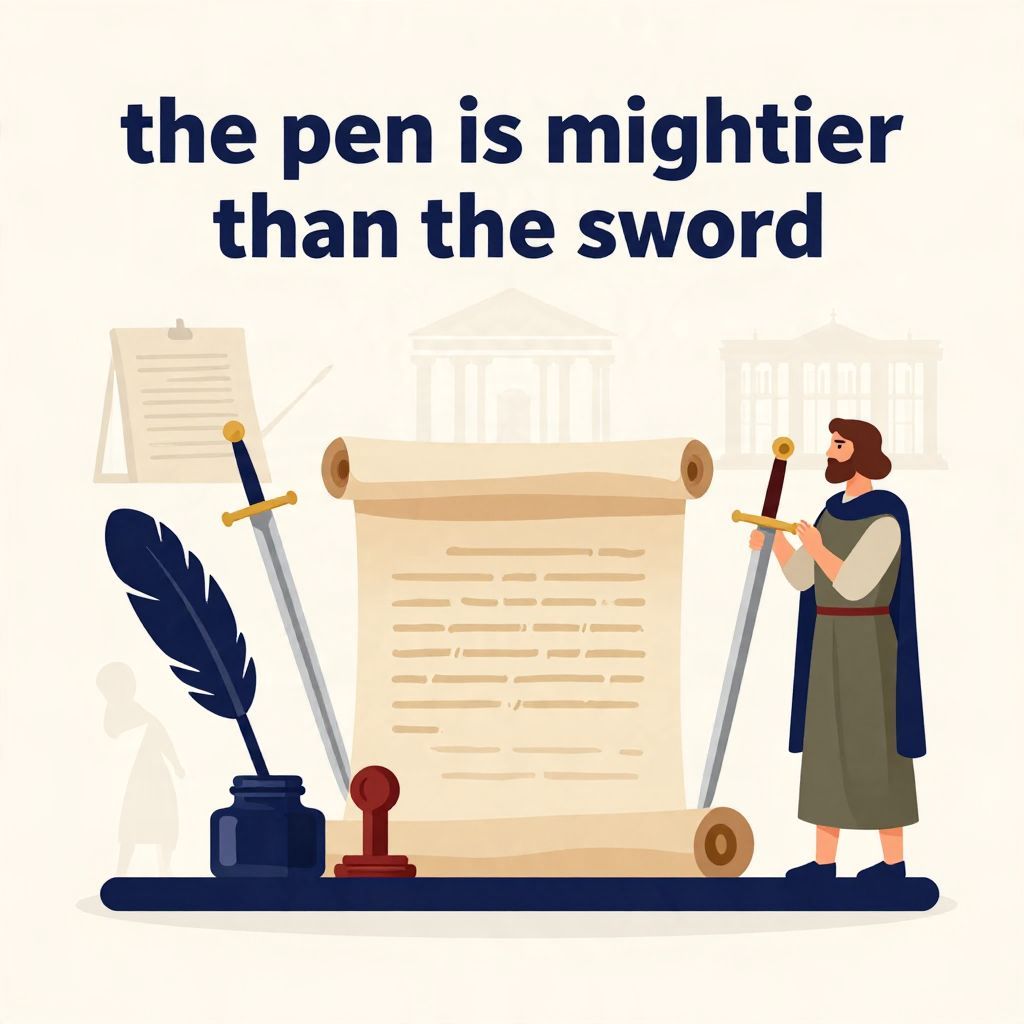
The pen is mightier than the sword is a proverb about the power of words, writing, and ideas to shape events more effectively than violence. It does not mean that force never matters in history. Rather, it argues that laws, speeches, books, pamphlets, and journalism can change minds, mobilize people, and outlast military victories.
The phrase became famous in the 19th century, but the idea behind it is much older. Across history, rulers, reformers, and revolutionaries have used writing to persuade, govern, resist oppression, and build movements that armies alone could not secure.
What does “The pen is mightier than the sword” mean?
The proverb means that written or spoken ideas can have greater and longer-lasting influence than violence. In historical terms, the “pen” stands for literacy, law, diplomacy, journalism, and persuasion, while the “sword” stands for war, coercion, and physical power.
Why the proverb matters historically
History repeatedly shows that military force can conquer territory, but writing can justify rule, create institutions, inspire reform, and preserve memory. A battle may be won in a day; a text can shape politics, religion, and culture for centuries.
Origins of the phrase and its older roots
The exact wording “the pen is mightier than the sword” is usually traced to the English writer Edward Bulwer-Lytton, who used a close version of the phrase in his 1839 play Richelieu; Or the Conspiracy. The line became widely quoted in the 19th century and helped fix the proverb in modern English.
But the concept is much older than Bulwer-Lytton. Ancient and medieval societies already recognized that writing could legitimize power, spread religion, record law, and challenge authority. The proverb is therefore best understood as a modern expression of a very old historical truth.
Earlier ideas similar to the proverb
- In classical antiquity, historians and philosophers often treated rhetoric and writing as tools of political power.
- In medieval Europe, charters, decrees, and religious texts shaped authority as much as armies did.
- In the Islamic world, Christian Europe, and East Asia alike, scholars and officials used written culture to govern and persuade.
A historical timeline of the proverb’s rise
The phrase became famous in the 1800s, but its meaning can be traced through much earlier history. Here is a simplified timeline of how the idea developed.
- Ancient world: Writing becomes a tool of administration, religion, and memory in early states such as Egypt, Mesopotamia, China, and Rome.
- Classical and medieval periods: Laws, chronicles, sermons, and diplomatic letters influence politics and belief systems.
- Early modern era: Printing expands the reach of pamphlets, books, and newspapers, making written argument more politically powerful.
- 1839: Bulwer-Lytton popularizes the modern phrasing in Richelieu.
- 19th and 20th centuries: Reformers, abolitionists, nationalists, and civil rights leaders use speeches, essays, and newspapers to mobilize mass movements.
- Digital age: The proverb remains relevant as writing, posting, and online publishing continue to shape public opinion.
How writing became a force in history
The power of the pen grew as societies became more literate and more dependent on records. Writing allowed people to communicate across distance and time, preserve ideas, and create institutions that outlived individual rulers. That made it a uniquely durable form of power.
1. Law and government
States rely on documents. Tax records, treaties, constitutions, edicts, and court judgments are all written instruments. A sword can compel obedience temporarily, but written law can organize a society for generations. The authority of many governments has depended on paperwork as much as on soldiers.
2. Religion and belief
Religious texts have shaped history on a vast scale. Sacred writings helped define doctrine, guide worship, and unify communities. In many societies, the copying, interpretation, and translation of texts mattered as much as military conquest.
3. Persuasion and reform
When people seek change, they often begin with words. Pamphlets, essays, newspapers, petitions, and speeches can expose injustice and rally support. Written argument is especially powerful because it can be circulated, debated, and remembered.
4. Memory and historical record
Writing also determines what future generations know. Chronicles, memoirs, newspapers, and archives preserve evidence of events. In that sense, the pen does not merely influence history; it helps define how history itself is understood.
Why the 19th century made the proverb famous
The 19th century was an age of expanding literacy, mass printing, and political debate. Newspapers reached wider audiences, pamphlets circulated quickly, and public opinion became a major force in politics. In that environment, a phrase praising the power of writing resonated strongly.
Bulwer-Lytton’s success was not accidental. He wrote at a time when readers were increasingly aware that ideas could move crowds, shape reform, and challenge established power. The proverb captured a modern reality: empires and governments could no longer rely only on force; they also had to manage opinion.
Printing and the spread of ideas
The printing press, introduced in Europe in the mid-15th century, transformed the scale of written influence. Books and pamphlets became cheaper and more available. This did not instantly make writing more important than violence, but it greatly increased the reach of arguments, criticisms, and political programs.
Historical examples of the pen overcoming the sword
History offers many cases where words changed society more effectively than weapons alone. These examples do not mean violence was absent; rather, they show that written and spoken persuasion often determined the deeper outcome.
The Reformation
Religious reform in 16th-century Europe depended heavily on texts. Martin Luther’s writings, printed and reprinted, spread ideas that challenged the Catholic Church. Debates over doctrine were fought with sermons, pamphlets, translations, and treatises. Printing helped turn a theological dispute into a continent-wide movement.
The abolitionist movement
In the 18th and 19th centuries, anti-slavery campaigners used books, newspapers, petitions, and speeches to attack the moral and political foundations of slavery. Their writing helped build public pressure that eventually contributed to abolition in various countries. Military force did not end slavery by itself; sustained moral argument mattered greatly.
Nationalist and independence movements
Many independence movements depended on newspapers, manifestos, and political essays. Leaders used writing to define national identity, criticize colonial rule, and organize supporters. In these movements, the pen often prepared the ground for political change before any armed struggle occurred.
The civil rights movement
In the 20th century, civil rights leaders used letters, sermons, essays, and speeches to appeal to law, conscience, and public opinion. Written and spoken words helped create a moral framework that made legal reform possible. The movement’s success shows how ideas can reshape a society’s understanding of justice.
Is the proverb always true?
Not exactly. History does not support a simple claim that writing always defeats force. Armies have destroyed cities, overthrown governments, and silenced opponents. In many periods, people who wrote dangerous ideas were censored, imprisoned, or killed. The sword can be immediate and brutal.
Still, the proverb remains powerful because violence rarely settles everything. Military conquest may win territory, but it does not automatically create legitimacy, loyalty, or lasting cultural change. Writing can do what force cannot: persuade, organize, justify, and endure.
A balanced historical reading
- The sword can compel obedience.
- The pen can create consent, memory, and legitimacy.
- Most major historical changes involve both force and persuasion.
- The proverb highlights the long-term influence of ideas, not the absence of conflict.
Why the proverb still matters today
In the modern world, the “pen” includes journalism, books, essays, legal documents, speeches, and digital communication. Public debate still shapes elections, social movements, international relations, and cultural change. Even in an age of advanced weapons, influence often begins with language.
That is why the proverb remains useful. It reminds us that power is not only physical. The ability to write clearly, argue persuasively, and preserve ideas can alter the course of events more deeply than force alone.
In historical terms, “the pen is mightier than the sword” is a proverb about lasting influence. The phrase became famous in the 19th century, but its deeper truth is older: laws, religious texts, pamphlets, newspapers, and speeches have repeatedly changed societies in ways armies could not. For related reading, see how Martin Luther King Jr. changed the world and what political engagement means in history.