
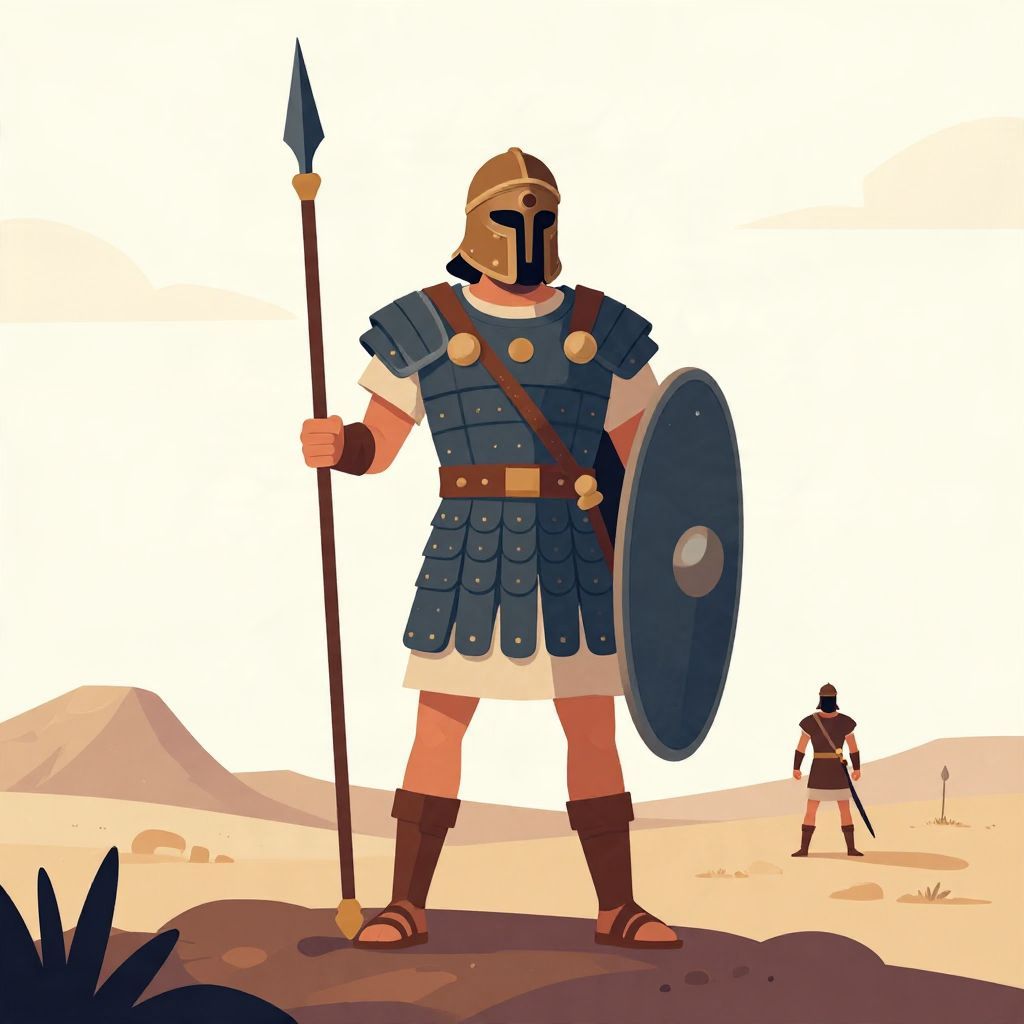
What did Goliath look like? The Bible presents him as a towering Philistine warrior whose size, armor, and weapons made him terrifying on the battlefield. But the story is also a mix of ancient text, literary tradition, and later interpretation, so historians treat his appearance with caution.
In historical terms, the best answer is that Goliath was imagined as an elite champion soldier, heavily armed and physically imposing, rather than a figure whose exact height or features can be verified with certainty.
What Did Goliath Look Like?
According to the biblical account in 1 Samuel 17, Goliath was a very large Philistine warrior wearing bronze armor, a helmet, greaves, and carrying a massive spear and sword. His exact height is disputed in ancient manuscripts, but he was clearly meant to appear as an intimidating, heavily equipped champion warrior.
The Biblical Description of Goliath
The most detailed description of Goliath comes from the Hebrew Bible, especially the story of David and Goliath in 1 Samuel 17. The text emphasizes his size, armor, and battlefield presence. He is described as a Philistine from Gath, a city associated with the Philistine world in the southern Levant.
His height in the ancient text
One major point of uncertainty is Goliath’s height. In the traditional Masoretic Hebrew text, he is described as “six cubits and a span,” which would make him roughly 9 feet 9 inches tall, depending on how a cubit is measured. However, some ancient witnesses, including the Greek Septuagint and a Dead Sea Scroll fragment, give his height as “four cubits and a span,” closer to about 6 feet 9 inches. That is still very tall for the ancient world, but far less extraordinary.
His armor and weapons
The text gives a vivid picture of a heavily armored warrior:
- a bronze helmet
- a coat of scale armor
- bronze greaves on his legs
- a bronze javelin slung between his shoulders
- a spear with a shaft described as like a weaver’s beam
- an armor-bearer who went before him
This description is important because it makes Goliath look less like a fantasy monster and more like a professional combatant equipped for close and ranged fighting.
How Historians Understand Goliath’s Appearance
Historians cannot confirm Goliath as a directly documented individual from archaeology alone. The story belongs to ancient Israelite literature and likely reflects a blend of memory, storytelling, and theological meaning. Still, the description fits what we know about Iron Age warfare in the Levant: champions, armor, spears, and single-combat challenges were all part of the military culture of the region.
A Philistine warrior, not a giant from myth alone
Philistines were a real people in the southern coastal region of Canaan during the Iron Age, roughly the 12th to 7th centuries BCE. They were often depicted by their enemies as formidable opponents. Goliath’s appearance in the story may reflect that reputation. His size may have been exaggerated to heighten the drama, but the armor and weapons are historically plausible.
Why the height varies in the manuscripts
The difference between “six cubits and a span” and “four cubits and a span” matters because it shows how ancient texts were copied and transmitted. Scholars debate which reading is earlier. The shorter reading may preserve an older tradition, while the longer reading could be a later expansion that made Goliath even more imposing. Either way, the text aims to stress that he was exceptionally large.
What Goliath Probably Looked Like in Historical Context
If we strip away later exaggeration, Goliath was probably imagined as a large, heavily armored Philistine champion with bronze equipment, a spear, and a sword. He likely wore the standard gear of a high-status warrior and may have been selected to represent his side in ritualized combat. His appearance would have been impressive, disciplined, and terrifying to an opponent.
Features the story emphasizes
The biblical narrative focuses on a few visual details rather than facial features, hair color, or personal markings. That tells us something important: the story is not interested in portraiture. It wants readers to notice his scale, armor, and military power. In other words, Goliath’s “look” is symbolic as well as physical.
Why armor mattered so much
In ancient warfare, armor communicated rank, wealth, and danger. Bronze scale armor would have been expensive and heavy. A large spear and sword signaled that Goliath was not a casual fighter but a specialist warrior. The armor-bearer suggests he was a man of status, not simply a lone brute.
Goliath’s Appearance in the Story of David
Goliath’s appearance is central to the David narrative because it sets up a dramatic contrast: the giant, armed, and experienced warrior versus the young shepherd armed with a sling. The story’s power depends on visual imbalance. Goliath looks unbeatable before the battle even begins.
The role of contrast
David’s victory is meaningful precisely because Goliath appears overwhelming. The text uses physical description to frame a theological message: human strength, armor, and stature do not guarantee victory. In the story’s logic, the seemingly weak can defeat the seemingly invincible through divine aid and courage.
Single combat in the ancient Near East
The duel between David and Goliath also fits a broader ancient pattern in which champions could represent armies. Such contests were not always literal battlefield practice in the modern sense, but they were a recognizable literary and cultural motif. Goliath’s appearance as a champion warrior supports that setting.
Historical Significance of Goliath’s Image
Goliath has had an enormous cultural afterlife because his appearance became shorthand for overwhelming odds. In later Jewish, Christian, and secular tradition, “Goliath” came to mean a giant obstacle or a powerful enemy. That lasting symbolism comes directly from the vivid way the biblical text describes him.
From ancient warrior to cultural symbol
Over time, Goliath became more than a character in an old battle story. Artists, preachers, writers, and historians have used his image to explore themes of courage, power, and divine justice. His physical description—especially his great size—helped make him memorable across centuries.
Why the story still matters
Even when read historically rather than literally, the Goliath account reveals how ancient people understood warfare, identity, and divine favor. It also shows how textual variation can shape interpretation. Whether he was about 6 feet 9 inches or nearly 10 feet tall in the tradition, Goliath was written to appear extraordinary.
What We Can Say with Confidence
- Goliath was presented as a Philistine warrior from Gath.
- He was described as exceptionally tall, though the exact height is disputed in ancient manuscripts.
- He wore bronze armor and carried heavy weapons.
- The story emphasizes his intimidating battlefield presence rather than detailed facial features.
- His appearance served a literary and theological purpose in the David narrative.
Conclusion
So, what did Goliath look like? In the biblical tradition, he was a towering, bronze-armored Philistine champion with a spear, sword, and helmet—an enemy designed to seem unstoppable. Historically, we cannot verify his exact appearance, but the story reflects real Iron Age warfare and the power of ancient storytelling. For related reading, see how big Goliath was in the Bible and how old David was when he fought Goliath.