
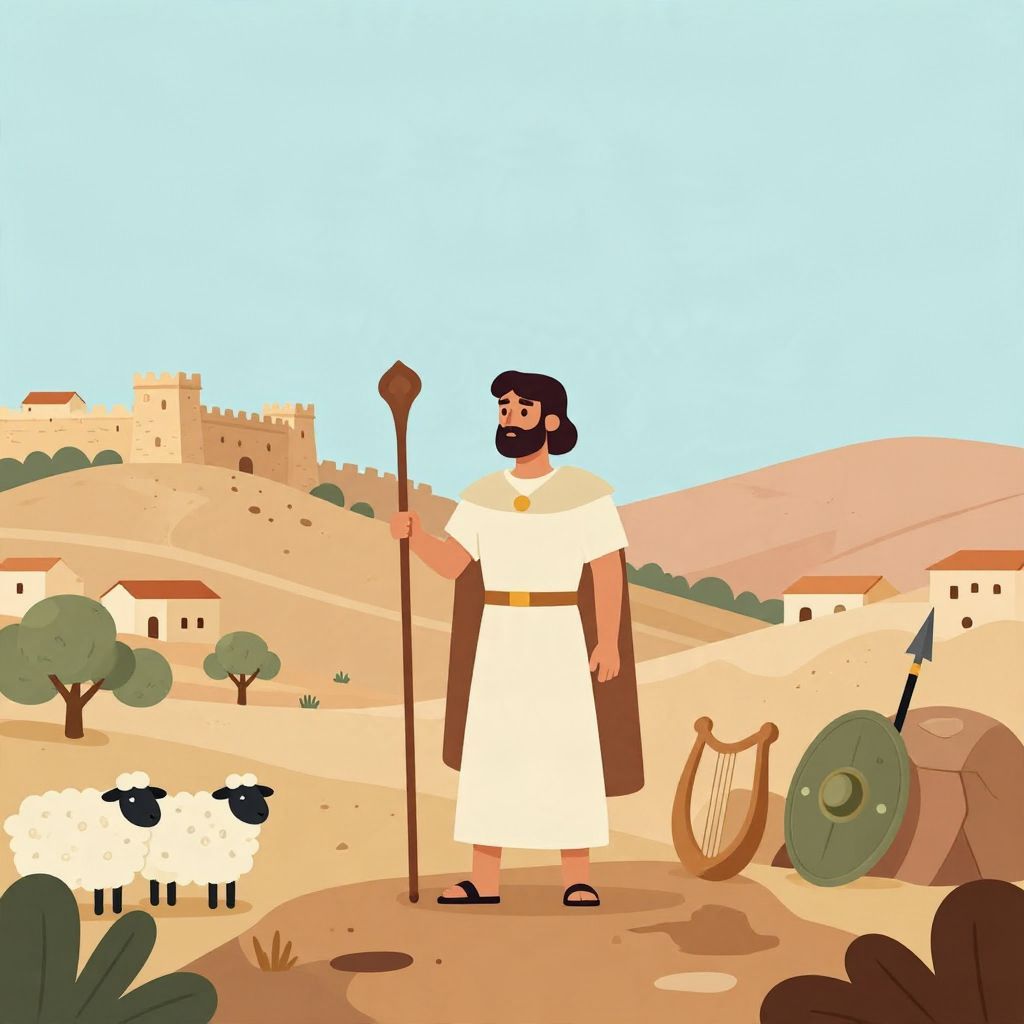
What did King David look like? The honest answer is that no surviving ancient source gives us a reliable physical description of him. David was a real historical and biblical figure associated with early Israel, but the familiar image of a harp-playing, bearded king comes from later art, tradition, and imagination rather than from eyewitness portraiture.
What historians can do is separate evidence from legend and explain what David may have looked like in the world of the early Iron Age Levant.
What Did King David Look Like?
There is no verified portrait of King David, and the Bible does not provide a detailed physical description. He was likely a man of the ancient Levant, probably of average height for his time, with the dress, hairstyle, and grooming typical of a highland pastoral society. The famous “King David” look is largely a product of later Jewish, Christian, and artistic tradition.
What We Actually Know About David’s Appearance
The strongest historical answer is simple: we do not know David’s exact face, build, or height. Ancient texts focus on his character, leadership, and political role, not on a full physical portrait. In the Hebrew Bible, David is described in terms of youth, beauty, and vigor at different moments, but these are literary descriptions rather than forensic evidence.
Why the sources are limited
In the ancient Near East, rulers were often represented symbolically rather than realistically. Texts emphasized legitimacy, divine favor, and military success. Even when kings were depicted in art, those images were usually idealized. For David, the problem is greater: no securely identified contemporary statue, relief, or inscription gives us a face to match the historical figure.
What the biblical texts say
David is introduced in the book of Samuel as a handsome young shepherd, and later accounts portray him as charismatic and physically active. One passage mentions his “ruddy” appearance, which may suggest a reddish complexion or youthful coloring, but the meaning is debated. Another episode describes him as a strikingly attractive young man. These details tell us how the text wants readers to see him, not what a modern portrait would show.
How Old Was David and What Would That Mean for His Appearance?
David’s life is usually placed in the late 11th or early 10th century BCE, though the exact chronology is debated. If he was a historical ruler, he would have lived in a small Iron Age kingdom or chiefdom environment. Men in that setting typically had hard physical lives, so David likely looked weathered by labor, travel, and warfare, especially in adulthood.
Likely age range and bodily condition
David is first presented as a young man when he enters Saul’s court, then as a warrior, fugitive, and finally king. That long arc suggests he changed from an adolescent or young adult into an older ruler. By the end of his life, he may have been physically frail. Ancient texts even depict him as cold and weak in old age, which fits the realities of aging in a premodern society.
What Might He Have Looked Like in the Ancient Levant?
While no one can reconstruct David with certainty, historians can infer broad features from the population and culture of his time. He probably looked like other highland Semites of the southern Levant: dark hair, brown eyes, and a complexion shaped by sun exposure. His clothing would have been practical rather than regal in the modern sense, especially in his earlier years.
Hair and beard
Men in the ancient Near East commonly wore beards, and David is often shown that way in later art. A beard would have been culturally normal and practical. Hair length varied, but long or medium-length hair was not unusual. Some biblical traditions also connect David with grooming and beauty, which could imply careful personal appearance, though not necessarily luxury.
Clothing and status markers
As a shepherd and warrior, David likely wore simple wool or linen garments, sandals, and perhaps a cloak. Once he became king, he would have had access to better textiles, jewelry, weapons, and insignia of power. Still, royal dress in the ancient Levant was not the ornate costume familiar from later medieval or Renaissance paintings. Status was shown through fabric quality, color, and accessories more than through a fixed “uniform.”
Build and height
Popular culture often imagines David as either small and boyish or tall and heroic. Neither image is secure. The Bible contrasts him with Saul, who is described as tall, but that contrast is theological and narrative as much as physical. Archaeological and skeletal evidence from the region suggests average male height would likely have been modest by modern standards, though individual variation was normal.
Why Later Art Made David Look a Certain Way
Much of what people think David looked like comes from later religious art, not ancient evidence. Medieval manuscripts, Renaissance paintings, and church decorations often portrayed him as a noble, bearded king with a harp. These images were designed to communicate symbolism: David as musician, psalmist, warrior, and righteous ruler.
The harp and the crown
The harp became one of David’s most enduring symbols because of his association with music and the Psalms. The crown, meanwhile, reflects his role as Israel’s idealized king. These objects are meaningful, but they are not proof of his actual appearance. They tell us how later generations understood him.
David in Jewish, Christian, and Islamic tradition
Different traditions remembered David in different ways. In Judaism, he became the ancestor of the messianic line. In Christianity, he was read as a precursor to Jesus. In Islamic tradition, Dawud is honored as a prophet-king. Each tradition emphasized moral and spiritual significance more than physical description, which is one reason his face remained open to artistic imagination.
Could Archaeology Tell Us More?
Archaeology can illuminate David’s world, but not his exact features. Excavations in the southern Levant help historians understand diet, housing, warfare, clothing, and settlement patterns in the period associated with early Israel. That context makes it easier to imagine David as a real person living in a real landscape, but it does not produce a portrait.
What archaeology can and cannot prove
Archaeology can show what people ate, how they lived, and what kinds of tools they used. It can also help historians judge the scale of political power in David’s era. But unless a clearly identified image or inscription of David appears—which has not happened—archaeology cannot tell us whether he had a narrow face, a broad nose, a beard, or a scar.
The historical David versus the literary David
Scholars often distinguish between a possible historical David and the larger biblical David shaped by later editors and storytellers. The historical figure, if reconstructed, was probably a local ruler or war leader in the highlands of Judah. The literary figure became a national ancestor, psalmist, and ideal king. Those two versions are related, but they are not identical.
Why the Question Still Matters
Asking what King David looked like is really a question about how history works. It reminds us that famous ancient figures often survive in memory without surviving in image. It also shows how later societies build visual identities around incomplete evidence. David’s importance lies less in a recoverable face than in the political and religious legacy attached to his name.
David’s historical significance
David matters because he became central to the story of Israelite kingship and to later ideas of legitimate rule. Whether every biblical detail is historical or not, the Davidic tradition shaped Jewish, Christian, and Islamic thought for centuries. His name came to represent covenant, kingship, and hope for restoration. That larger legacy explains why people still want to know what he looked like.
So, What Did King David Look Like?
In the strict historical sense, we cannot know. David probably looked like an Iron Age man from the southern Levant: dark-haired, bearded, sun-weathered, and dressed according to the needs of shepherding, warfare, and kingship. The iconic image of a majestic harpist-king is a powerful tradition, but it is not a verified likeness. What survives most clearly is not his face, but his enduring place in history and memory.
If you want to place David more precisely in time, see when King David lived, or explore the question of how old David was when he died for more on the chronology of his life.